Hidden Gems of 2024: Must-See Films You Might Have Missed
Discover four extraordinary 2024 films that defied expectations and delivered some of year's most powerful cinema.
Editorial Notes
BucketMovies Editorial covers classic cinema, repertory discoveries, and context-rich film criticism with an emphasis on source-backed reporting and careful editorial review.
Every awards season brings the same familiar names to the forefront. Studios pour millions into campaigns, critics champion the prestige pictures, and the same half-dozen titles dominate the conversation. Yet beneath the glossy marketing and the red carpet spectacle lies a wealth of remarkable cinema that often escapes mainstream attention.
The 2024 film year proved particularly rich in such overlooked achievements. While certain productions commanded headlines and dominated Oscar speculation, a constellation of equally extraordinary films navigated their way through multiplexes and festival circuits with comparatively modest profiles. These are the movies that reward patient viewers, the ones that linger in the mind long after the credits roll, challenging assumptions about storytelling, performance, and the very boundaries of what cinema can accomplish.
This essay examines four such films—each distinct in vision and execution, yet united by a willingness to take creative risks that larger productions rarely permit. From a Brooklyn stripper’s ill-fated romance with Russian oligarchy to a Holocaust survivor’s architectural ambitions in postwar America, from a body horror meditation on female aging to a first-person journey through Jim Crow-era reform schools, these films demonstrate that audacity and artistry remain alive in contemporary cinema. They are the hidden gems that truly defined a remarkable year in film.
Anora: A Modern Fairy Tale Fractured by Reality
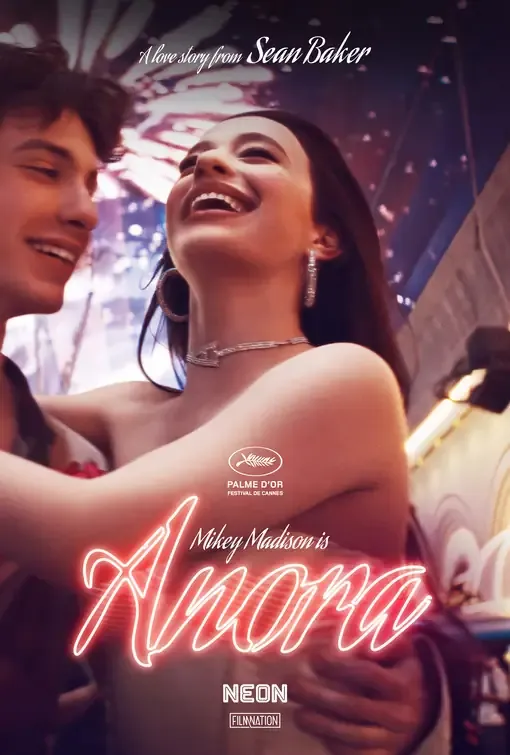
Sean Baker’s Anora arrived at Cannes in May 2024 and left with the festival’s highest honor, the Palme d’Or—the first American film to win in fifteen years. Yet despite this prestigious recognition, the film has existed in a peculiar limbo, neither achieving the commercial breakout some predicted nor cementing itself in the cultural conversation the way Baker’s previous work The Florida Project did. This relative obscurity makes Anora precisely the kind of hidden gem that rewards patient attention.
The film introduces us to Anora Mikeheeva, whom everyone calls Ani, a twenty-three-year-old stripper working in Brooklyn. Baker films her workplace with the same naturalistic eye he brought to the motels of Orlando, presenting her profession without sensationalism or judgment. Ani is pragmatic, ambitious, and quietly dignified—a woman who understands the transactional nature of her work while maintaining an inner life that transcends it.
Her world shifts when Vanya Ivanov, the ne’er-do-well son of a Russian oligarch, becomes a regular customer. Played with guileless charm by Mark Eydelshteyn, Vanya is less a romantic hero than a catalyst for Ani’s transformation. Their relationship moves quickly—he’s charming, generous, and apparently smitten—and when he offers marriage, Ani sees not just love but escape, an upgrade from the economic vulnerability that defines her current existence.
Baker’s screenplay demonstrates his characteristic empathy for marginalized Americans while taking unexpected narrative turns. The first act unfolds as a contemporary Cinderella story, complete with helicopter rides over Manhattan and spontaneous shopping sprees. Then Vanya’s parents arrive, and the fairy tale fractures. The arrival of Russian henchmen—led by a magnificently menacing Yuri Borisov—transforms the film into something closer to a Hitchcockian thriller, as Ani finds herself trapped in a situation where escape seems impossible.
What makes Anora remarkable is Baker’s refusal to deliver a predictable ending. The film does not moralize about Ani’s choices or provide catharsis through conventional triumph. Instead, it offers something more complex and emotionally honest: a portrait of resilience forged through humiliation, a woman who refuses to be broken even when the world conspires against her. Mikey Madison delivers a performance of extraordinary range, transitioning from confident professional to hopeful romantic to hunted animal with seamless conviction. Her final scene—a wordless breakdown that somehow encompasses rage, grief, and tentative hope—ranks among the year’s most powerful moments of screen acting.
The Brutalist: Architecture as American Ambition
If Anora represents American independent cinema at its most intimate, Brady Corbet’s The Brutalist operates at the opposite extreme: a sprawling, ambitious epic that spans decades and continents while exploring themes of immigration, artistic integrity, and the psychological weight of history.
The film opens in 1947, when László Tóth arrives at Ellis Island. A Hungarian architect, Tóth has survived the Holocaust and arrives in America carrying nothing but his skills, his trauma, and the blueprints for a vision of modernist grandeur. Adrien Brody embodies this fractured survivor with physical and emotional precision, his movements cautious yet determined, his eyes carrying the particular emptiness of someone who has witnessed the worst humanity can offer.
Corbet structures the narrative around László’s attempts to rebuild his life and career. Settling in Pennsylvania with his wife Erzsébet (Felicity Jones, delivering subtle power in a role that could easily have been reduced to supportive spouse) and his nephew Istvan (Aaron Pierre), László finds work creating furniture for wealthy clients while nursing dreams of architectural significance. His opportunity arrives when he encounters Harrison Lee Van Buren (Joe Alwyn, in a performance of aristocratic menace), a dying industrialist who offers László a commission: design a community center for his hometown.
What follows is a meditation on the tension between artistic vision and economic reality, between immigrant ambition and native suspicion. Corbet’s direction evokes the widescreen epics of mid-century Hollywood while incorporating found footage that grounds the personal story in historical context. The production design by Maya Shimoguchi recreates the period with meticulous care, from the period-appropriate automobiles to the architectural models that László obsessively refines.
The film’s centerpiece is the community center itself—a brutalist concrete structure that emerges from the Pennsylvania landscape like an accusation. In architecture as in life, László’s modernist vision proves too alien for his new homeland. Americans want their monuments to celebrate, not challenge; they want their art to comfort, not confront. The tension between László’s artistic integrity and Harrison’s expectations provides the film’s dramatic engine, building toward a confrontation that proves both devastating and strangely cathartic.
The Brutalist received a thirteen-minute standing ovation at its Venice premiere and has since accumulated awards recognition, yet it remains a difficult film to categorize or easily recommend. Its ambitions are massive, its runtime substantial, and its emotional register often uncomfortable. But for viewers willing to engage with its demanding vision, the film offers a genuine achievement: a statement about art, immigration, and the permanent scars of historical trauma that refuses easy resolution or comfortable conclusions.
The Substance: Body Horror as Feminist Manifesto
Coralie Fargeat’s The Substance premiered at Cannes in May 2024 and quickly established itself as the most controversial film in competition—a distinction that, given Cannes’s history of provocation, is saying something. The film polarized critics and audiences alike, with some championing it as a feminist masterpiece and others dismissing it as exploitative shock cinema. This very division, however, makes it essential viewing: a work of such uncompromising vision that indifference seems impossible.
The premise, on paper, reads like high-concept science fiction: Elisabeth Sparkle, a celebrated actress and fitness instructor, discovers a black-market drug called “the Substance” that promises to create a younger, more perfect version of oneself. Eligible candidates receive a carefully measured dose, from which emerges a physical replica—younger, stronger, unblemished by age. The catch: the two versions must alternate control of the shared body, switching every seven days, and any deviation from the schedule triggers catastrophic consequences.
Fargeat, whose previous feature Revenge established her talent for visceral body horror, pushes this concept to its grotesque limits. The transformation sequences are not merely disturbing but transgressive, depicting the emergence of Sue (Margaret Qualley, remarkable in the younger role) from Elisabeth’s body with visceral intensity that recalls the birth horror of Alien while adding layers of commentary about female objectification and the entertainment industry’s treatment of women’s bodies.
Demi Moore, in the central role, delivers the most courageous performance of her career. Elisabeth is not a sympathetic victim but a woman who has internalized the entertainment industry’s standards to such a degree that she cannot conceive of worth without youth. Her decision to use the Substance stems not from desperation but from conviction—a belief that her value is measured entirely in physical terms. Moore plays this internalization with tragic complexity, never allowing Elisabeth to become merely pathetic.
What distinguishes The Substance from mere exploitation is Fargeat’s authorial control. Every frame, every camera movement, every grotesque transformation serves the film’s thematic architecture. The body horror is not gratuitous but purposeful, forcing viewers to confront the same impossible standards that Elisabeth has internalized. When the film’s violence becomes truly stomach-churning—and it does, repeatedly—our discomfort reflects our own complicity in the systems that demand such sacrifices from women.
The climactic confrontation between Elisabeth and Sue literalizes the generational warfare that society perpetuates against aging women. There is no reconciliation, no healing, no transcendent message about self-acceptance. Instead, Fargeat delivers an ending of such overwhelming bleakness that it functions as both horror and accusation. We are what we consume, the film suggests, and the entertainment industry has been feeding us women’s bodies for so long that we have learned to devour them ourselves.
Nickel Boys: First-Person Cinema as Historical Witness
RaMell Ross’s Nickel Boys represents perhaps the most formally daring film of 2024—a narrative feature that employs first-person cinematography to tell the story of two Black teenagers incarcerated at a notorious Florida reform school during the Jim Crow era. Adapted from Colson Whitehead’s Pulitzer Prize-winning novel, the film transforms literary adaptation into something approaching pure cinema, forcing viewers to inhabit perspectives that conventional filmmaking rarely attempts.
The approach is immediately apparent: the film opens with the camera positioned at eye level, looking out at the world through the eyes of Elwood Curtis, a young Black teenager in 1960s Tallahassee. We see his reflection in a television screen, his grandmother’s ironing board, a bus window. We do not see his face. This is not an oversight but a deliberate strategy, one that transforms the viewing experience into an act of identification rather than observation.
Ethan Herisse voices Elwood, whose intellectual curiosity and moral compass have been shaped by his grandmother’s care and the examples of Martin Luther King Jr. and the space program. Elwood has been accepted to a technical college when, through a catastrophic misunderstanding, he hitches a ride in a stolen car and is sentenced to the Nickel Academy—a real institution whose horrors the film depicts with unflinching clarity.
The Nickel Academy operates as a microcosm of American racism, a place where Black boys are forced into rigged boxing matches while white boys enjoy football, where resistance means death and unmarked graves. Ross films this nightmare with formal rigor, maintaining the first-person perspective even through scenes of extreme brutality. We do not witness the torture from a safe distance; we experience it from inside Elwood’s skull, making the horror viscerally inescapable.
The film’s structure introduces a second first-person perspective when Elwood befriends Turner, another inmate whose pragmatic survival strategies contrast with Elwood’s moral idealism. Brandon Wilson voices Turner, and the film periodically shifts perspective to his point of view, sometimes replaying scenes we have already witnessed from Elwood’s angle. This technique creates an intimacy between the two boys that transcends conventional narrative friendship, making their bond feel earned rather than imposed.
The cinematography by Jomo Fray transforms technical constraint into expressive opportunity. The limitations of a single perspective—its inability to show the protagonist’s face, its restricted field of vision—become metaphors for the way institutional oppression narrows possibility. When the film eventually introduces a third-person perspective during its powerful conclusion, the expansion of visual space carries profound emotional weight.
Nickel Boys screened at the New York Film Festival and earned awards recognition, yet its experimental approach limits its audience. This is a film that demands active participation, refusing the comfortable spectatorship that mainstream cinema encourages. But for viewers willing to submit to its rigorous perspective, the film offers an experience unlike any other: a historical drama that refuses to historicize, a coming-of-age story set in a waking nightmare, a testament to human resilience under conditions specifically designed to destroy it.
Conclusion: The Case for Seeking Out the Hidden
These four films—Anora, The Brutalist, The Substance, and Nickel Boys—represent only a fraction of the remarkable cinema that 2024 produced. Each took creative risks that larger-budget productions would never permit. Each prioritized vision over accessibility, artistic ambition over commercial calculation. Each demanded something from its viewers: patience, attention, willingness to engage with uncomfortable perspectives.
The paradox of awards season is that while it celebrates excellence, its mechanisms often work against genuine discovery. The same films receive coverage across multiple publications; the same opinions propagate through critical echo chambers; the same names dominate conversation. Hidden gems exist because the attention economy creates winners and losers, and the losers often include work of considerable merit.
Seeking out such films requires effort. It means reading beyond the major critics, attending smaller theatrical releases, exploring festival lineups, and trusting intuition over consensus. It means accepting that not every remarkable film will be accompanied by the marketing machinery that guarantees visibility. And it means recognizing that the movies which challenge us most often arrive without the assurance of easy entertainment.
The four films examined here show what that effort can yield. They expand our understanding of what cinema can accomplish, what stories can be told, what performances can achieve. They deserve not merely attention but advocacy—viewers who will champion them, discuss them, and ensure that their significance extends beyond awards season into genuine cultural conversation. Curation matters. These films are worth finding, worth defending, and worth returning to again and again.
Share This Article
Comments