The Rivals of Amziah King Review: McConaughey's Best Work in Years
Andrew Patterson's sun-dappled neo-noir about a beekeeping musician in rural Oklahoma is a rare film that earns every ounce of its charm.
Editorial Notes
BucketMovies Editorial covers classic cinema, repertory discoveries, and context-rich film criticism with an emphasis on source-backed reporting and careful editorial review.
Matthew McConaughey has spent the last few years doing… whatever it is Matthew McConaughey does. Some good voice work here, a random streaming movie there, a lot of Lincoln commercials. You get the sense he’s been waiting for something worth his time. The Rivals of Amziah King is that something.
Andrew Patterson’s film, which opened in limited release this week, is a sun-dappled neo-noir about a beekeeping musician in rural Oklahoma who reunites with his former foster daughter and tries to build something lasting in a community threatened by criminal enterprise. That sentence makes it sound straightforward. It isn’t. The film digresses, meanders, and takes its sweet time getting where it’s going, and that’s exactly the point.
The movie was filmed in 2023 around Birmingham, Alabama, standing in for rural Oklahoma, and it has the kind of authenticity that comes from actually being in the places it depicts. You can feel the heat, smell the fried food, hear the cicadas. Patterson, who previously made the well-received The Vast of Night, has a knack for making specific places feel universal without losing their particular character.
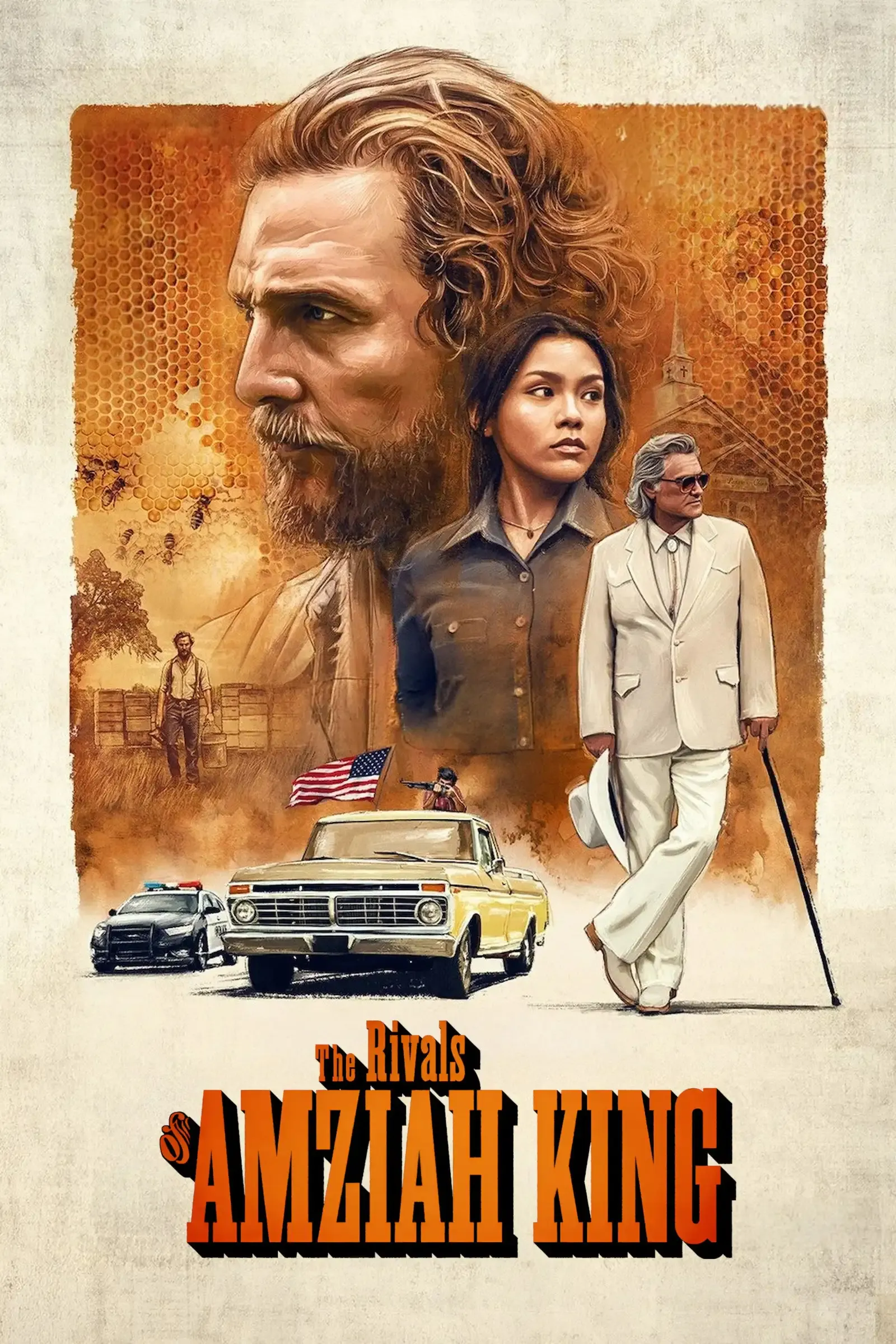
McConaughey as Amziah King
McConaughey plays Amziah King, a widower and apiarist with a billy goat beard who holds court at a drive-in burger stand off the highway somewhere in rural Oklahoma. He’s the mandolin player and lead vocalist for a scrappy bluegrass quintet that performs for crowds of locals who’ve come for the steak sandwiches and cherry Cokes as much as the music.
Patterson gives McConaughey a proper movie star introduction: strolling from his pickup truck, ordering five steak sandwiches and Dr. Peppers for the band, then picking up his mandolin and making music. The editing is jazzy, with split edits where audio carries over unrelated imagery or the image freezes for visual punctuation. It’s a style that might feel indulgent in lesser hands, but Patterson earns it.
This is McConaughey at his most relaxed and commanding. He sings, he plays mandolin (actually plays it, not just faking for the camera), and he carries scenes with the easy charisma that made him a star in the first place. There’s a scene where he teaches his foster daughter about bees, using the hive as an allegory for community, that’s both affecting and surprisingly informative about the realities of beekeeping.
At 56, McConaughey brings a gravity to the role that younger actors couldn’t match. Amziah is a man who’s lived enough to know what matters and lost enough to understand the cost of getting it wrong. When he talks about the balance of a beehive, about how every bee has a purpose and every purpose serves the whole, you believe he’s thought about these things. You believe he’s the kind of man who’d stay up late listening to crickets and thinking about community.
The honey business as moral framework
The film treats beekeeping and honey production with a seriousness you’d expect from a documentary about organized crime. It turns out the honey industry in North America is largely unregulated, relying on the ethics of individual beekeepers. Apiaries set their own prices, and certain strains of honey command premium rates based on the nectar source. White clover honey, the kind Amziah produces, is particularly prized.
This isn’t just flavor text. Patterson uses the honey business as a moral framework for the entire film. Amziah’s commitment to doing things the right way, even when it’s harder, becomes a statement about how communities function when people actually care about each other. The criminal enterprises run by Kurt Russell’s Dob McCoy represent the opposite approach: taking shortcuts, cutting corners, and treating people as obstacles rather than neighbors.
The honey metaphor runs deeper than you might expect. Bees don’t work for themselves; they work for the hive. Amziah understands this intuitively, and the film argues that this kind of thinking, the idea that your work serves something larger than your own bank account, is what holds small communities together. It’s a quiet argument, never preachy, but it lands with real weight because Patterson earns it through细节 and character rather than dialogue.
A novel disguised as a movie
The most striking thing about The Rivals of Amziah King is its structure. The film plays out over discrete episodes that are rich in flavor and local color, but it skillfully disguises the precise shape of its narrative for nearly half its runtime. You’re watching what feels like a series of vignettes about life in a small Oklahoma town, and then suddenly you realize you’ve been watching a thriller all along.
Patterson is creating a world here, one that in many respects is as alien as science fiction. The rhythms of life in this community, the way people interact with each other, the importance of music and shared meals and showing up when someone needs help, these things feel both timeless and specific. It’s a world where a fried steak sandwich and a cherry Coke carry more weight than any corporate transaction.
The film’s digressive nature might frustrate viewers expecting a tight, propulsive thriller. But if you surrender to its pace, you’ll find something richer: a portrait of a place and a people that feels earned rather than manufactured. Patterson understands that the best stories aren’t about what happens but about who it happens to, and he gives us characters worth investing in before asking us to care about what they’re up against.
There’s a long sequence in the middle of the film where Amziah takes Kotari, his foster daughter, on a tour of his beekeeping operation. It goes on for maybe ten minutes, and nothing “happens” in the traditional sense. But by the end of it, you understand something about both characters that no amount of plot exposition could convey. You understand what they mean to each other, and why the threats to their way of life matter.
The music
The bluegrass performances are genuinely good. McConaughey and his bandmates, including Ben Hardesty and Owen Teague on violin, play with an authenticity that suggests real rehearsal and real affection for the genre. The songs aren’t just background music; they’re scenes unto themselves, moments where the characters express things they can’t quite put into words.
“Quill,” originally from the band The Last Bison, gets a standout performance in the film’s first act. McConaughey and Hardesty trade vocals while Teague saws away on violin, and the whole thing has the feel of a jam session that’s been happening for years and will keep happening long after the credits roll.
The music also serves a structural purpose. Each performance marks a passage of time, a shift in relationships, or a moment of reflection. When Amziah picks up his mandolin, you know something has changed, even if you can’t quite articulate what. It’s a clever device that Patterson uses sparingly enough to avoid feeling gimmicky.
The bluegrass itself is surprisingly varied. There are uptempo numbers that feel like celebrations, slow ballads that carry real emotional weight, and a few instrumentals that let the musicians show off without being showy. If you have any affection for the genre, you’ll leave the theater wanting to track down the soundtrack.
The darkness underneath
For all its warmth, The Rivals of Amziah King has a dark undercurrent. The criminal enterprises threatening the community aren’t cartoonish; they’re rooted in the same economic pressures that affect every small town in America. Kurt Russell’s Dob McCoy isn’t a villain so much as a symptom of a system that rewards exploitation over cooperation.
The film’s title hints at this tension. Amziah King has rivals, people who want what he has or want to control what he’s built. The conflict isn’t resolved with violence or dramatic confrontations but with the slow, steady work of building something worth protecting.
Russell brings his usual charm to the role, but there’s something menacing underneath it that never quite surfaces. McCoy is the kind of man who smiles while he’s taking something from you, who makes you feel like you should be grateful for the opportunity to be exploited. It’s a performance that could easily have been one-dimensional, but Russell finds the humanity in it, the part of McCoy that knows he’s doing wrong and does it anyway because he can’t see another way.
The film doesn’t moralize about this. It presents it as fact, the way weather is fact, the way the sun coming up every morning is fact. Some people build, some people take, and the tension between those two impulses is what drives the story.
The verdict
The Rivals of Amziah King isn’t for everyone. It’s slow, it’s digressive, and it demands patience. But for viewers willing to meet it on its own terms, it’s a remarkable film: brimming with style, self-assurance, and characters you’ll want to spend more time with.
McConaughey hasn’t been this good in years. Patterson has made a film that feels like a discovery, the kind of movie you tell friends about because you can’t quite believe it exists. It’s a honey of a film, sweet and golden, with just enough darkness underneath to make the sweetness count.
The film opens in wider release this week, and if you have any affection for character-driven stories, for films that trust their audience to keep up, for performances that feel lived-in rather than performed, seek it out. In a summer full of blockbusters and franchise entries, The Rivals of Amziah King is the kind of movie that reminds you why cinema matters: because sometimes the best stories are the quiet ones, told by people who have something real to say.
It’s also worth noting that the film arrives at a moment when small-town America is often depicted as either a political monolith or a forgotten wasteland. Patterson refuses both framings. His Oklahoma is complicated, beautiful, and struggling, populated by people who are neither saints nor sinners but simply human. The film doesn’t ask you to pity them or admire them; it asks you to see them, which is a far more difficult and rewarding proposition.
If you’re looking for a movie that will stay with you long after the credits roll, one that will make you think about community and connection and the things we build when we’re not paying attention, The Rivals of Amziah King is it. It’s a film about bees and honey and music and murder, but mostly it’s about what it means to belong somewhere, and why that matters more than we often admit.
Share This Article
Comments