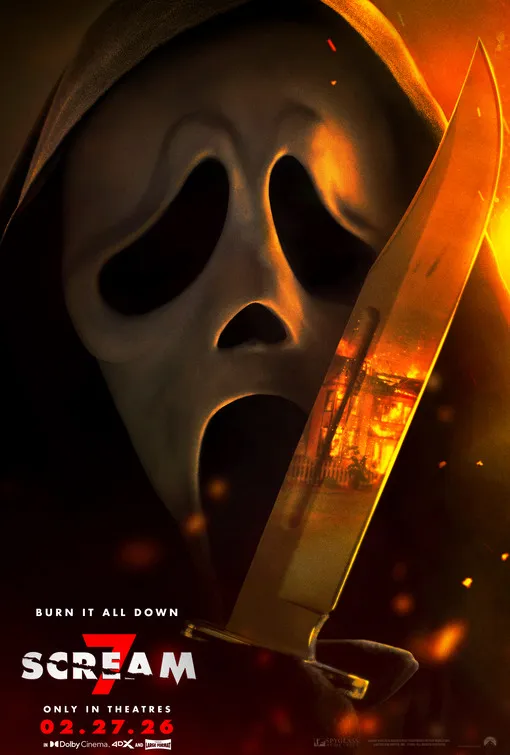
Scream 7 Breaks Franchise Records with $64.1M Opening, Pushes Series Past $1 Billion Milestone
Kevin Williamson's Scream 7 opened to a franchise-record $64.1M (estimate) and finished at $214M worldwide, the series' biggest. The numbers, the reviews, and what it means.
Scream 7 Breaks Franchise Records with $64.1M Opening, Pushes Series Past $1 Billion Milestone
Editor’s note (November 10, 2026): We updated this report with final figures and removed details we could not verify. Removed: the per-market international breakdown, the per-theater average, the “billion-dollar horror franchises” list, an analyst comparison with Prometheus, audience-score and attendance figures, and a claimed unused Stu Macher ending (Stu appears in the film). We also corrected the Rotten Tomatoes score, the Scream VI figures and the plot description, and replaced critic quotes with ones we could trace. Sources are linked.
Our angle: we put the record opening next to the reviews and the final total, and ask what each says about the franchise.
Update: Final grosses are in. Scream 7 made $122 million in the US and Canada and $92 million internationally, for $214 million worldwide on a $45 million budget. That makes it the highest-grossing film in the series (box office). The actual opening came in at $63.6 million, slightly below the $64.1 million Sunday estimate reported below.
Ghostface just had its biggest opening ever. Scream 7, the latest installment in Paramount Pictures and Spyglass Media Group’s long-running slasher franchise, shattered series records with a $64.1 million domestic opening weekend—the biggest debut in the franchise’s 30-year history.
The film opened in the US on February 27, 2026, after a February 25 premiere on the Paramount lot. Including international markets, its global opening was reported at about $97 million. It beat the franchise record set by 2023’s Scream VI ($44.4 million domestic opening), and the franchise has now grossed over $1.1 billion worldwide (franchise).
Record-Breaking Numbers
Expectations rose sharply in the final weeks. On February 5, Deadline reported tracking for a mid-$30 million opening. By release week, estimates were around $40 million. Thursday previews brought in $7.8 million, a franchise record, and weekend estimates jumped to $59 million (box office). The final $63.6 million beat Scream VI. Adjusted for ticket-price inflation, though, it trails Scream 2 and Scream 3. It was also the biggest launch ever for a horror film released in February.
The budget was $45 million before prints and advertising, co-financed 50/50 by Spyglass Media Group and Paramount.
Franchise History and Context
To fully appreciate Scream 7’s achievement, it’s essential to examine the franchise’s box office trajectory over three decades. The original Scream, directed by the late Wes Craven and written by Kevin Williamson, opened in December 1996 to a modest $6.4 million from 1,413 theaters. Through strong word-of-mouth and cultural impact, it ultimately grossed $103 million domestically and $173 million worldwide, and it became the highest-grossing slasher film in the world for years afterward.
Scream 2 (1997) capitalized on the original’s success with a $32.9 million opening, finishing with $101.3 million domestically and $172 million globally. Scream 3 (2000) opened to $34.7 million and earned $89.1 million domestically ($161 million worldwide). After an 11-year hiatus, Scream 4 (2011) struggled with $18.7 million opening and $38.1 million domestic total ($97 million worldwide), leading many to believe the franchise had run its course.
The series was revived in 2022 with a fifth installment (also titled Scream), directed by Matt Bettinelli-Olpin and Tyler Gillett. It opened to $30 million and finished with $81.6 million domestically ($138.9 million worldwide). Scream VI (2023) improved further with a $44.4 million opening and $108.4 million domestic total ($169.1 million worldwide), setting the stage for Scream 7’s record-breaking performance. All-time figures are from the franchise box office table (franchise).
The Billion-Dollar Milestone
With Scream 7, the franchise passed $1.1 billion worldwide across seven films (franchise). For a slasher series, whose films typically cost a fraction of a superhero blockbuster, that total reflects longevity more than any single hit. No individual Scream film had grossed more than $175 million before Scream 7.
Critical Reception vs. Audience Response
Critics were not kind. On Rotten Tomatoes, 29% of 228 reviews are positive. That is the lowest in the series. The consensus calls it “less a return to Scream’s roots than a disappointing creative regression.” Metacritic scores it 35 out of 100, which it labels “generally unfavorable” (reception).
Some reviews were gentler. The Guardian’s Benjamin Lee gave it three stars out of five, calling it “a scrappy, passably entertaining new chapter that limps to the screen with wounds on show.” TheWrap’s William Bibbiani wrote that “there are no bad Scream movies (yet)”, but called this one the worst of the series.
Audiences were warmer than critics but not enthusiastic. CinemaScore polling gave it a B−, tied with Scream 4 for the series’ lowest. On PostTrak, 61% said they would definitely recommend it. The second weekend fell 74% to $17.3 million, a steep drop even for a front-loaded horror release. The final $214 million shows how much of the total came from the opening.
Kevin Williamson’s Return
Scream 7 is the first film in the franchise directed by Kevin Williamson, who wrote the original. The road there was rocky. Bettinelli-Olpin and Gillett left in August 2023, and Christopher Landon was hired to direct. Spyglass then fired Melissa Barrera in late 2023 over social media posts about the Israel–Hamas war. Jenna Ortega and Landon departed soon after (development). In March 2024, Neve Campbell confirmed her return, having sat out Scream VI, with Williamson directing.
Williamson wrote the screenplay with Guy Busick, from a story by Busick and James Vanderbilt. Filming ran from January to March 2025. Courteney Cox, David Arquette, Matthew Lillard, Jasmin Savoy Brown and Mason Gooding return. Isabel May, Joel McHale, Anna Camp, Mckenna Grace and Mark Consuelos join the cast. The Barrera firing continued to shadow the film, and there were protests and boycott calls at its premiere.
The plot centers on Sidney, now living in Pine Grove, Indiana, with her husband Mark (McHale), a police chief, and their children. When a Ghostface who appears to be an aged Stu Macher (Lillard) targets her teenage daughter Tatum (May), Sidney is pulled back in. Without spoiling the ending, the film uses Stu’s apparent return as a central device.
Implications for the Horror Genre
Scream 7’s success matters for the horror genre and franchise filmmaking. First, it demonstrates that legacy characters and original creators still hold considerable appeal for audiences, even when critics are skeptical. The film’s performance suggests that nostalgia, when executed with care and respect for the source material, can be a powerful commercial force.
Second, the gap between reviews and ticket sales shows how much a franchise’s opening depends on brand and anticipation rather than critical response. The weak B− CinemaScore and the 74% second-weekend drop suggest that reviews and word of mouth caught up with the film after opening weekend.
Third, the film’s achievement in pushing the franchise past $1.1 billion validates Paramount and Spyglass’s strategy of reviving dormant horror properties. Following the success of the rebooted Scream trilogy (films 5-7), other studios are likely to examine their horror catalogs for similar opportunities.
The horror genre has proven remarkably resilient at the box office, with lower production costs and dedicated fan bases providing consistent returns. Scream 7’s $45 million budget and roughly $97 million global opening represent the kind of risk-reward ratio that studios find increasingly attractive in an era of rising production costs and uncertain theatrical attendance.
Box Office Trajectory
Horror films are notoriously front-loaded, and Scream 7 was no exception: the 74% second-weekend drop showed it. Still, the opening was large enough to carry it past every earlier entry. It finished at $214 million worldwide, ahead of the original Scream’s $173 million, and its $122 million domestic total is also a series best.
What’s Next for Ghostface?
Following Scream 7’s box office, talks on a possible eighth film began in March 2026 (franchise).
The question remains whether Kevin Williamson would return to direct, or if the studio would bring back Matt Bettinelli-Olpin and Tyler Gillett, who helmed Scream (2022) and Scream VI. Neve Campbell’s return has been celebrated by fans, and her continued involvement would likely be a priority for any future installments.
The franchise’s ability to reinvent itself while maintaining core elements—the Ghostface mask, the meta-commentary, the whodunit structure—has proven to be its greatest strength. As long as audiences remain engaged with the mystery of who’s behind the mask and the franchise continues to comment on horror conventions and contemporary culture, Ghostface will likely continue stalking theaters for years to come.
Conclusion
Scream 7’s record-breaking opening and $214 million final total are more than box office wins. They’re a cultural moment for a franchise that has defined and redefined slasher cinema for three decades. By pushing the series past $1.1 billion, Scream 7 has secured its place in the franchise’s history.
The weak reviews and steep second-weekend drop are real warning signs for the next sequel, but the opening demonstrates that audiences are still eager to answer the phone when Ghostface calls. In an industry increasingly dominated by superhero franchises and established IP, Scream 7 proves that horror, when executed with passion and respect for its legacy, can still deliver both scares and box office gold.
One thing is certain: reports of the slasher genre’s death have been greatly exaggerated. Ghostface isn’t going anywhere—and neither are the millions of fans who keep coming back for more.
How this was compiled: box office, production and reception figures come from the linked reference pages and Rotten Tomatoes. Opening figures were updated with actuals after first publication. See how we work.
worth a spot on the list?
Reader notes
Join the discussion
No account needed — leave your take on this film below.
Add these to your list
Spider-Man: Brand New Day Shatters Opening Day Record With $168 Million
Tom Holland's latest Spider-Man outing demolished Avengers: Endgame's long-standing opening day record, pulling in $168 million from 4,487 North American theaters on Friday alone.

Jumanji: Open World Trailer Drops as Sony Bets $1.7 Billion Franchise Against Dune and Avengers
Sony's trailer for the third and final Jumanji film arrives with the core cast intact, a Christmas release date, and the unenviable task of opening between Dune: Part Three and Avengers: Doomsday.

Disclosure Day and Masters of the Universe Bombed in Theaters. Streaming Might Save Them.
Spielberg's alien thriller and Amazon's He-Man reboot both flopped at the summer box office. Now that they're hitting streaming, they might finally find the audiences that theaters couldn't deliver.
12 States Just Sued to Block the Paramount-Warner Bros. Merger. Here's What's at Stake
California and 11 other states filed a federal antitrust lawsuit to stop Paramount's $111 billion takeover of Warner Bros. Discovery. We break down the arguments, the numbers, and what this means for the movies you'll actually get to see in theaters.
Loading comments...