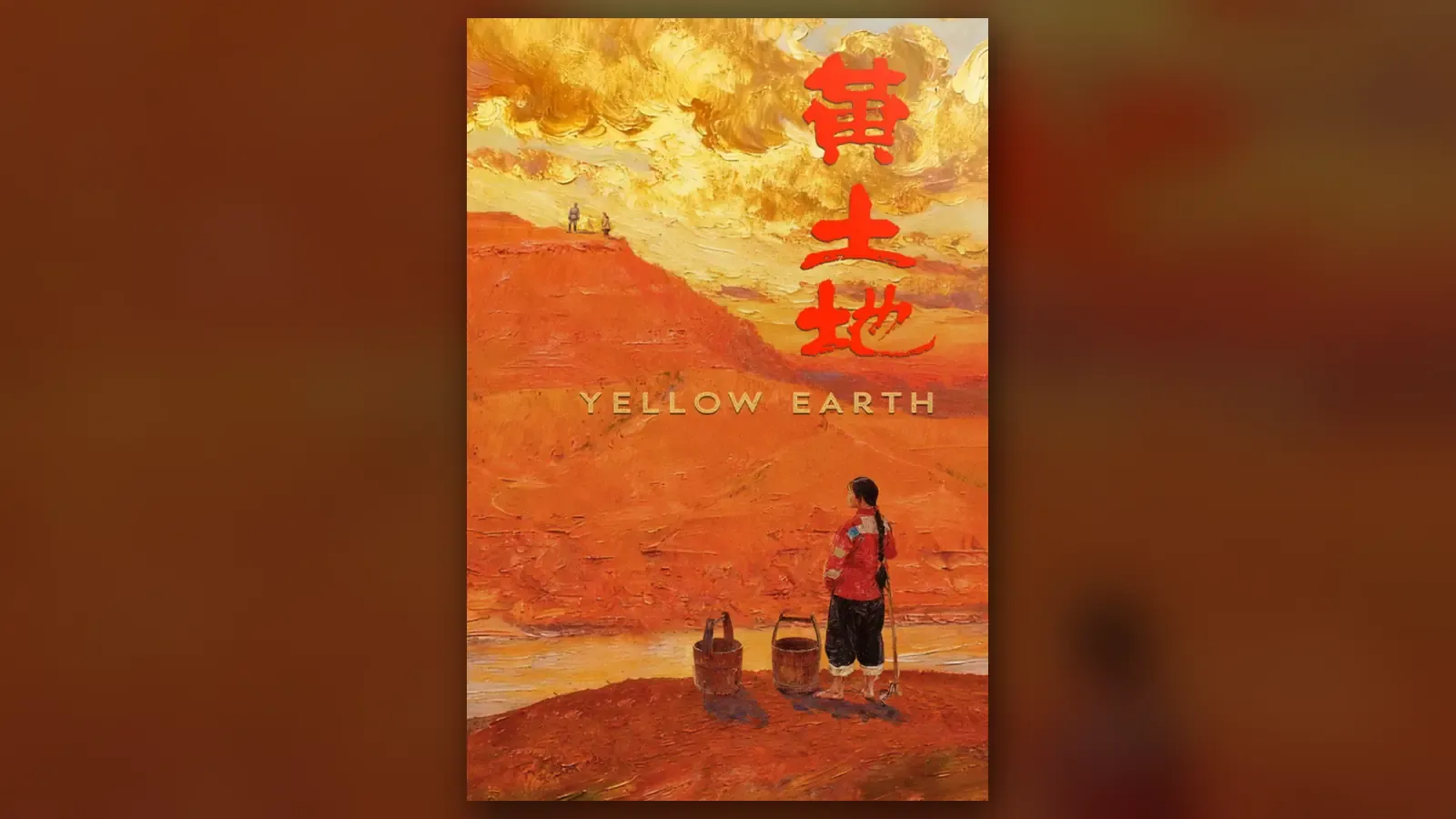
Yellow Earth (1984): The Film That Launched Chinese Fifth Generation Cinema
Chen Kaige's debut and Zhang Yimou's first cinematography work created a new visual language for Chinese cinema. A simple story of a soldier and a peasant girl becomes a meditation on tradition, revolution, and the land itself.
Editor’s note (November 10, 2026): We corrected and trimmed this analysis. Gu Qing travels from Yan’an into the Kuomintang-controlled north of Shaanxi. Cuiqiao is 14, and her marriage was arranged because her dowry had already paid for her mother’s funeral and her brother’s engagement. In the finale Gu Qing does return; it is not a vision. We removed a description of a riverbank search we could not confirm, a reference list we could not check and a numerical rating, and we added the film’s studio history and reception.
Our angle: Yellow Earth is usually praised for its images. Its sharper idea is about song: a Party worker arrives to collect folk songs and rewrite them, and the film asks what happens to the people whose voice is being borrowed.
In 1984, a group of young Chinese filmmakers who would later be called the “Fifth Generation” made one of their first major works. Chen Kaige and Zhang Yimou had entered the Beijing Film Academy in 1978, Chen in directing and Zhang in cinematography. After graduating in 1982 both were assigned to Guangxi Film Studio, which produced the film. Yellow Earth wasn’t just a debut—it was a declaration: Chinese cinema would never look the same again.
Chen Kaige directed. Zhang Yimou photographed. Together they created something unprecedented: a Chinese film that didn’t serve propaganda, that trusted images over dialogue, that treated the peasantry as mysterious rather than heroic. Censors criticized its “indulgence with poverty and backwardness,” and domestic critics called it “opaque and flat.” Abroad, it became a breakthrough.
Forty years later, it remains one of the most visually stunning films ever made—and one of the most quietly devastating.
The Setup: A Soldier Collecting Songs
Early spring, 1939. Gu Qing (Wang Xueqi), a soldier from the Eighth Route Army’s propaganda department, travels alone from Yan’an into the Kuomintang-controlled north of Shaanxi. His job is to collect peasant folk songs so they can be rewritten with Communist lyrics to boost soldiers’ morale (plot and setting).
Gu Qing stays with a poor, illiterate family: a widowed father, his daughter Cuiqiao (Xue Bai) and her younger brother Hanhan. He tells them that in the Communist areas, women are educated and choose whom they marry. The father dislikes this talk. Cuiqiao listens happily.
She is 14, and she has been told she must marry a much older man within months. Her dowry has already been spent on her mother’s funeral and her brother’s engagement. The soldier’s stories of freedom plant dangerous hope.
The plot is spare. A man visits. He leaves. The consequences unfold.
 One of the film’s most striking ideas appears in its faces: the village watches, listens, and measures the stranger before it ever believes him.
Zhang Yimou’s Cinematography: The Earth as Character
Before Zhang Yimou became a director of crowd-pleasers like Hero and House of Flying Daggers, he was a cinematographer—and Yellow Earth shows why his visual sense is extraordinary.
The title is literal. Zhang shoots the loess plateau of northern China as an endless expanse of yellow-brown earth, undulating hills that dwarf every human figure. The people aren’t photographed against landscapes; they’re absorbed into them.
| Visual element | Our reading |
|---|---|
| Vast yellow earth | Tradition, history, weight of the past |
| Human figures tiny against horizon | Insignificance of individual |
| Yellow River (muddy, powerful) | Life, death, force beyond control |
| Dark interiors, cave dwellings | Poverty, confinement |
| Sky dominating frame | Heaven, fate, the unchangeable |
This isn’t political cinema’s usual approach—the heroic peasant, the noble worker. Zhang shows peasants as part of the land, shaped by it, trapped in it. There’s beauty here, but it’s the beauty of endurance, not triumph.
 Zhang Yimou’s camera keeps returning to Cuiqiao’s face, not to sentimentalize her, but to place private longing inside an immense and indifferent landscape.
The Silence and the Singing
Yellow Earth is a quiet film. Long stretches pass with minimal dialogue—just wind, footsteps, the rhythms of agricultural labor. When people do speak, it’s in proverbs and folk sayings, the compressed language of generations.
But the singing is extraordinary. Cuiqiao’s voice, high and pure, rises from the earth like something the land itself is expressing. The folk songs she sings are about suffering, about women’s fate, about desires that can never be fulfilled.
Chen Kaige understood that these songs carry meaning ideology can’t touch. The Party wanted to use them for propaganda. But the songs themselves predate the Party. They predate revolutions. They’re older than history as politics understands it. They’re the voice of the land.
The Ending: Hope and Tragedy
⚠️ Spoiler Warning: Discussion of the ending follows.
When Gu Qing leaves, Cuiqiao waits for him on the road and begs to go with him. He does not know about her marriage, and tells her she cannot follow without the army’s permission, but that he will come back for her. The wedding comes, and she is carried off in a bridal sedan. Later she tells Hanhan she wants to run away and join the army. At night she tries to cross the turbulent Yellow River, singing the song Gu Qing taught her.
Whether she makes it across is never shown. The ambiguity is the point. Revolutionary hope and peasant tragedy coexist in the same frame.
In the final sequence, Gu Qing returns as he promised. The family’s home is empty. In the village he finds the peasants, led by Cuiqiao’s father, praying and dancing for rain over drought-killed crops. Hanhan sees Gu and tries to reach him, but the crowd blocks his way. The film ends on the sound of Cuiqiao’s song. The historian W. K. Cheng reads these closing scenes as the Party’s incorporation of the people’s voice. Is revolution arriving, or is it as far away as the rain?
 The film’s emotional center is not romance, but distance: two people in the same frame, separated by class, history, and what each thinks the future might mean.
The Fifth Generation Context
Yellow Earth was made by graduates of the Beijing Film Academy’s class of 1982, the first class admitted after the Cultural Revolution. Many of that generation had spent their teenage years in the countryside, and they had reasons to distrust both tradition and revolution.
Their cinema refused the propagandistic optimism of earlier Chinese film. It also refused Western narrative conventions. What emerged was something new: visually sophisticated, emotionally ambiguous, rooted in Chinese landscape and folk culture but not serving any political master.
Chen Kaige, Zhang Yimou, Tian Zhuangzhuang—these directors would go on to define Chinese cinema for decades. But Yellow Earth came first, and its influence echoes in every serious Chinese film that followed.
Why It Matters
At a moment when Chinese cinema is dominated by commercial blockbusters and careful political messaging, Yellow Earth reminds us what was possible. This is real art cinema—work that trusts the audience, that refuses easy answers, that finds meaning in images rather than speeches.
The yellow earth remains. The girl’s song lingers. The revolution came and went. The land endures.
Strengths and limits
What works:
- Zhang Yimou’s cinematography
- Zhao Jiping’s score and the folk songs
- Ambiguity serves the themes
- A new visual language for Chinese cinema
- The ending devastates through restraint
What doesn’t:
- Pacing will challenge some viewers
- Cultural and historical context helps appreciation
If You Liked This, Try:
- Red Sorghum (1987) — Zhang Yimou’s directorial debut
- Old Well (1987) — Zhang Yimou in front of the camera
- Farewell My Concubine (1993) — Chen Kaige’s later epic
- The Horse Thief (1986) — Tian Zhuangzhuang’s Fifth Generation masterpiece
- Raise the Red Lantern (1991) — Zhang Yimou’s visual poetry
- Platform (2000) — Jia Zhangke’s more recent take on Chinese history
Yellow Earth is not an easy film. It asks you to watch slowly, to find meaning in landscape and silence, to accept ambiguity as truth. The revolution promises freedom. The river promises death. The earth promises only continuity.
Cuiqiao rows into the yellow water. We never know if she arrives. But her song continues, carried by the wind across the plateau, asking questions the land will never answer.
Music and reception
Zhao Jiping composed the score. He drew on field research and local folk music, and wrote a distinct theme for each of the four main characters. The scholar Mary Ann Farquhar argues that song is Cuiqiao’s chief means of expression, giving voice to hardship and longing she cannot otherwise speak.
At home, reception was mixed to negative. The film avoided a complete ban, but it was “under constant attack since its first screenings.” Outside China it was far better received. At its 1985 Hong Kong International Film Festival premiere it was hailed as “an outstanding breakthrough.” Critic Richard James Havis wrote that it “proved a sensation,” and it won four international festival prizes in 1985. These details are collected, with sources, on the film’s reference page.
How this was compiled: plot, production history, music and reception come from the linked reference page and the scholars and critics it cites. Bucket Movies did not interview anyone for this piece. See how we work.
worth a spot on the list?
Reader notes
Join the discussion
No account needed — leave your take on this film below.
Add these to your list
Old Well (1987): Zhang Yimou's Star Turn as a Village Searching for Water
Wu Tianming's rural drama won the Tokyo Grand Prix and launched Zhang Yimou's acting career. A film about digging for water becomes a meditation on sacrifice, tradition, and the cost of community.
Hardcore (1979): Paul Schrader's Calvinist Nightmare
George C. Scott plays a devout Michigan father searching Los Angeles for his missing daughter. Paul Schrader's most personal film is a study of faith, shame and a father forced to hear why his child left.
The Ascent (1977): Larisa Shepitko's Brutal Meditation on Sacrifice and Betrayal
A Soviet masterpiece that transcends propaganda to become one of cinema's most devastating explorations of moral choice under impossible circumstances. Shepitko's final completed film remains unbearably powerful.
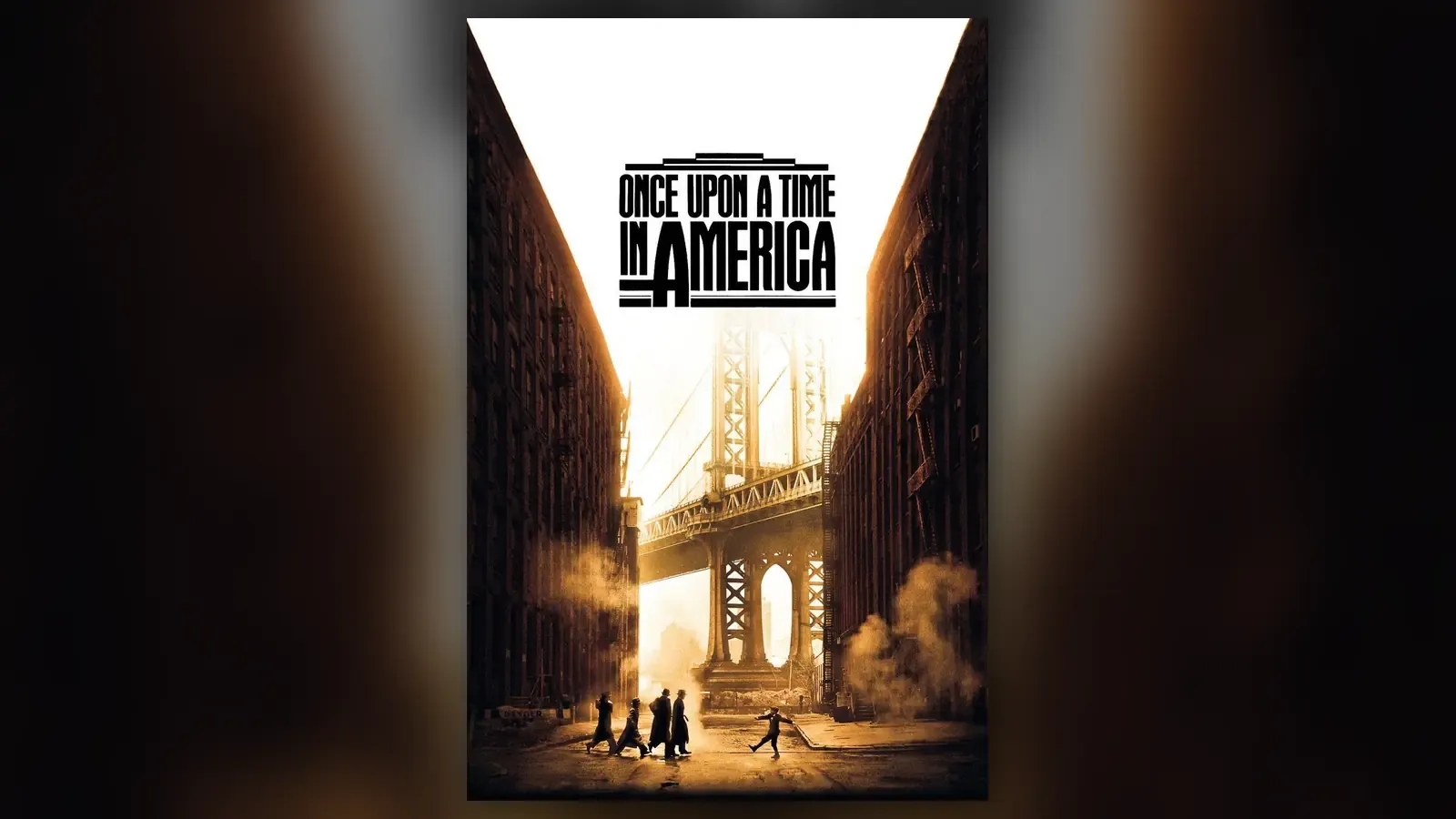
Once Upon a Time in America: Leone's Requiem for the American Dream
Sergio Leone's 1984 epic took 15 years to make and was butchered by studios. The restored version reveals one of cinema's most ambitious meditations on memory, betrayal, and the cost of the American Dream.
Loading comments...