1976: The Year That Changed Cinema Forever
Fifty years later, Rocky, Taxi Driver, and Network remain as relevant and powerful as ever—proof that 1976 was a golden year in American filmmaking
Editorial Notes
Anna edits BucketMovies criticism and essay packages, with a steady interest in classic Hollywood, literary adaptations, and repertory programming.
Leah Carter
Research Editor
Leah handles source checks, release-date verification, awards coverage, and the reporting framework behind BucketMovies news and industry pieces.
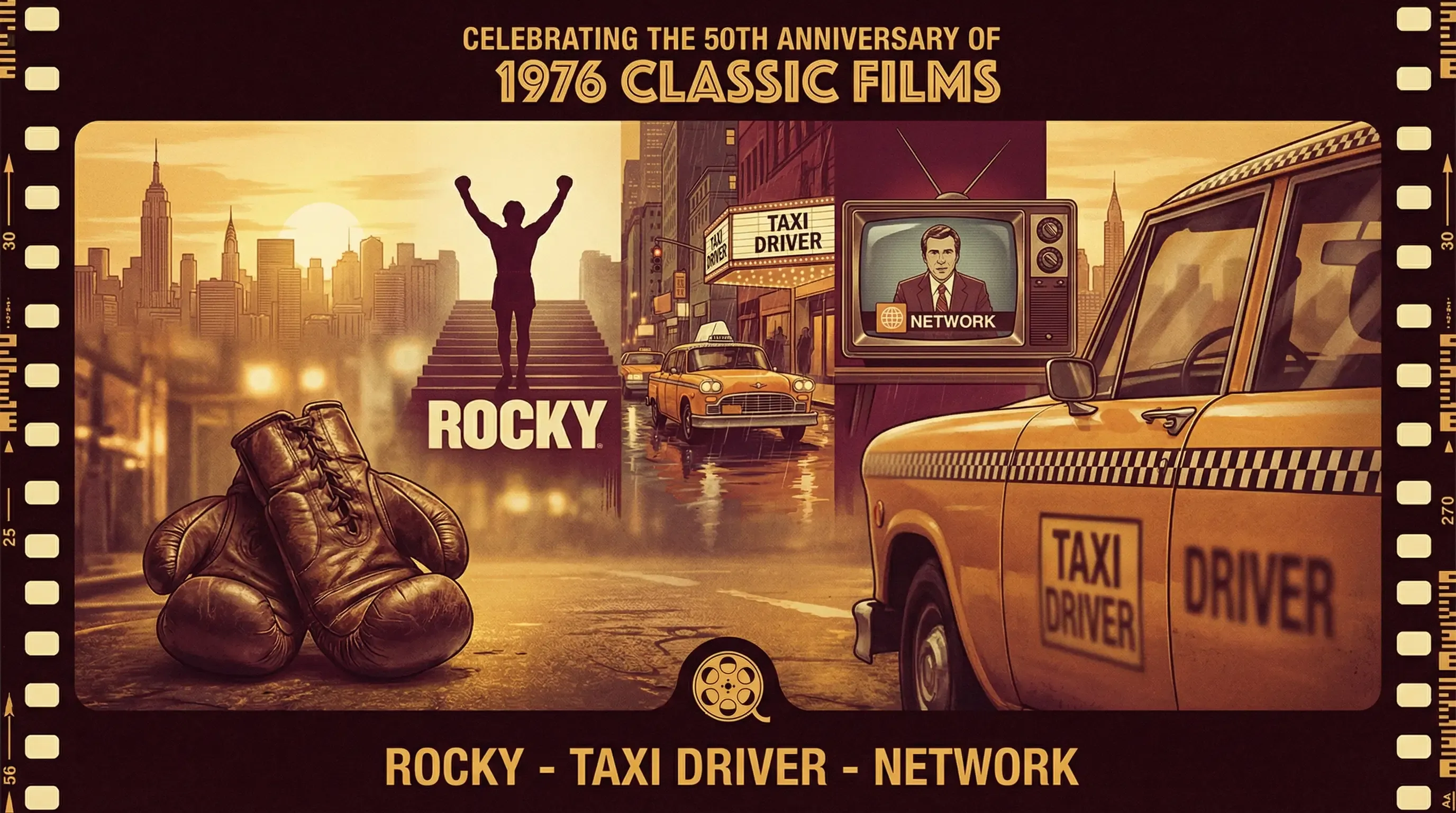
On February 8, 1976, Martin Scorsese’s Taxi Driver premiered at the Coronet Theater on Broadway, generating immediate shock and awe. By year’s end, Sylvester Stallone’s Rocky would become the highest-grossing film of the year and claim the Best Picture Oscar. Between these two releases, Sidney Lumet’s Network would deliver a media satire so prescient that it feels more relevant in 2026 than it did half a century ago.
1976 wasn’t just a good year for cinema—it was a watershed moment that redefined what American films could be. As we mark the 50th anniversary of these masterworks, their power reveals something about both the era that created them and our current moment.
The Cultural Crucible of 1976
To understand why 1976 produced such extraordinary cinema, we need to grasp the cultural moment. America was still reeling from Vietnam, the first war the nation had definitively lost. The Watergate scandal had shattered faith in institutions. The post-war economic boom had collapsed into stagflation and urban decay. New York City, the setting for both Taxi Driver and Network, teetered on the edge of bankruptcy.
This was the soil from which the American New Wave grew. Filmmakers who came of age in the 1960s—Scorsese, Francis Ford Coppola, Robert Altman—were now making their most ambitious work. They brought European art cinema sensibilities to Hollywood genres, creating films that were simultaneously entertaining and deeply unsettling.
The year 1976 captured this zeitgeist perfectly. While the nation celebrated its bicentennial with patriotic pageantry, its most vital artists were creating works that interrogated American mythology with unflinching honesty.
Rocky: The Dignity of the Underdog
When Sylvester Stallone brought his Rocky screenplay to executives, no one could have predicted its cultural impact. The film would gross $55.9 million domestically, earn ten Academy Award nominations, and win three including Best Picture. It would also create one of cinema’s most durable characters.
But Rocky succeeds precisely because it subverts sports movie conventions. This isn’t a film about winning—it’s a film about dignity.
Rocky Balboa’s goal is never to defeat Apollo Creed. He knows that’s impossible. His goal is simply to “go the distance”—to still be standing when the final bell rings. As he tells Adrian, “If I can go that distance, then I’ll know for the first time in my life that I weren’t just another bum from the neighborhood.”
This is a different way to think about heroism. Traditional sports narratives are about triumph over adversity, about the underdog who beats the odds. Rocky is about proving to yourself that you have value, regardless of the outcome.
The film’s ending crystallizes this philosophy. Rocky loses the split decision. There’s no twist, no last-minute reversal. He simply loses. But the film treats this as completion, not failure. As the crowd erupts and Rocky frantically calls for Adrian, we understand that he’s already won what matters. He’s reclaimed his dignity. He’s proven he’s not a “bum.”
The Adrian factor is crucial here. When she finally reaches him through the crowd, their embrace becomes the film’s true climax. Rocky has found something more valuable than a championship belt—human connection and a sense of belonging. The celebratory chaos around them fades to background noise.
This is why Rocky endures while countless other sports movies have faded. It’s not really about boxing at all. It’s a character study about self-worth, about the internal struggle to believe you matter when society tells you otherwise. The American Film Institute ranked it #78 in their list of the greatest American films, but its cultural impact extends far beyond that number.
Taxi Driver: America’s Dark Mirror
If Rocky offered a battered but ultimately hopeful vision of working-class America, Taxi Driver presented something far more disturbing: a portrait of alienation so complete it curdles into violence.
Travis Bickle, played by Robert De Niro in what remains the most complete performance of his career, is a Vietnam veteran driving a cab through New York’s nighttime streets. What he sees—or what he chooses to see—is a city drowning in filth and corruption. “All the animals come out at night,” he observes in his journal. “Whores, skunk pussies, buggers, queens, fairies, dopers, junkies. Sick, venal. Someday a real rain will come and wash all this scum off the streets.”
Paul Schrader’s screenplay and Scorsese’s direction position us uncomfortably inside Travis’s deteriorating psyche. The film’s impressionistic cinematography, combined with Bernard Herrmann’s brooding score (completed hours before the composer’s death), creates a nightmarish vision of urban decay. We’re trapped in the passenger seat beside him, watching the city through his eyes.
What makes Taxi Driver so unsettling is how it captures the psychology of the alienated loner who turns to violence. Travis isn’t a monster. He’s lonely, damaged, searching for meaning and connection. His attempts at romance with Betsy (Cybill Shepherd) are painfully awkward. His desire to “save” the child prostitute Iris (Jodie Foster) contains genuine compassion, however twisted his methods become.
The film’s climactic bloodbath—which generated enormous controversy upon release—serves a necessary function. It provides a conclusion to the pressure that’s been building throughout the film. When Travis finally explodes into violence, it’s both shocking and somehow inevitable.
Fifty years later, Taxi Driver feels more relevant than ever. The themes of toxic masculinity, untreated mental illness from war, violent vigilantism, and the attempted assassination of a political candidate could be ripped from today’s headlines. The film was five decades ahead of its time in diagnosing the social foundations of American pathology.
Roger Ebert, one of the few critics who immediately recognized the film’s greatness, called it “one of the best films I’ve ever seen.” He understood that the graphic violence wasn’t exploitation—it was necessary to show the logical endpoint of Travis’s worldview.
Network: The Prophecy That Came True
While Taxi Driver and Rocky have aged remarkably well, Sidney Lumet’s Network has achieved something different: it’s become more relevant with each passing year.
Paddy Chayefsky’s screenplay—which the Writers Guild of America later named the greatest screenplay ever written—tells the story of Howard Beale, a veteran news anchor fired due to declining ratings. With two weeks left on air, Howard announces he’ll commit suicide on live television. When he’s sent out the next night to apologize, he instead launches into a profanity-laced rant about the miserable state of the world.
The network executives, seeing ratings spike, decide to exploit Howard’s mental breakdown for profit. His “angry man” schtick becomes a hit show, complete with the iconic mantra: “I’m as mad as hell, and I’m not gonna take this anymore!”
What seemed like wild satire in 1976 now looks like documentary realism. Network predicted the rise of infotainment, the exploitation of outrage for ratings, and the prioritization of quarterly earnings over journalistic integrity or human wellbeing. Howard Beale feels like a precursor to controversial influencers and exploited pop stars—people whose mental health struggles are monetized by those around them.
The film’s central insight—that media corporations will exploit anything, including human suffering, if it generates eyeballs and revenue—is now the operating principle of our media landscape. Social media platforms optimize for engagement. News networks chase outrage. The traditional TV networks may be fighting a losing battle, but the bones of Network’s satire remain timeless.
Peter Finch’s performance as Beale earned him a posthumous Best Actor Oscar, one of three acting wins for the film (Faye Dunaway for Best Actress, Beatrice Straight for Best Supporting Actress with just five minutes of screen time). But the entire ensemble is extraordinary. William Holden, Robert Duvall, and Ned Beatty all deliver standout turns in a film that balances razor-sharp satire with genuine human drama.
Network is as heartbreaking as it is hilarious. For every racy satirical gem—like the contract dispute over the absurdly provocative “Mao Tse-Tung Hour”—the film takes time to explore its characters as real people. Everyone serves a comedic function in the overall media satire, but they’re also richly drawn and three-dimensional.
The Supporting Cast: A Year of Riches
While Rocky, Taxi Driver, and Network dominate discussions of 1976, the year produced numerous other significant films.
Alan J. Pakula’s All the President’s Men laid the template for political investigative thrillers, showing how Bob Woodward and Carl Bernstein’s dogged journalism helped expose the Watergate scandal. Rather than sensationalizing the narrative, Pakula took a low-key detective approach that emphasized the importance of a free press and the threat of unchecked power—themes that remain urgently relevant.
Brian De Palma’s Carrie, adapted from Stephen King’s novel, became a horror landmark. The scene where Carrie White is drenched in pig’s blood at prom remains visually jarring, and Sissy Spacek’s performance earned her an Academy Award nomination. The film’s exploration of bullying, religious fanaticism, and adolescent cruelty continues to resonate.
Richard Donner’s The Omen proved that horror could be both commercially successful and artistically ambitious, earning Jerry Goldsmith an Oscar for his chilling score. The film’s depiction of the Antichrist as an innocent-looking child created a template that horror filmmakers still follow.
Even comedies like The Bad News Bears managed to smuggle in social commentary, using Little League baseball to critique the hyper-competitiveness that adults impose on children.
The Lasting Impact
The films of 1976 shaped the future of cinema. Rocky spawned a franchise that continues to this day through the Creed films, proving that stories about dignity and perseverance never go out of style. It also demonstrated that a sports movie could be primarily a character study.
Taxi Driver influenced generations of filmmakers exploring urban alienation and psychological breakdown. Its visual style and narrative approach can be seen in everything from Fight Club to Joker. The film’s willingness to position audiences inside a disturbed protagonist’s perspective opened new possibilities for cinema.
Network’s influence is perhaps most obvious in our current media landscape. Every time a news network prioritizes outrage over information, every time a social media platform optimizes for engagement over truth, we’re living in the world Network predicted.
These films also represented the peak of the American New Wave, a movement that brought European art cinema sensibilities to Hollywood storytelling. The gritty realism, moral ambiguity, and willingness to end on unresolved notes that characterized 1970s American cinema can be traced directly to films like these.
Fifty Years Later: Why They Still Matter
As we mark the 50th anniversary of these films, their continued relevance is striking. We live in a time of economic anxiety, political polarization, and media fragmentation—not so different from 1976. The questions these films asked about dignity, alienation, and institutional corruption remain urgent.
Rocky reminds us that success isn’t always about winning, that dignity and self-respect matter more than external validation. In an age of social media metrics and constant comparison, this message feels more necessary than ever.
Taxi Driver warns us about the dangers of alienation and untreated trauma, about how loneliness can curdle into violence. As we grapple with issues of toxic masculinity and political violence, the film’s insights remain painfully relevant.
Network shows us how media institutions prioritize profit over truth, how they exploit outrage and suffering for ratings. In the age of algorithmic feeds and engagement optimization, Chayefsky’s satire has become our reality.
These films endure because they’re timeless examinations of human nature and American society. Great cinema illuminates, challenges, and provokes—and these three films do all of that.
Fifty years later, 1976 remains a high-water mark for American filmmaking. The films produced that year continue to inspire, disturb, and move audiences because they dared to tell difficult truths about who we are and what we value. They prove that cinema at its best is more than escapism—it’s a mirror held up to society, reflecting both our failures and our capacity for dignity in the face of those failures.
As we watch these films again in 2026, we’re not just revisiting the past. We’re confronting questions that remain as urgent today as they were half a century ago. That’s the mark of truly great cinema—it doesn’t age, it deepens.
Share This Article
Comments