The Cabinet of Dr. Caligari (1920): Expressionism, Authority, and the Shape of Fear
A 3000+ word analysis of The Cabinet of Dr. Caligari, from its jagged Expressionist sets and frame story to its politics of authority, performance, and long afterlife in horror and noir.
Editorial Notes
BucketMovies Editorial covers classic cinema, repertory discoveries, and context-rich film criticism with an emphasis on source-backed reporting and careful editorial review.
Leah Carter
Research Editor
Leah handles source checks, release-date verification, awards coverage, and the reporting framework behind BucketMovies news and industry pieces.
Executive Summary
The Cabinet of Dr. Caligari still feels dangerous because it makes form carry fear. When it premiered in Berlin on February 26, 1920, it did more than give audiences a strange murder story. It proposed a new way for cinema to think. Walls could lean. Shadows could be painted instead of cast. Faces could look carved by panic. A whole town could seem guilty before the plot explained why.
My argument is simple. The film’s real innovation is not only its Expressionist decor, famous as that is. The deeper achievement is that every part of the movie, set design, acting, framing, narrative structure, and even public showmanship, works toward the same suspicion: authority is unstable, performance can mask violence, and fear can be organized.
Key ideas in this essay:
- The film turns post-World War I anxiety into a visual system, not just a mood.
- Cesare is frightening, but the larger horror is obedience.
- The frame story does not neatly cancel the film’s distrust of authority. It keeps the distrust alive.
- The movie shaped horror and noir because it made style causal, not decorative.
Read time: about 20 minutes
Introduction
Some silent classics need a running start. Caligari does not. Within minutes, you know the world is off. Windows tilt like broken teeth. Streets narrow into knife-points. Painted shadows cut across walls as if darkness itself had been drafted by an art director. You do not have to know anything about German Expressionism to sense that ordinary reality has already failed.
That is what keeps the film alive for me. Plenty of old horror movies survive as important fossils. The Cabinet of Dr. Caligari survives as an active experience. It still gets under the skin. Part of that comes from the story, a fairground showman, a sleepwalker, a string of murders, and a final twist that throws the whole narrative into dispute. But the larger reason is formal. The movie makes fear architectural. It does not decorate madness. It builds a world where madness, authority, spectacle, and obedience become hard to separate.
This analysis takes a plain position: Caligari matters because it fused style and suspicion so completely that the look of the film became part of the plot. The movie does not simply tell us that something is wrong. It teaches us to see wrongness in every wall, doorway, and street corner. That is why it still feels modern, and why its influence reaches far beyond the “silent horror classic” label it usually gets.
Background and Context
The film arrived at a raw moment. BFI’s centenary essay places it squarely in the aftermath of World War I, when Germany was living with military defeat, economic strain, and a larger cultural mood of exhaustion and disorientation. That background matters because the movie’s ugliness is not random ugliness. Its jagged lines and unstable streets register a world that no longer trusts straight lines, official language, or calm surfaces.
The historical facts help sharpen the picture. Filmportal lists the shoot in Berlin-Weissensee between December 1919 and January 1920, with the premiere at the Marmorhaus in Berlin on February 26, 1920. The credits tell their own story: Robert Wiene directing, Hans Janowitz and Carl Mayer writing, Erich Pommer and Rudolf Meinert producing, Willy Hameister on camera, and Hermann Warm, Walter Reimann, and Walter Rohrig building the design. Lay those names out and the film looks less like a happy accident than a concentrated wager. Everyone pushed in the same direction.
Britannica calls it the first great work in horror and the first film of German Expressionism. Those labels are useful, but they can flatten what the movie actually does. Horror suggests shocks and threat. Expressionism suggests a style category. Caligari is larger than either label by itself. It is about how institutions stage reality, how crowds accept performance as truth, and how inner states can take over the visible world.
How This Reading Was Built
I leaned on film-historical sources rather than fan summaries. BFI helped with the wartime context and the long debate over the frame story. Britannica anchored the film’s place in horror and Expressionism. Filmportal supplied production credits, release facts, and the basic history of the restored version. MoMA’s program note matters because it says plainly why the settings were so famous in the first place: they carry the force of expressionist painting and stage design into cinema. The Murnau Stiftung notes matter for a different reason. They remind us that the film is not frozen in 1920. It is still being reconstructed, rescored, and re-seen through archival work.
That mix of sources matters because Caligari has spent a century under layers of myth. It is often introduced as the first true horror film, an anti-authoritarian allegory, a dream, a proto-noir, or a filmed stage piece. Some of that is accurate, some of it is inflated, and some of it depends on which historical argument you accept. The safer route is to stay close to what the movie actually does on screen, then use history to sharpen the reading rather than drown it.
The Fairground Is the First Crime Scene
One of the smartest things in the film is also one of the easiest to overlook: horror enters through entertainment. Dr. Caligari does not begin as a hidden monster. He begins as a showman, a man who wants a permit, a crowd, a booth, and a captive audience. He sells mystery before he commits murder. That order matters.
The fairground is the first place where power turns into spectacle. Caligari talks, gestures, and controls access. Cesare is displayed as an object, a body to be watched and used. A crowd forms. Curiosity does the rest. Long before anyone is killed, the movie has already sketched the basic mechanism of public manipulation. A commanding voice arranges the scene, a passive body becomes the medium, and the audience participates because the event has been framed as entertainment.
That setup also gives the film a sly self-awareness. Cinema itself is a public attraction, and Caligari knows it. The movie is not above selling its own weirdness. Filmportal preserves an early review that recalls the advertising slogan “Du musst Caligari werden,” or “You must become Caligari,” a line that turned the film into a kind of citywide dare before people had even seen it. I like that detail because it keeps the film grounded in commercial instinct as well as artistic ambition. The movie wanted to disturb people, yes, but it also wanted to pull them in.
This is why Caligari remains frightening even before we decide what he represents politically. He is a manager of attention. He knows how to turn passivity into participation. He stages the conditions under which violence can later pass as fate. That is a modern kind of menace.
Why the Painted Sets Still Feel Wrong in the Best Way
If you stripped away the murders and the twist, the film would still be memorable because it refuses ordinary space. Streets taper into points. Doors lean as if they are listening. Windows look cut by someone who distrusted geometry. Even the painted shadows are aggressive. They do not imitate natural light. They insist on mood.
MoMA’s note gets at the core of it: the settings derive from expressionist painting and stage design, and almost nothing in the film depends on realism in the ordinary cinematic sense. That might sound like a limitation, but it is one of the movie’s strengths. Because the world is so openly artificial, the film never asks us to confuse realism with truth. It asks whether a false-looking world can tell the truth faster.
It can. Holstenwall is not believable as geography. It is believable as a condition. The warped space tells you that authority is unstable, perception is compromised, and civic life has already tilted into nightmare. The decor is not background. It is an argument made in paint, wood, and line.
BFI also points out that the all-over Expressionist look had a commercial logic, not only an artistic one. That detail matters because it keeps the film from hardening into museum prestige. The filmmakers wanted the style to make a sensation. They wanted difference. They wanted the visual shock to sell tickets. That is worth remembering because formal daring and audience appeal are not opposites here. The weird thing was also the hook.
Caligari, Cesare, and the Horror of Obedience
The film’s most enduring figure might be Cesare. Conrad Veidt’s sleepwalker is tall, hollow-eyed, and so thin he seems less like a man than a line drawing given legs. But the deepest fear in the movie is not his body. It is his relation to command. He kills because he is ordered to kill. He predicts death because his body has been turned into an instrument of doom. He is frightening, but he is also tragic. The film offers almost no evidence of a private self untouched by control.
That is why Dr. Caligari matters more as a handler than as a mad eccentric. He is terrifying because he knows how to use a body that is no longer fully its own. BFI’s historical framing helps here. Later critics saw Cesare as a figure for the young men sent off to kill under orders in the war’s aftermath. You do not need to reduce the whole film to a single allegory to see why that reading persists. The movie is obsessed with submission. Commands move downward. Violence moves outward. Responsibility becomes slippery.
What keeps the film from becoming a simple symbolic essay is the way it writes the cost of command onto Cesare himself. He is not a machine. He looks exhausted, brittle, almost pre-buried. The horror is not only what he does. It is what has been done to him. A monster under orders is different from a monster acting freely. The second figure invites punishment. The first invites a harder question: what kind of social world produces bodies that can be used this way?
Jane, Desire, and the Strange Mercy of Cesare
Jane is the clearest limit in the film and also one of its most revealing figures. The movie gives her less interior life than it gives the male rivalry around her. That part has aged badly, and there is no reason to pretend otherwise. She is too often an emblem, the desired woman, the threatened woman, the woman whose body converts suspicion into proof.
Still, the film uses her with more tension than a simple victim role would suggest. The rooftop abduction sequence is one of the movie’s strangest passages because it briefly changes the emotional temperature. Cesare enters intending murder. Instead he lifts Jane and carries her through the distorted city, and the scene becomes suspended between violence, pity, desire, and collapse. He still frightens her, and us, but the murder machine hesitates.
That hesitation matters. It does not redeem Cesare, and it does not solve the film’s gender politics. What it does is expose a crack inside the obedience structure. For a moment, the body under orders fails to act as ordered. That flicker of refusal gives the sequence its haunted beauty. The movie does not turn Jane into a fully realized subject, but it does use her scene with Cesare to show that domination is never as stable as the dominator imagines.
The Frame Story and the Fight Over What the Film Means
No element of Caligari has generated more argument than its frame story. Franzis narrates the central plot, only for the ending to suggest that he himself is an asylum patient and that the respectable director he accused may be innocent. On paper, that twist sounds like it should settle everything. The tale was delusion. Authority is restored. End of argument.
The movie is not that obedient.
BFI is especially useful here because it summarizes the classic objection from Siegfried Kracauer, who thought the frame device softened the film’s distrust of authority by turning rebellion into madness. That is a serious argument, and it deserves to be taken seriously. If Franzis is simply insane, then Caligari becomes a decent authority figure after all. Yet the film never presents that final world as clean, stable, or reassuring. The asylum in the frame scenes still looks eerie. The faces are still strange. The director’s promise that he now knows how to cure Franzis does not land like moral order returning. It lands like another attempt to control the story.
That ambiguity is the point. The twist does not erase the earlier material. It contaminates both sides. Was Franzis paranoid, or did he glimpse something real through a distorted lens? Is the doctor sane, or merely better dressed than the people around him? The movie refuses to give a stable answer, and that refusal is one of the main reasons it still feels alive. Too many twist endings lock a movie shut. This one leaves it ajar.
I also think the frame story changes how we read the sets. If Franzis invented the tale, then the crooked town might be his projection. But the film refuses to localize distortion neatly inside one mind. The opening and closing spaces do not become normal. That matters because it keeps psychology from functioning as an alibi. The world remains warped. The institution remains uncanny. Authority remains suspect.
Performance, Light, and the Physical Work of Silent Fear
Because the sets get so much attention, people sometimes underrate the acting. That is a mistake. Caligari would not work if the performers stayed naturalistic inside those painted spaces. They have to meet the world halfway, and they do.
MoMA’s note says Werner Krauss and Conrad Veidt harmonize with the atmosphere of unreality, and that feels exactly right. Krauss plays Caligari with a twitchy, needling force. He is not grand in the stately mad-scientist mode. He nags, presses, leans, and flares. His face feels overarticulated, almost weaponized. Veidt does something different. Cesare moves like a body pulled between ritual and collapse. When he rises from the cabinet, the scene still shocks because waking up looks painful, not triumphant.
The silent format helps. Without spoken dialogue fixing the tone, bodies and spaces carry more weight. A turn of the head, a pause in a doorway, a painted slash pretending to be a shadow, all of it counts. Murder scenes can become abstract without losing force. Filmportal’s commentary on the page points to the shadowed murder and the rooftop chase as the movie’s most striking passages, and I think that is right. The film does not need realism to create danger. It needs clarity of shape.
Then there is the light. Britannica emphasizes the film’s shadowy visual field, but what matters is not darkness by itself. It is designed darkness. The shadows often seem placed rather than cast. That makes them feel intentional, almost administrative. Someone has decided where fear belongs. Once again the look folds back into the politics. Disorder appears arranged. Panic feels managed.
Why the Film Changed Horror, Noir, and More
It is tempting to reduce the film’s influence to iconography. Later horror borrowed the haunted sleepwalker, the twisted streets, the sinister authority figure, and the painted shadow. Later noir borrowed the guilty city and the sense that architecture could accuse the people living inside it. All of that is true. Britannica directly connects Caligari to later Expressionist films and then outward to American film noir.
But the stronger influence lies deeper than the imagery. What later filmmakers inherited was a method. Caligari showed that style could be causal. The shapes inside the frame were not decorative trim around the story. They were part of the story’s logic. Once that door opens, whole traditions become possible. Horror can treat environment as a source of dread rather than a location for dread. Crime films can make cities feel morally warped. Psychological cinema can let space reveal inner life without apologizing to realism first.
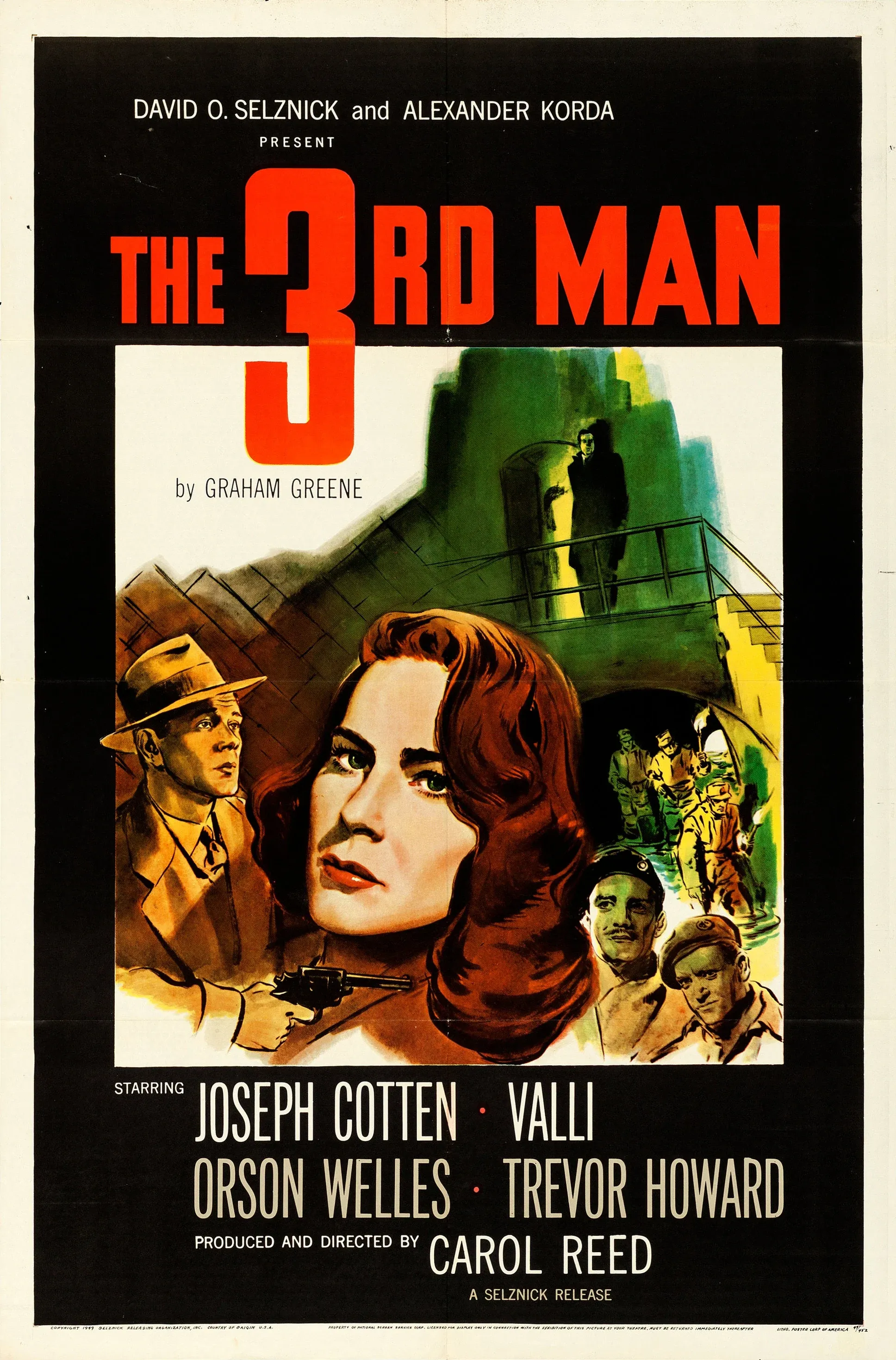
I keep thinking about how many later masterpieces accept that wager. The Third Man turns Vienna into moral geometry. Film noir makes whole streets look compromised. Psychological horror keeps rediscovering that rooms can think. None of those films look exactly like Caligari, but many of them accept its underlying premise: show the mind through space, then let space push back.
The Film’s Second Life Through Restoration
One lazy habit in old-film criticism is to talk about a movie as if it arrived once and stayed fixed forever. Caligari did not. It survives through archives, restorations, rescoring, and curatorial choices.
This is where the Murnau Stiftung material becomes more than trivia. Their 2014 restoration pulled together sources from multiple German and international archives, including the Bundesarchiv-Filmarchiv, the British Film Institute, the Cinematheque francaise, MoMA, and the Cineteca di Bologna. The work ran from April 2012 to January 2014 and resulted in a 4K master that premiered at Berlinale Classics on February 9, 2014, with John Zorn performing a specially composed and partly improvised score. That is not just a technical refresh. It is another event in the film’s life.
Filmportal tracks that restored version too, listing it at 77 minutes and noting its 2014 Berlin debut. That matters because silent films rarely survive as single untouched objects. They exist through partial prints, altered versions, different tinting histories, and new musical lives. The version you see shapes the film you think you know.
I do not say that to dissolve the film into relativism. I say it because restoration makes the film’s strangeness visible again. Murnau’s note about the preserved camera negative in the Bundesarchiv is especially useful. Better contrast and cleaner detail do not tame the movie. They sharpen it. The painted shadows hit harder. The tinting feels more deliberate. The artificiality looks less like age and more like choice.
Why It Still Feels Modern
A lot of writing about silent classics strains to prove present-day relevance. Caligari does not need much help. What feels modern is not simply the surface weirdness. We live with weird images. What feels modern is the film’s suspicion that public reality is staged, that authority depends on performance, and that people can be made to act against their own moral interests.
That is not a dated fear. It is one of the central fears of mass society. The fairground show, the institutional director, the passive body used to transmit violence, the crowd that watches first and thinks later, the unstable relation between story and truth, all of it still speaks. The film understands that spectacle can make domination look interesting before it makes domination look criminal.
I also think the movie survives because it is short, direct, and mean. It wastes little time. It does not soften itself with explanatory psychology. It trusts mood, image, and repetition. Modern viewers can still meet it halfway because it does not ask for dutiful reverence. It asks for attention.
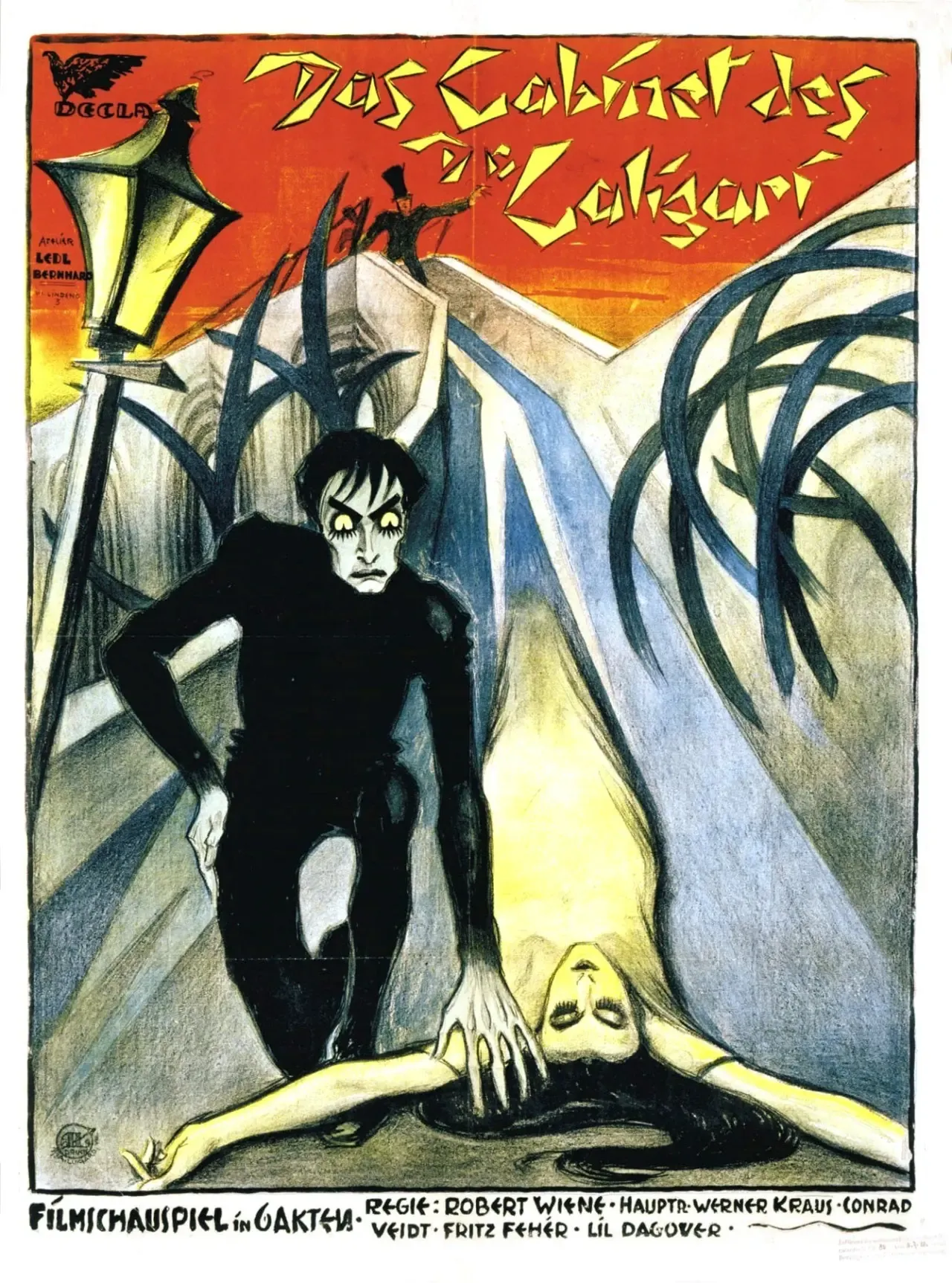
That is why the original poster art still feels right for the film. One surviving 1920 poster variant on Wikimedia Commons is cataloged as public domain in the United States because it was published before January 1, 1931. The image looks less like an invitation than a warning. That suits the movie. Caligari still announces itself as something contagious.
Final Thought
Some classics survive because later generations learn to be polite around them. The Cabinet of Dr. Caligari survives because it keeps biting back.
I keep returning to one simple fact: the movie makes fear visible before the plot explains it. That is rare. By the time Franzis starts accusing, by the time Cesare starts moving, by the time the asylum comes back into view, the film has already taught us how to feel. Straight lines cannot be trusted. Calm authority cannot be trusted. Normal space cannot be trusted. Once the movie establishes that grammar, the story becomes more than a mystery. It becomes a study of how power rearranges perception.
That is why Caligari still matters. Not because it was first in every category people attach to it. Not because it is useful in a film-history lecture. It matters because it found a way to make style do ideological work without losing the pleasure of horror. The movie is eerie, yes, but it is also sly, commercial, theatrical, and ruthless in its economy. It remains one of the clearest cases where cinema discovered that a set could think.
If you want a later film that turns a city into a moral trap, read our take on The Third Man. If you want another classic that uses performance and space to strip an industry bare, pair this with Sunset Boulevard. Caligari sits near the headwaters of both traditions, and after a century, the water still looks poisoned in the most compelling way.
Sources and Further Reading
- BFI, “100 years of The Cabinet of Dr. Caligari: why we’re still living in its shadows”: https://www.bfi.org.uk/features/100-years-cabinet-dr-caligari/
- Encyclopaedia Britannica, “The Cabinet of Dr. Caligari”: https://www.britannica.com/topic/The-Cabinet-of-Dr-Caligari
- filmportal.de, English film entry for Das Cabinet des Dr. Caligari: https://www.filmportal.de/en/movie/das-cabinet-des-dr-caligari_ea43d4a69c1a5006e03053d50b37753d
- Friedrich-Wilhelm-Murnau-Stiftung, restoration premiere note: https://www.murnau-stiftung.de/news/digitale-restaurierung-der-murnau-stiftung-von-das-cabinet-des-dr-caligari-feiert-premiere-bei
- MoMA program note for Das Cabinet des Dr. Caligari: https://www.moma.org/calendar/events/6120
- Wikimedia Commons, poster file metadata used for the cover image: https://commons.wikimedia.org/wiki/File:Das_Cabinet_des_Dr._Caligari.JPG
Share This Article
Comments