Pandora's Box (1929): Louise Brooks and the Scandal of Modern Desire
An in-depth analysis of Pandora's Box, from Louise Brooks's Lulu and Pabst's cool camera to Weimar sexuality, censorship, and the film's unsettling modernity.
Editorial Notes
Anna edits BucketMovies criticism and essay packages, with a steady interest in classic Hollywood, literary adaptations, and repertory programming.
Leah Carter
Research Editor
Leah handles source checks, release-date verification, awards coverage, and the reporting framework behind BucketMovies news and industry pieces.
Some old movies feel historic in a flattering, slightly dead way. Pandora’s Box does not. It still feels like trouble. You can see why audiences in 1929 did not quite know what to do with it, and why later generations kept dragging it back into the light. On paper, the film looks like a scandal machine: a showgirl named Lulu moves through a chain of lovers, admirers, opportunists, and victims, leaving jealousy, violence, and collapse behind her. That summary is accurate, but it also misses the strange thing the film keeps doing.
G. W. Pabst never lets Lulu settle into a moral lesson. She is not a warning sign, not a tidy femme fatale, not a martyr, and not a straightforward innocent either. Louise Brooks plays her as someone who lives from moment to moment with a smile that can read as generous, blank, playful, manipulative, or all four at once. That instability is the movie’s engine. It is also why Pandora’s Box still feels more modern than a lot of films made decades later.
Criterion describes the film as “sensationally modern,” and that sounds right to me, though the reason is not just sexual frankness. Plenty of movies can shock. What Pandora’s Box does is harder. It makes desire look like a social atmosphere. Everyone around Lulu reads her, wants something from her, fears her, misjudges her, or uses her as a screen for fantasies they already had. Pabst’s cool, watchful style turns that into the whole subject of the film.
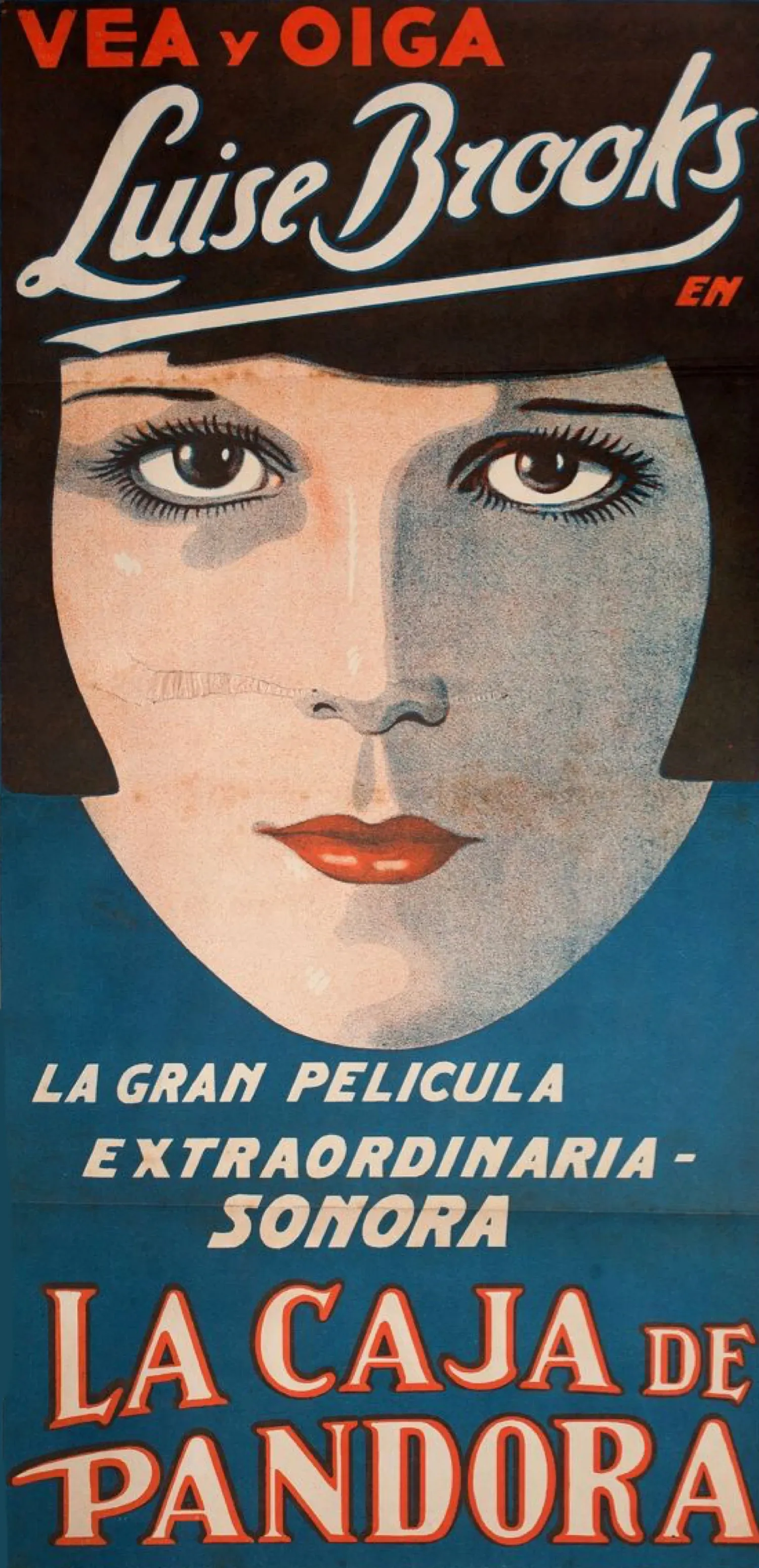
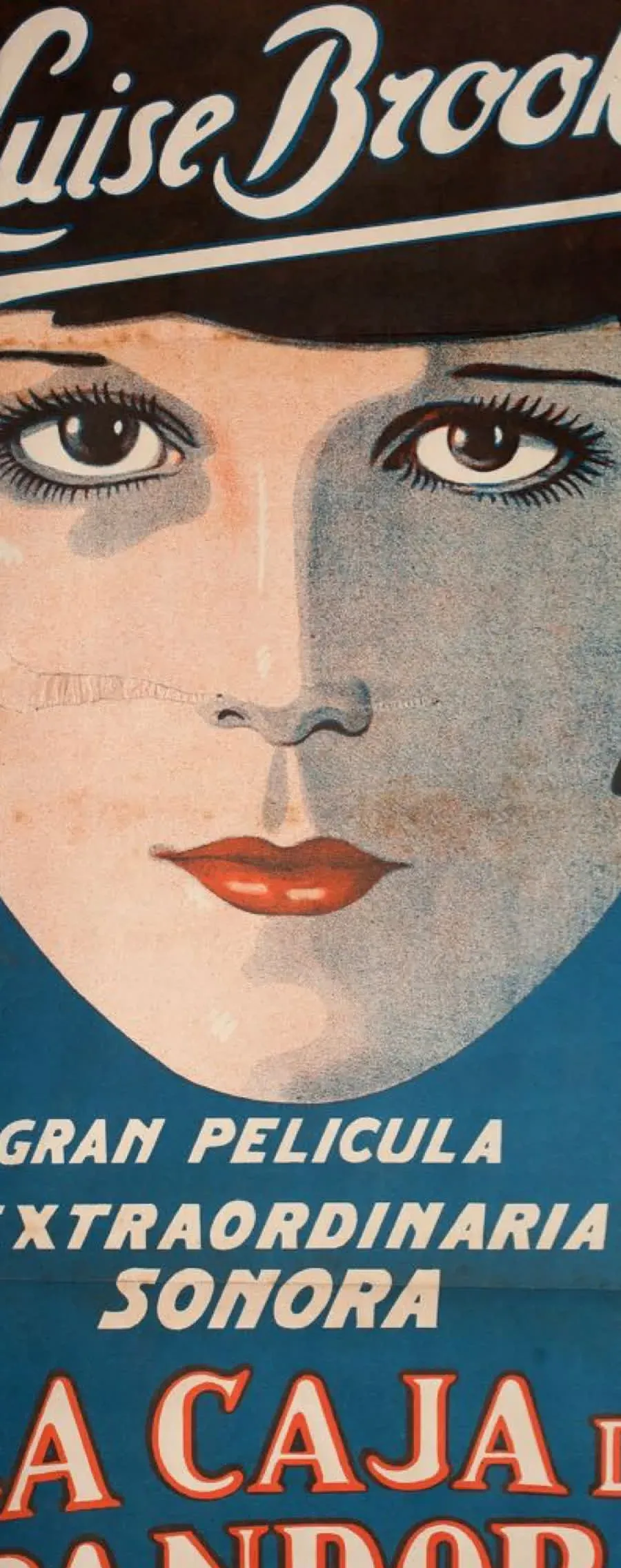 Detail from the original 1929 Spanish-language poster for Pandora’s Box, preserved via Wikimedia Commons.
Louise Brooks Makes Lulu Hard to Contain
The most famous thing about Pandora’s Box is also the hardest thing to pin down: Louise Brooks. Critics have spent nearly a century trying to explain why her Lulu feels so alive. Some praise the haircut, some the eyes, some the fact that she seems to belong to a different decade from everyone around her. All of that is true, but it does not quite get there.
Senses of Cinema puts the emphasis where it belongs, on Brooks’s naturalism. She does not act like someone translating silent-film emotion into a fixed set of gestures. She behaves. Her movements have a dancer’s ease, but they do not feel rehearsed for effect. She turns, leans, watches, hesitates, and smiles with an immediacy that keeps puncturing the melodrama surrounding her. It is one of those performances that changes the texture of the whole film. Everyone else can seem slightly heightened, stylized, trapped in the machinery of the plot. Brooks seems to have wandered in from real life.
That tension is part of the point. J. Hoberman’s Criterion essay argues that Brooks became inseparable from this role, and you can see why. Pabst had considered Marlene Dietrich for Lulu, then saw Brooks and changed course. MoMA notes that he chose the younger and more innocent-looking actress at the last moment. That choice matters because Brooks does not play danger as calculation. She plays it as presence. She does not enter a scene looking like she has already solved everyone. She enters it curious, amused, and open in ways that make the people around her lose their bearings.
I think that is what keeps Lulu from becoming a cliché. A routine femme fatale knows the room. Brooks’s Lulu often seems to discover her effect while it is happening. Sometimes she enjoys it. Sometimes she barely registers it. Sometimes she looks honestly hurt that other people have turned obsession into accusation. The performance never settles the question of how much Lulu understands about herself, which is exactly why the film can keep moving without collapsing into sermonizing.
Pabst Films Desire as a Crowd Problem
One easy way to misread Pandora’s Box is to say that Lulu destroys everyone around her. The movie itself encourages that reading just enough to make it tempting. Men ruin themselves chasing her. A woman falls in love with her. A marriage implodes. A death sets the rest of the plot in motion. By the end, bodies and fortunes have piled up.
But the film is less interested in blaming Lulu than in watching a whole social order expose itself around her. Hoberman calls the psychology of the film “instinct-driven,” which gets at something important. Pabst is not constructing moral chess. He is watching appetites surface. Men who like to think of themselves as dignified or rational turn coarse the moment Lulu stops reflecting the image they want back from her. Respectability in Pandora’s Box is thin paint over panic.
That is why the father-son rivalry at the center of the plot feels so embarrassing rather than tragic in a noble sense. Fritz Kortner’s Dr. Schön wants Lulu on private terms. He wants her as pleasure, not as public fact. Once she breaks out of that arrangement, his authority starts to disintegrate. The disaster that follows says less about a temptress bringing doom than about bourgeois masculinity collapsing under its own hypocrisy.
MoMA is useful here because it places Pabst a little outside the better-known expressionist path. He is less interested in myth than in psychology and sexuality as lived modern tensions. BFI’s Pamela Hutchinson goes further and ties him to New Objectivity, the cooler, harder-edged realist current in Weimar culture. That feels exactly right when you watch the film’s interiors. They are elegant, but not dreamy. The framing is sharp, alert, often uncomfortably clear. Pabst is not wrapping Lulu in haze. He is placing her in a social machine and letting the gears show.
Even the title becomes more interesting that way. Pandora’s box suggests that a woman opens the container and releases catastrophe. Pabst’s film keeps asking whether the box was the culture around her all along.
The Film’s Sexual Modernity Still Feels Unfinished
What made Pandora’s Box scandalous in 1929 is not hard to spot. The film is sexually frank, and not just in a vague “pre-Code” sense. It acknowledges overlapping desires, queer attachment, prostitution, kept-woman arrangements, class transaction, and the sheer instability of labeling Lulu for long enough to punish her properly. Senses of Cinema stresses the film’s non-moralistic candor, and I think that phrase is key. The movie does not stand outside the erotic mess and tell us how to rank it.
Countess Geschwitz is the clearest example. In a lesser film she would be a coded side note, there to add color or taboo. Here she is one of the people who sees Lulu most clearly, and one of the few whose love does not immediately harden into ownership. That does not make her simple or saintly, but it does widen the film’s emotional field. Desire in Pandora’s Box is not one thing. It changes shape depending on who is doing the looking, and what they believe they are owed in return.
That fluidity is one reason the movie still feels alive. It has not aged into a neat progressive artifact or a quaint relic of permissive Berlin nightlife. It is much stranger than that. Brooks herself later wrote about the city around the production as a place where sexual commerce and experimentation were out in the open, and Senses quotes her vivid account of Berlin nightlife to good effect. You can feel some of that world pressing in on the film, but Pabst never turns it into tourist atmosphere. Weimar modernity is not set dressing here. It is a condition of instability.
The San Francisco Silent Film Festival essay is useful on the other side of this history. It reminds us how quickly censorship and mutilation followed. Versions were cut, altered, or retitled. In France, familial relationships were softened by changing intertitles. In the United States, the ending was tampered with. By the time the film reached New York, so much had been removed that critics could dismiss it as disconnected. That history matters because it tells you the film’s provocations were not incidental. People cut it precisely because it would not sit still inside older categories of decency and narrative punishment.
Censorship Did Not Just Damage the Film. It Changed Its Reputation
One of the most interesting things about Pandora’s Box is that its greatness was not obvious at release. BFI notes that it failed commercially and then rose much later. The San Francisco Silent Film Festival essay fills in the uglier details: hostile reviews, censorship fights, damaged prints, and years of neglect. At one point, Iris Barry at MoMA told Brooks the film had no lasting value. That now sounds absurd, but it is a useful kind of absurdity. It reminds us that canon is not a natural process. People miss things, often for embarrassingly revealing reasons.
The early attacks on Brooks are especially telling. She was called attractive but unconvincing, or worse. She was thought too American, too modern, too unlike the literary Lulu that German critics thought they owned. The film’s reception starts to look less like a neutral aesthetic disagreement and more like a defensive reaction to a performer who threw accepted categories out of joint.
I do not mean that Pandora’s Box was always destined to be worshipped. Plenty of controversial films just age into footnotes. What saved this one was that the formal intelligence was always there waiting for better viewers and better prints. Once the film began to circulate more fully, the arguments against it started to look small. What had seemed lurid looked exacting. What had seemed chaotic looked coolly structured. What had seemed like a star vehicle began to look like one of the sharpest studies of desire and social panic in late silent cinema.
That afterlife also makes the movie feel unexpectedly contemporary. We still live with the consequences of mutilated circulation, distorted first impressions, and moral panic dressed up as criticism. Pandora’s Box survived all that, but it took decades.
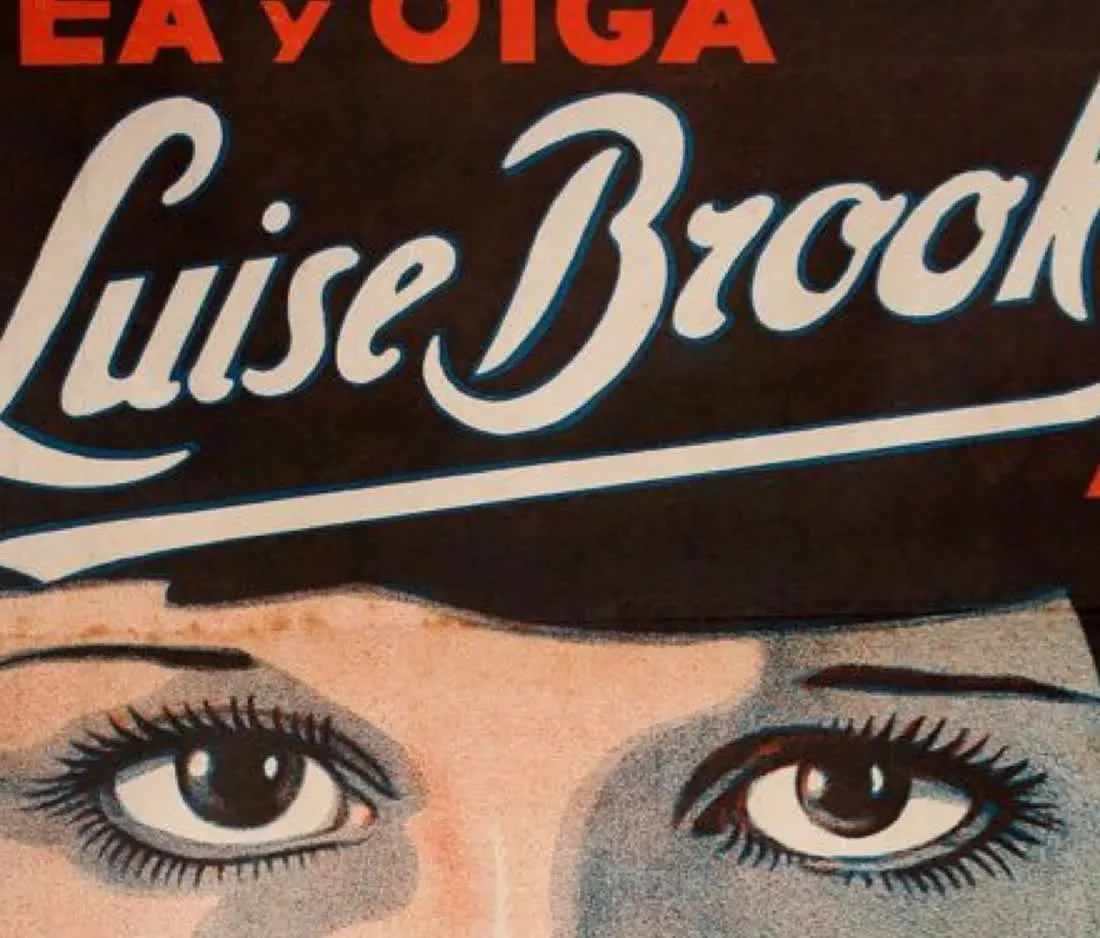 Top section of the original poster, with Louise Brooks’ name and stylized bob preserved in the design.
Why the Ending Still Feels So Cold
The last stretch of Pandora’s Box is one of the reasons the film stays under your skin. After all the theatrical scandal of the earlier acts, the story narrows into poverty, exhaustion, and London fog. Alwa is finished. Lulu is reduced to survival. Jack the Ripper enters not as gothic spectacle but as another man moving through the city’s trade in women.
There is something brutal about how little Pabst softens this. By the end, Lulu is no longer the glittering center of a decadent social whirl. She is exposed, tired, and cornered by a world that has already extracted everything it could from her image. The descent could have been filmed as moral reckoning. Instead it feels like economic and emotional attrition.
That difference matters. If the film wanted simple punishment, it had many chances to deliver it earlier and more loudly. Instead the final act feels like the point where everyone else’s projections fall away and the material conditions close in. The famous modernity of Pandora’s Box is not just sexual openness. It is the sense that bodies circulate through systems of class, money, and appetite that are much larger than any single scandal.
The ending also protects the film from glamor. Brooks is mesmerizing all the way through, but Pabst does not let fascination turn into worship. He keeps asking what that fascination costs. For the characters, for Lulu, for the viewer. By the time the film ends, the spell has not been broken, exactly. It has been exposed.
Why Pandora’s Box Still Feels Current
It is easy to say a silent film is “surprisingly modern” and leave it there. Pandora’s Box deserves a sharper claim. It feels current because it understands how quickly a culture can convert desire into blame. Everyone wants access to Lulu’s energy. Everyone resents the fact that she cannot be frozen into the role that would make that access safe. The cycle is familiar: fascination, possession, panic, punishment.
That is one reason the film pairs so well with our pieces on The Cabinet of Dr. Caligari (1920): Expressionism, Authority, and the Shape of Fear and Sunrise: A Song of Two Humans (1927): Temptation, Motion, and the Last Silent Dream. All three films come out of the silent era, but each finds a different way to turn style into social diagnosis. Caligari twists space. Sunrise turns movement into feeling. Pandora’s Box uses cool surfaces and unstable desire to show a world telling on itself.
I also think the film survives because Brooks never lets Lulu harden into a symbol. Symbols get admired. Lulu stays dangerous. She is too human to tidy up and too elusive to own. That makes the film feel unfinished in the best way. It keeps generating arguments.
Final Thought
What makes Pandora’s Box last is not that it shocked people once. A lot of movies have done that and vanished. It lasts because it keeps refusing the categories that would make it easy to file away. Louise Brooks is too direct to become pure myth, too strange to become ordinary, and too alive to be reduced to a cautionary emblem. Pabst, for his part, refuses to either condemn or rescue her in the ways melodrama usually demands.
What remains is a film about looking, wanting, and blaming, made with a steadiness that still feels almost rude. It does not flatter the audience’s morality. It does not hand out innocence cleanly. It just keeps watching a society reveal its nerves around one woman who will not become legible on command. That is why Pandora’s Box still feels less like a relic than like a wound that never closed properly.
Sources and Further Reading
- Pandora’s Box (1929) - The Criterion Collection
- Opening Pandora’s Box - The Criterion Collection
- G. W. Pabst’s Pandora’s Box - MoMA
- Pandora’s Box (G.W. Pabst, 1929) - Senses of Cinema
- Pandora’s Box - BFI Southbank Programme Notes - BFI
- Pandora’s Box - San Francisco Silent Film Festival
- File:“La Caja de Pandora” poster, 1929.jpg - Wikimedia Commons
Share This Article
Comments