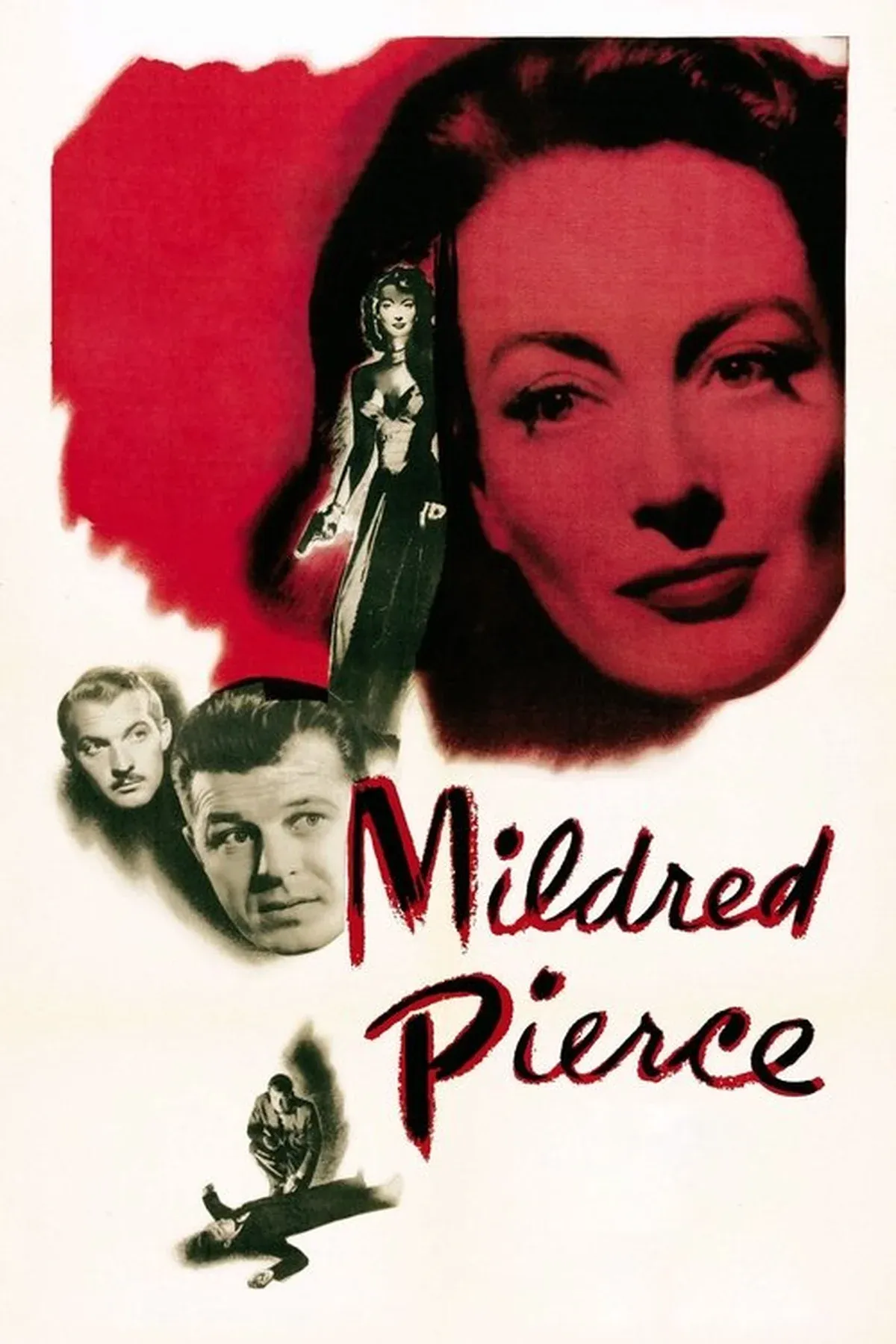
Mildred Pierce (1945): Joan Crawford, Class Hunger, and the Cost of Mother Love
An in-depth analysis of Mildred Pierce, focusing on Joan Crawford's ferocious performance, Michael Curtiz's noir framing, and the film's bruising portrait of female labor, class shame, and maternal obsession.
Editorial Notes
Anna edits BucketMovies criticism and essay packages, with a steady interest in classic Hollywood, literary adaptations, and repertory programming.
Leah Carter
Research Editor
Leah handles source checks, release-date verification, awards coverage, and the reporting framework behind BucketMovies news and industry pieces.
One of the smartest things Mildred Pierce does is pretend, at first, to be a murder picture. The gunshot, the corpse, the police questioning, the hard shadows on Venetian blinds, all of that tells you Warner Bros. knows how to sell a noir. Then the film slides somewhere stranger. It becomes a story about a woman working herself raw, a daughter who treats class as a weapon, and a culture that respects female ambition only when it arrives disguised as sacrifice.
That mix is what makes the movie hard to shake. James M. Cain gave the material its social bite, but Michael Curtiz and his collaborators sharpened it by wrapping it in fatalism and flashback. TCM’s long essay on the production is useful here because it stresses how the adaptation darkened Cain’s material without losing its interest in money, aspiration, and resentment. Criterion’s Imogen Sara Smith goes even closer to the bone when she describes the film as a study of unseen and unrewarded female labor. Put those together and the movie snaps into focus. The murder matters. The work matters more.
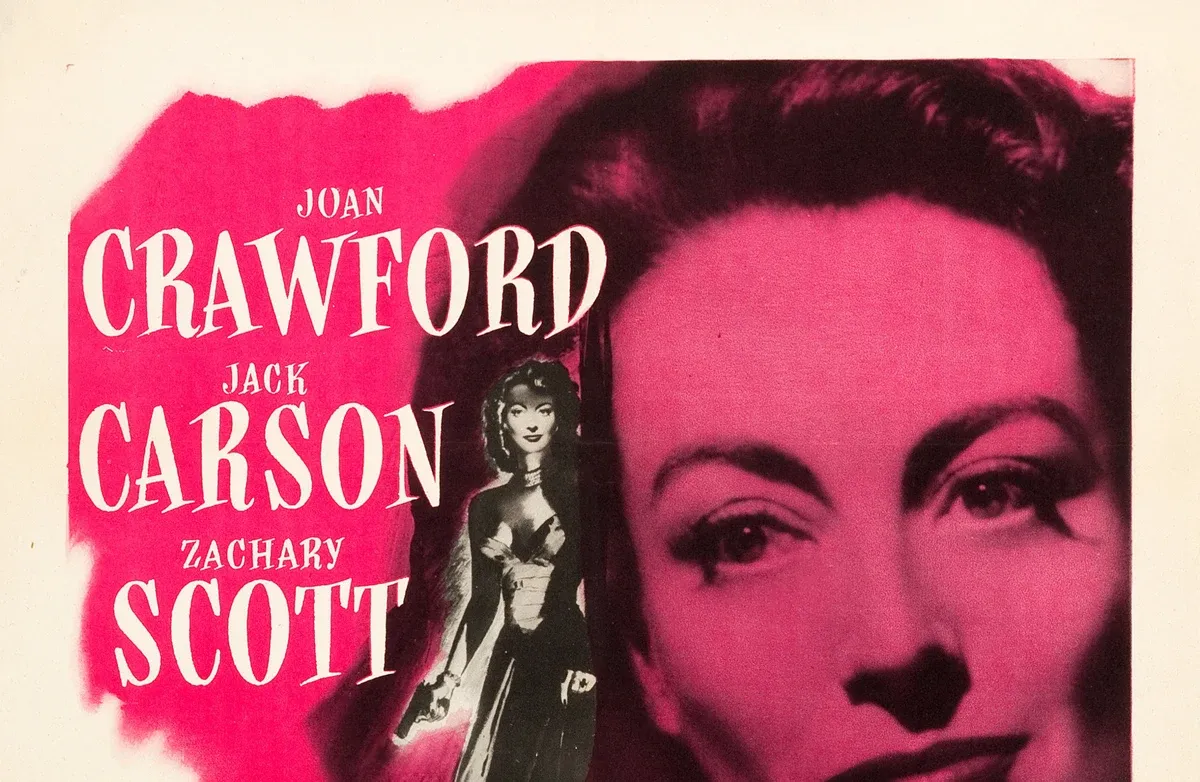 Upper section of the original release poster for Mildred Pierce, preserved via Wikimedia Commons.
The Murder Is a Hook, but Work Is the Real Subject
Mildred does not become memorable because she is trapped in a mystery. She becomes memorable because the movie never lets us forget what it costs her to keep moving. Before she is a restaurant owner, she is a divorced mother counting money, swallowing humiliation, and entering the labor market with no protection except her will. The film notices uniforms, trays, kitchen heat, ledgers, storefronts, and the small acts of self-correction that turn panic into professionalism.
I keep coming back to how practical the movie is. Mildred learns the restaurant business because she has to. She sells pies because they sell. She studies what people want, what neighborhoods can bear, how decor changes the price a customer will tolerate. Her intelligence is commercial before it is symbolic. That matters, because the film is often described as a melodrama about maternal suffering, and it is that, but it is also one of the sharpest Hollywood movies about female labor crossing into entrepreneurship.
Criterion’s essay gets at this beautifully. The film grants real attention to labor usually pushed into the background, the work of serving, cleaning, cooking, smoothing things over, staying attractive, staying calm, staying useful. Mildred’s problem is not that she lacks drive. It is that every form of drive available to her gets rerouted back into care work. Even her business success becomes another way to mother, to provide, to appease, to overcompensate.
The noir frame deepens the trap. A straight social drama might have let Mildred’s rise look clean or triumphant. Curtiz refuses that. The flashback structure tells us from the start that whatever she built came attached to damage. Success is never free in this film. It already carries the shadow of punishment.
Joan Crawford Makes Ambition Feel Physical
This was Crawford’s first film at Warner Bros. after MGM cut her loose, and the comeback story is real enough. The Library of Congress essay on the film notes how strongly Crawford identified with Mildred and how hard she fought for the part. The Academy crowned the performance with Best Actress at the 18th Oscars. Those facts are worth knowing, but they would mean little if the work itself were not so exact.
Crawford makes Mildred’s ambition bodily. You feel it in the way she enters rooms, recalculates a smile, keeps her chin high when someone is looking down on her, then lets exhaustion hit only in fragments. She understands that Mildred is never simply a “strong woman” in the slogan sense. She is anxious, proud, practical, sentimental, calculating, and too easily moved by the people who know how to use her feelings against her.
That contradiction is the performance. Mildred can negotiate leases and charm investors, but she goes soft where Veda is concerned. Crawford does not smooth that out. She lets Mildred look canny in one scene and almost embarrassingly hopeful in the next. The swing is painful because it feels earned. Mildred’s competence in public does not rescue her from delusion at home.
I also think Crawford understands something that gets lost when people talk about the film only as a noir classic. Mildred wants style. She wants nicer rooms, better clothes, polished surfaces, a life with some elegance in it. The movie never mocks her for that. In fact, it shares the desire. It likes the furs, the restaurants, the beach house, the glamorous entrances. The trouble starts when style stops being pleasure and turns into tribute paid to someone else’s contempt.
Veda Knows Exactly What Money Cannot Buy
Ann Blyth’s Veda is one of the nastiest children in studio Hollywood, and the nastiness is specific. She does not hate her mother because Mildred is weak. She hates what Mildred’s labor reveals. Veda cannot stand the smell of striving. Pies, chicken dinners, restaurant grease, the whole upward climb, all of it embarrasses her because it leaves fingerprints. She wants class without the visible process of getting there.
That is why Veda is more frightening than a standard spoiled daughter. She understands social hierarchy with perfect clarity. She knows that a fur coat is useful, that a rich address matters, that polish can erase evidence, but she also knows where the erasure fails. Her mother’s money can buy access. It cannot make the past disappear. Veda’s cruelty grows from that gap, and she punishes Mildred for trying to close it.
Britannica calls the film one of Curtiz’s best, and I think part of the reason is that he never cheapens Veda into mere adolescent spite. She is class resentment in human form. Every scene with her tightens around the same wound. Mildred believes material success will translate into love. Veda knows it will not. She takes the gifts anyway.
There is something especially bleak in the way the film links class aspiration to maternal longing. Mildred builds businesses, not to escape dependence entirely, but to win affection from someone who despises the means by which that comfort was earned. That is a vicious circle, and the film sees it clearly. Every expansion of Mildred’s success becomes fresh proof, in Veda’s eyes, that her mother started from the wrong place.
Noir Turns Maternal Devotion Into a Bad Investment
One of the best decisions in the adaptation is the flashback structure. It pulls the whole story under a cloud of dread. We know, before the details arrive, that something has gone rotten. That knowledge changes how we read every sacrifice Mildred makes. Generosity stops looking innocent. Romantic optimism looks like a financing plan for disaster.
TCM’s “Why You Should Watch” piece points to the film’s strange balance of melodrama and noir, and that balance is the center of it. The melodrama supplies emotional excess, mother love, humiliation, grief, social climbing. The noir current keeps asking what those feelings cost, who profits from them, and how desire curdles once money and status start carrying all the moral weight.
Mildred is often described as obsessive where Veda is concerned, and fair enough, but the movie is more precise than that. It shows obsession becoming policy. Mildred does not simply love too much. She organizes her whole life around satisfying a standard that keeps shifting. One school, then another. One dress, then a better one. One home, then a larger one. One man, then a richer one. The terms never stop changing because the demand underneath them is impossible. Veda wants distance from origins, and Mildred is one of those origins.
That is what makes the film so sour. Love here is not healing. It is leverage. It is bargaining. It is labor performed in the hope of emotional return. The noir frame does not trivialize that. It tells us we are watching people make economic decisions with their feelings and then call the result family.
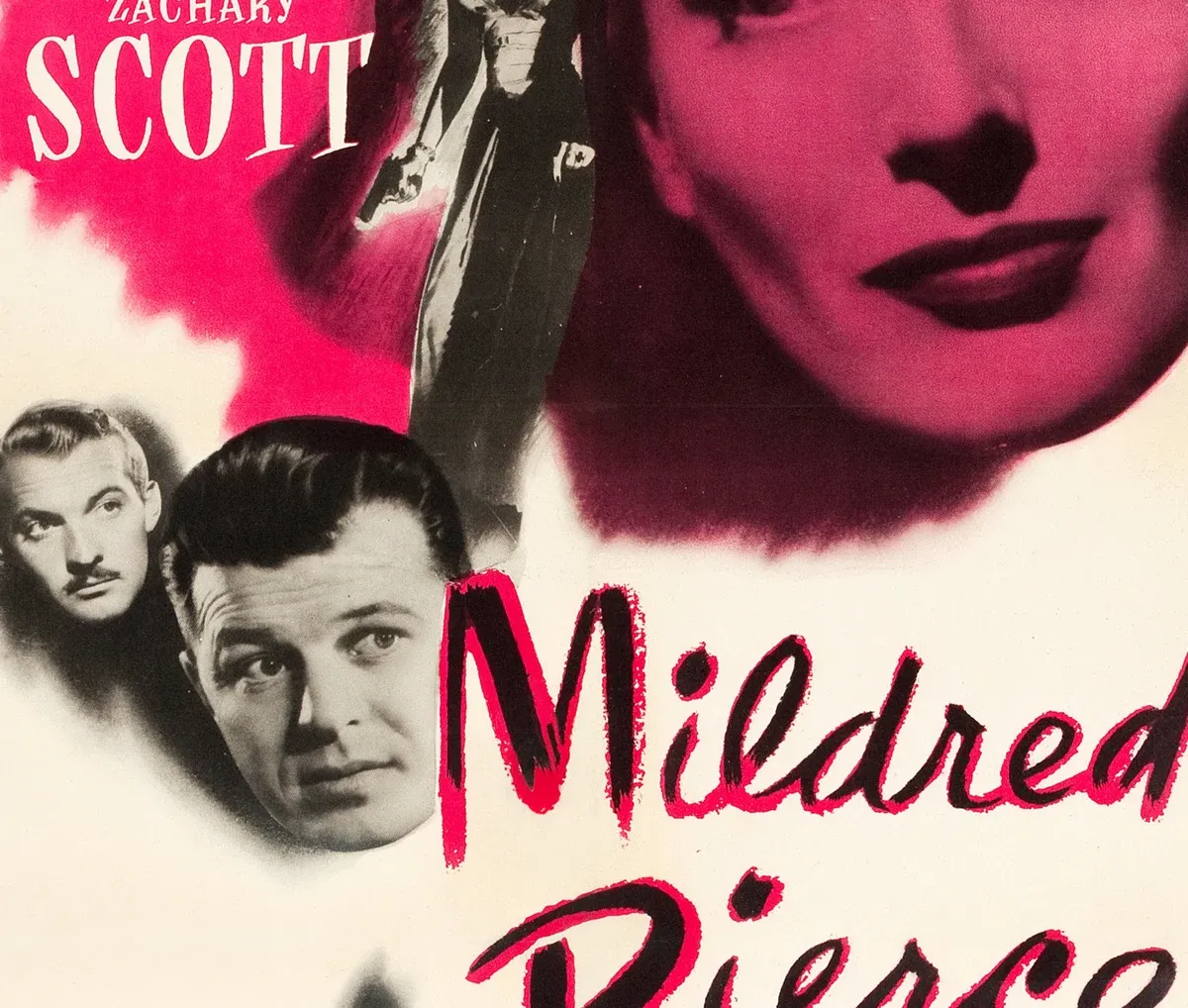 Central detail from the original poster, concentrating the film’s glamour and menace into a single image.
Houses, Clothes, and Chicken Dinners
The material surfaces in Mildred Pierce are never decoration. They are arguments. A restaurant interior says one thing, a beach house says another, a dress says another still. The old studio craftsmanship matters here. TCM’s production essay notes the density of the sets, and Criterion’s restoration piece points to the luminously restored black-and-white textures that make those spaces read with fresh force. The result is a world where class is always visible, even when characters want to pretend it has become natural.
Food is especially important. Cain and the film both understand that cooking can be care, business, seduction, and stigma at the same time. Mildred’s pies are her talent, her entry point, her labor history, and the mark Veda cannot forgive. A restaurant empire should be a success story. In this film, it is also a reminder that the mother built everything with her hands.
That detail does a lot of moral work. Plenty of Hollywood success stories are built on reinvention, but Mildred Pierce refuses clean reinvention. Mildred can refine the product, expand the brand, change her wardrobe, and move into grander rooms. She cannot stop being connected to work that stains, smells, and serves. The film respects that work. Veda does not.
This is one reason the movie feels richer than the usual cautionary tale about ambition. Mildred is not punished for wanting money. She is punished for believing money can solve a wound that money only dramatizes. Every upgrade makes the class tension more visible because it reveals how desperate the purchase was.
Why the Ending Refuses Comfort
The film’s ending gives us revelation, but not relief. The Library of Congress essay describes the closing image of Mildred and Bert leaving the police station as a kind of postwar survival picture, the sun coming up after a night of interrogation and wreckage. I see what the essay means. There is endurance there. There is also damage that cannot be unwound.
I do not read the ending as a simple restoration of the proper family. Bert may be steadier than the men Mildred chases elsewhere, but the movie is too bruised to pretend we are back at the beginning with better values. Too much has been exposed. Mildred has seen what Veda is willing to do. She has also seen what she herself was willing to excuse, fund, and misrecognize.
That lack of comfort is part of why the film lasts. The National Film Registry added it in 1996, and the choice still makes sense. Mildred Pierce survives because it is less interested in moral tidiness than in pressure. It keeps asking what happens when maternal devotion, class anxiety, and commercial hustle all point in slightly different directions. The answer, over and over, is corrosion.
For readers moving through our run of classic films about women, image, and punishment, this makes a strong companion to Leave Her to Heaven (1945): Possession, Color, and the Cruelty of Perfect Love and Sunset Boulevard (1950): Hollywood’s Most Ruthless Mirror. Those films also understand that glamour is rarely innocent. Mildred Pierce adds another hard truth. Sometimes the dream house and the fur coat are not a false ending placed over suffering. They are part of the suffering.
Final Thought
What makes Mildred Pierce endure is its refusal to flatter anyone’s fantasy. It does not flatter domestic virtue. It does not flatter wealth. It does not flatter ambition, romance, or sacrifice. It looks at all of them, then asks who is doing the work, who is ashamed of the work, and who gets to turn that shame into power.
Crawford is the center of that achievement. She gives Mildred glamour, nerves, grit, vanity, and a frightening capacity to keep going. Curtiz gives her a world in which love can be measured in rent, menus, and social embarrassment. The result is a movie that feels harsher every time I revisit it. Under the noir frame, under the comeback legend, under the murder plot, there is a simple ugly idea that the film never lets go of: sometimes the person you build everything for is the one who cannot bear the sight of what it took to build it.
Sources and Further Reading
- Mildred Pierce: A Woman’s Work - The Criterion Collection
- Bringing Mildred Pierce Back to Luminous Life - The Criterion Collection
- Mildred Pierce - Turner Classic Movies
- Why You Should Watch: Mildred Pierce (1945) - Turner Classic Movies
- Mildred Pierce | film by Curtiz [1945] - Encyclopaedia Britannica
- The 18th Academy Awards | 1946 - Academy of Motion Picture Arts and Sciences
- Complete National Film Registry Listing - Library of Congress
- Mildred Pierce - Library of Congress
- File:Mildred Pierce (1945 poster).jpg - Wikimedia Commons
Share This Article
Comments


.jpg)