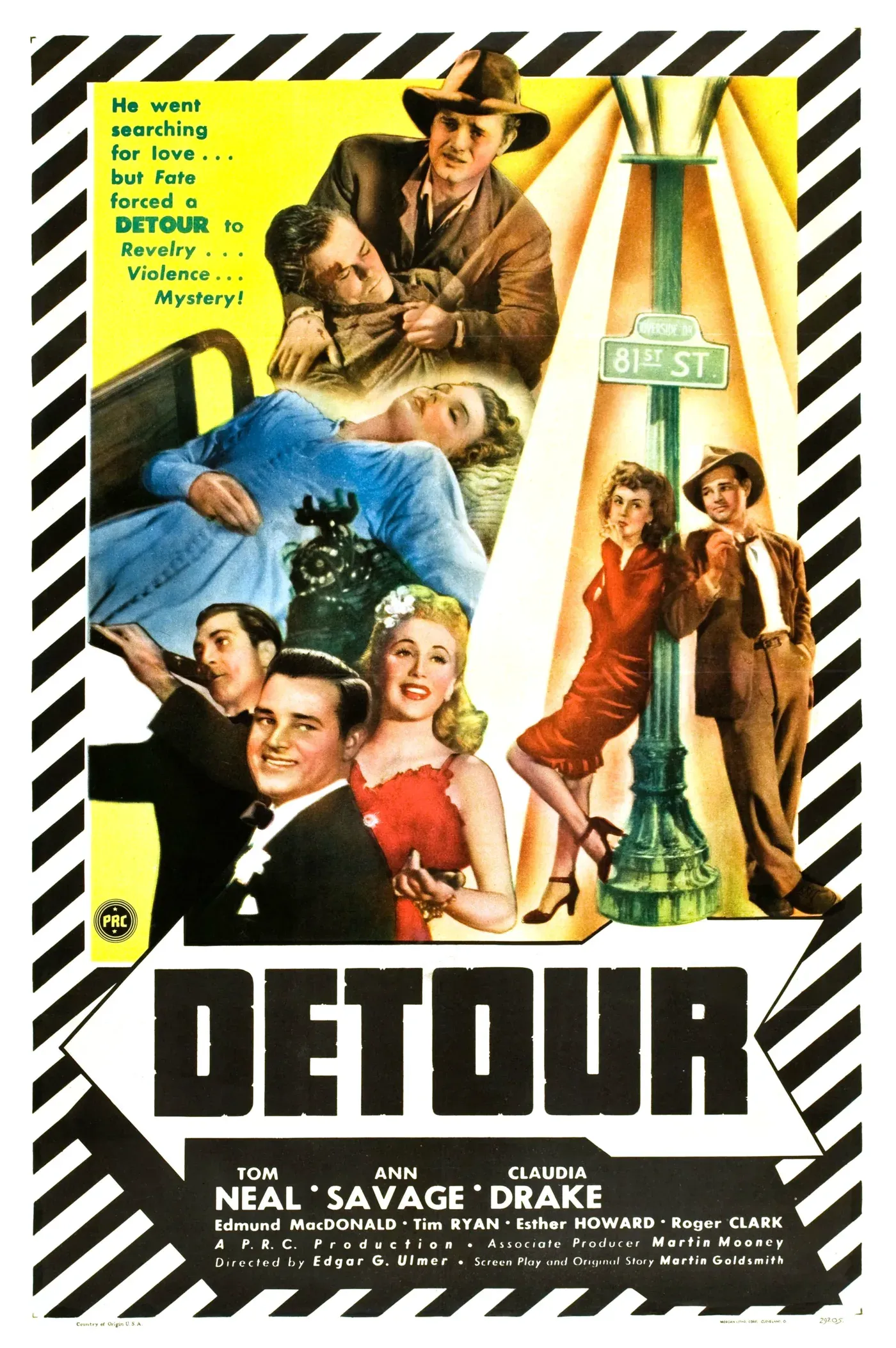
Detour (1945): Poverty Row Noir and the Lies Men Call Fate
An in-depth analysis of Detour, focusing on Edgar G. Ulmer's stripped-down noir style, Al Roberts's unreliable narration, and Ann Savage's ferocious performance as Vera.
Editorial Notes
Anna edits BucketMovies criticism and essay packages, with a steady interest in classic Hollywood, literary adaptations, and repertory programming.
Leah Carter
Research Editor
Leah handles source checks, release-date verification, awards coverage, and the reporting framework behind BucketMovies news and industry pieces.
No great film looks more like it might fall apart than Detour. The sets are thin. The back projection can look shabby. The streets of New York feel like they were assembled from fog, one lamp, and a prayer. Even the hero sounds half convinced that he is feeding us a story he barely believes himself. None of that weakens the picture. It is why the movie still bites.
Edgar G. Ulmer’s 1945 noir was made far from Hollywood prestige. Criterion calls it the mother of all B noirs, and that feels earned. TCM notes that Ulmer shot it in six days with seven actors, one outdoor desert location, and only a handful of cramped sets. On paper, that sounds like a recipe for something disposable. On screen, it becomes a style. Detour does not hide its poverty. It turns that poverty into mood, into moral ugliness, into a world where every bad decision seems to have been made in advance.
That is why the film keeps getting stronger with age. Plenty of noirs offer fatalism. Detour offers self-pity, panic, excuses, and the sick little relief of finding someone else to blame. It gives us a man who keeps saying fate ruined him, then quietly shows us how often he reaches for the worst available choice. It also gives him Vera, played by Ann Savage with such open contempt that the whole film seems to tighten around her voice.
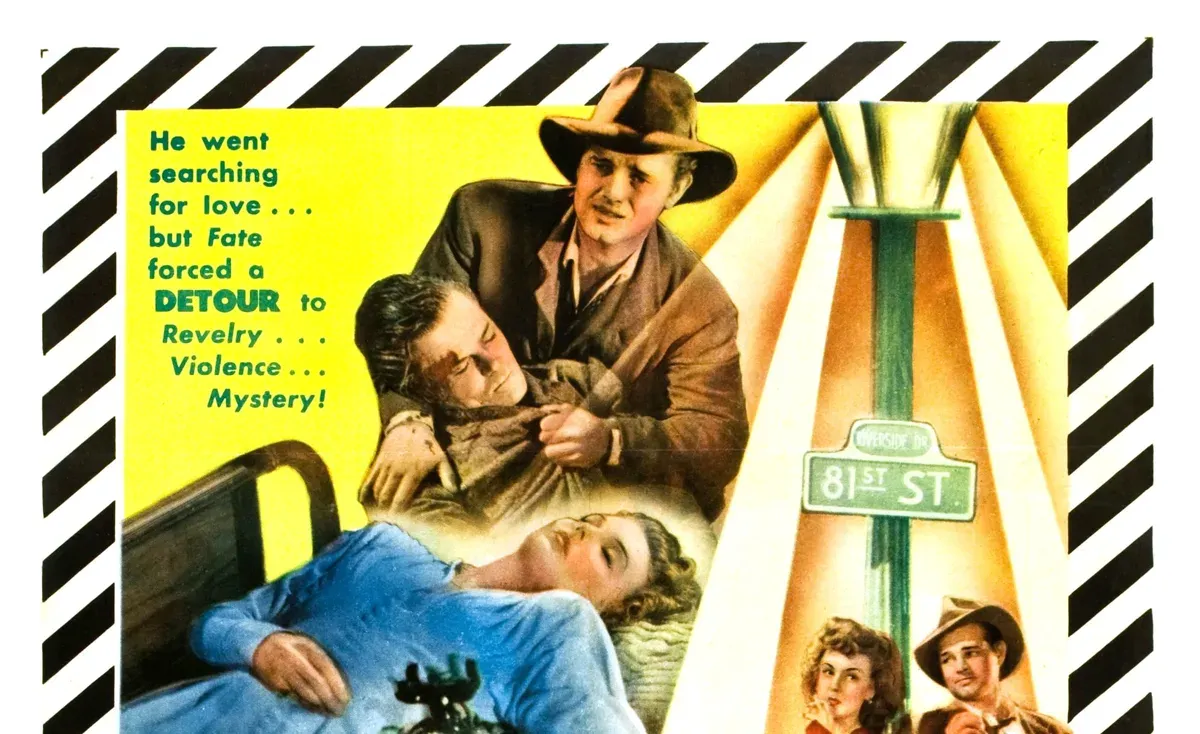 Top section of the original release poster for Detour, preserved via Wikimedia Commons.
Al Roberts and the Story He Tells to Save Himself
The most important thing in Detour is not the plot twist, or the body, or even the road. It is the voice. Tom Neal’s Al Roberts begins talking and almost immediately sounds like a man asking for sympathy before he has earned any. He is stranded in a diner, angry at a song on a jukebox, sunk in his own misery, and ready to explain how the world did this to him.
Robert Polito’s Criterion essay gets to the center of the film when he argues that its great achievement lies in subjective narration. That idea opens everything up. We are not watching a neutral record of events. We are trapped inside Al’s account of events, and his account is soaked in denial. He tells us he is unlucky. He tells us he is cornered. He tells us he had no good options. The movie keeps making that claim feel shakier.
I keep coming back to how quickly Al moves from misfortune to theft. Charles Haskell dies under murky circumstances, and Al’s response is not horror followed by a reasonable appeal for help. He takes the money, the car, the clothes, the identity. He does it with the brisk logic of someone who has already rehearsed the excuse. “They’d never believe me” becomes permission for everything that follows.
That is what makes the film so sour. Many noirs give us compromised men. Detour gives us a man who narrates his own compromise as if it were tragic weather. The famous closing line about fate or some mysterious force putting the finger on you for no reason has been quoted for decades because it sounds like pure noir doom. It is also ridiculous, and I think Ulmer knows it. By the time Al says it, he has spent the whole film confusing bad luck with character.
This does not mean the film becomes a neat morality play. Ulmer is too sly for that. Al is not a mastermind. He is weak, impulsive, frightened, and stupid in ways that feel painfully human. That mix matters. He is never grand enough to become a tragic antihero. He is smaller than that. Smaller, and somehow more revealing.
Poverty Row Was Not a Handicap. It Was the Method
There is a lazy way to praise Detour: to say it is impressive because it rises above its budget. I do not think that is correct. The budget is in the film’s bloodstream. Its cheapness is not an obstacle that Ulmer heroically transcends. It is the pressure that shapes the whole piece.
Criterion’s short feature on the film makes this point well. Ulmer was operating on the edge of the industry, working with almost no time and almost no money, and that marginal position sharpened his instincts. TCM lays out the production facts in blunt terms: six shooting days, minimal sets, one desert location. The result is not realism. It is abstraction by necessity.
The cities in Detour do not feel lived in. They feel imagined by a desperate mind. New York is a fog bank with a sidewalk. Los Angeles is reduced to car lots, cheap apartments, and one humiliating telephone connection after another. The highways are not a space of freedom in the American sense. They are blank corridors between mistakes.
That bareness gives the film a dream texture that richer noirs often lack. A studio picture with more money might have filled the frame with detail and reassured us that the world was solid. Detour does the opposite. It makes everything look provisional. Rooms feel borrowed. Streets look temporary. The world seems as if it could vanish the minute Al stops talking.
Senses of Cinema’s writing on Ulmer helps here because it places him in the shadow of European expressionism without turning him into a museum piece. You can feel that inheritance in Detour, but it arrives in ragged form. This is not The Cabinet of Dr. Caligari with polished design and stylized sets. It is expressionism after the money has run out. Shadows, fog, cramped frames, a face half lost in grime. Nothing elegant about it. Nothing wasted either.
That stripped-down method is why the film still feels modern. So much contemporary noir is overdesigned. Detour has no room for polish. It reaches a harsher place by working with less.
Ann Savage Turns Vera Into Judgment
Then Vera enters, and the film gets meaner.
A lot of classic noirs have dangerous women. Few have anyone as openly vicious as Ann Savage here. Criterion’s edition calls her the most vicious femme fatale in cinema history, and while those kinds of claims can be cheap, I understand the temptation. Savage does not flirt her way into control. She snarls her way there. She talks to Al as if she can smell cowardice on him, which, to be fair, she can.
What I love about the performance is that Vera is not polished enough to be glamorous in the usual noir sense. She is sweaty, irritated, suspicious, always one breath away from insult. There is no velvet surface to peel back. She arrives as damage already done. The film does not ask us to discover that she is trouble. It drops trouble into the passenger seat.
But Vera also raises a harder question: how much of her do we trust? We only know her through Al’s story. Polito’s essay points out that Detour includes scenes Al could not possibly know in the form we see them. That matters for Vera more than anyone. Is she this ferocious at every second, or is this how Al needs to remember her so he can cast himself as the put-upon victim of a monstrous woman?
I do not think the film gives a clean answer, and it is better for that. Vera is cruel enough in plain terms. She blackmails him, humiliates him, corners him. Yet she also has the clarity Al lacks. She sees the scam at once. She understands that he is driving another man’s car and wearing another man’s life. She knows panic when she sees it, and she moves to exploit it.
That makes her more than a femme fatale. She is the one person in the movie who refuses Al’s self-description. Sue Harvey, the singer he follows west, exists in his memory as a lost ideal, a fragile figure waiting somewhere on the other end of a phone line. Vera will not grant him that dream. She talks back. She names the rot. She turns his road movie into a filthy little chamber piece.
Savage’s line readings do half the work. They are clipped, nasal, abrasive, impatient. No seduction, no mystery, no tragic softness. She sounds like someone who has been cheated enough times to hear every lie in advance. That voice is one of the reasons Detour never slips into romantic doom. Vera keeps puncturing the fantasy.
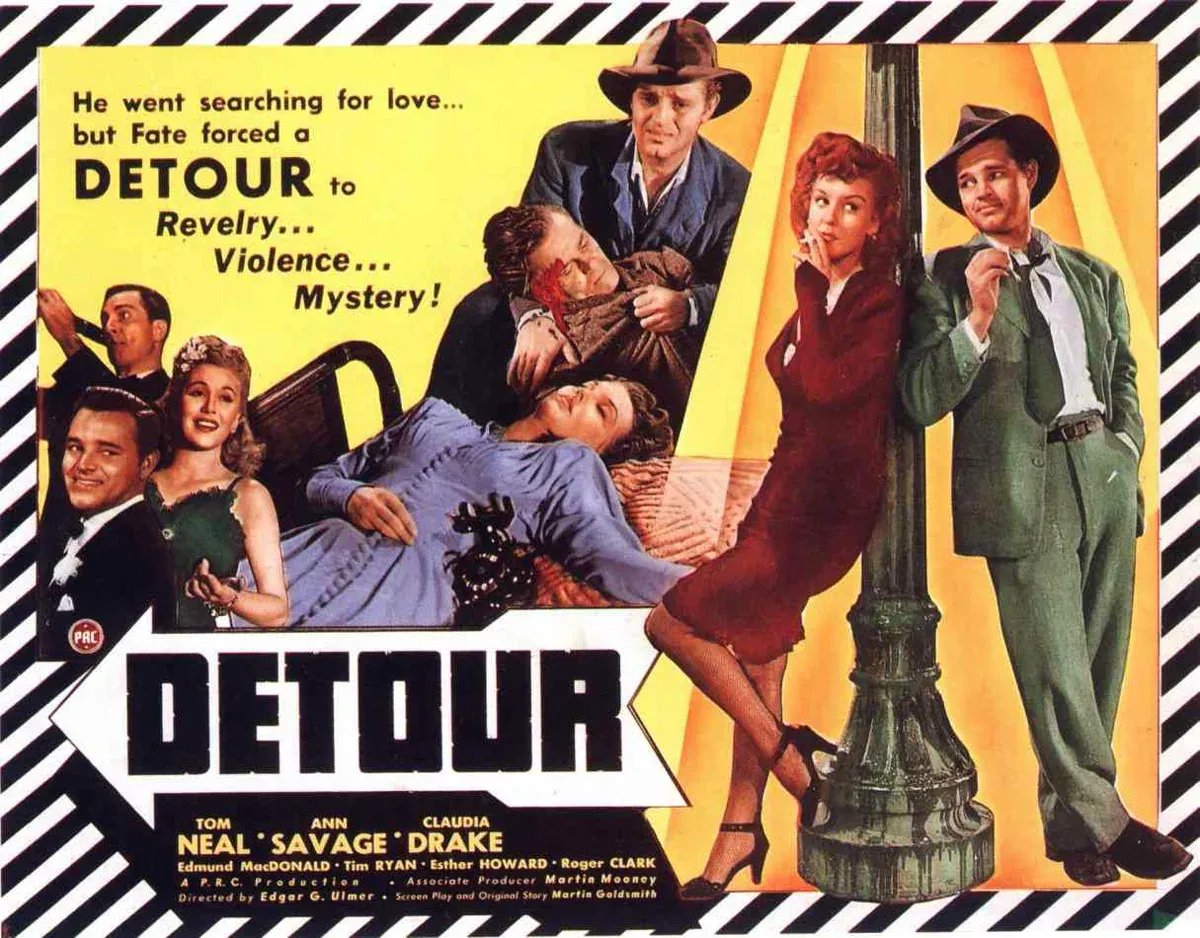 Alternate period poster artwork for Detour, used here as a second original illustration.
The Road Leads Nowhere
American movies love the road because the road can stand for reinvention. Leave your old life, head west, become someone else. Detour treats that myth with open disgust.
Al hitchhikes from New York to California because Sue has gone west to look for work. That setup sounds almost innocent at first, like a Depression or wartime variation on the national promise of mobility. But nothing in the film suggests movement will improve him. Every mile makes him seedier. Every ride puts him deeper inside another lie.
That is why the title lands so hard. A detour is supposed to be temporary. A wrong turn. A delay before the real route resumes. In Ulmer’s film, the detour is the route. There is no straight path hiding beneath it. The wrong turn reveals the truth.
The American landscape itself is flattened into doom. There is desert, yes, but not the kind that gives westerns their harsh freedom. There are highways, but they do not open the world. They reduce it. People do not meet on the road in any liberating sense. They collide. They trap each other in cars, hotel rooms, and phone booths. The journey shrinks into a sequence of bad enclosures.
This is one reason Detour pairs so well with The Third Man (1949): Why Vienna Haunts Every Frame and Leave Her to Heaven (1945): Possession, Color, and the Cruelty of Perfect Love. All three films understand that noir is a matter of pressure, not shadow alone. In The Third Man, the city presses in through history and rubble. In Leave Her to Heaven, it comes through beauty, marriage, and possession. In Detour, it comes through reduction. Fewer sets, fewer people, fewer exits. By the end, it feels like the whole country has narrowed into a trap built for one mediocre man.
Why Detour Still Feels Alive in 2026
The Library of Congress placed Detour in the National Film Registry in 1992, and it has kept growing in stature since then. That rise makes sense. The film has two things that age well: a ruthless sense of proportion and no patience for false nobility.
Its proportion comes from economy. At sixty-nine minutes, the movie does not waste a breath. There is no atmospheric padding, even though atmosphere is one of its great strengths. The film moves with the speed of bad rationalization. One excuse opens onto another. One panic breeds the next. Before long, Al has narrated himself into a corner.
Its refusal of nobility is even better. Plenty of noirs let male defeat look romantic. Detour makes defeat grubby. Al is not a doomed poet or a knight errant ruined by passion. He is a nightclub pianist with a grievance and a gift for self-pity. That is harsher, and closer to the bone.
I think that is why the film still reaches people who have seen every canonical noir. It does not offer the usual pleasures in their polished form. There is no star charisma to lean on, no grand production design, no lacquered cynicism. There is just this sickly, fast, cheap story that keeps revealing new layers of bad faith. The restoration history noted by Criterion matters because it lets us see the film properly again, but the film’s force was already there. Better image quality does not create the poison. It only clarifies it.
Final Thought
What stays with me after Detour is not the body on the road or even Vera’s venom. It is the tone of Al’s voice, that injured, pleading, resentful tone of a man who wants fate to absorb the blame that belongs to him.
Ulmer understood that noir could be made out of almost nothing if the moral atmosphere was foul enough. He built a world from fog, cheap rooms, one stolen car, and a man allergic to honesty. Then he put Ann Savage in the middle of it like a blade. The result still feels nasty in the right way. Detour does not ask whether the universe is fair. It asks why people are so eager to call their own choices destiny.
Sources and Further Reading
- Detour (1945) - The Criterion Collection
- Some Detours to Detour - The Criterion Collection
- A Recipe for Quick and Dirty Noir - The Criterion Collection
- Detour (1945) - Detour - Turner Classic Movies
- Detour (1945) - BFI
- Detour - Encyclopaedia Britannica
- Detour: National Film Registry #4 - Library of Congress
- Detour - Library of Congress
- Ulmer, Edgar G. - Senses of Cinema
- File:Detour (poster).jpg - Wikimedia Commons
- File:DetourPoster1.jpg - Wikimedia Commons
Share This Article
Comments
.jpg)
