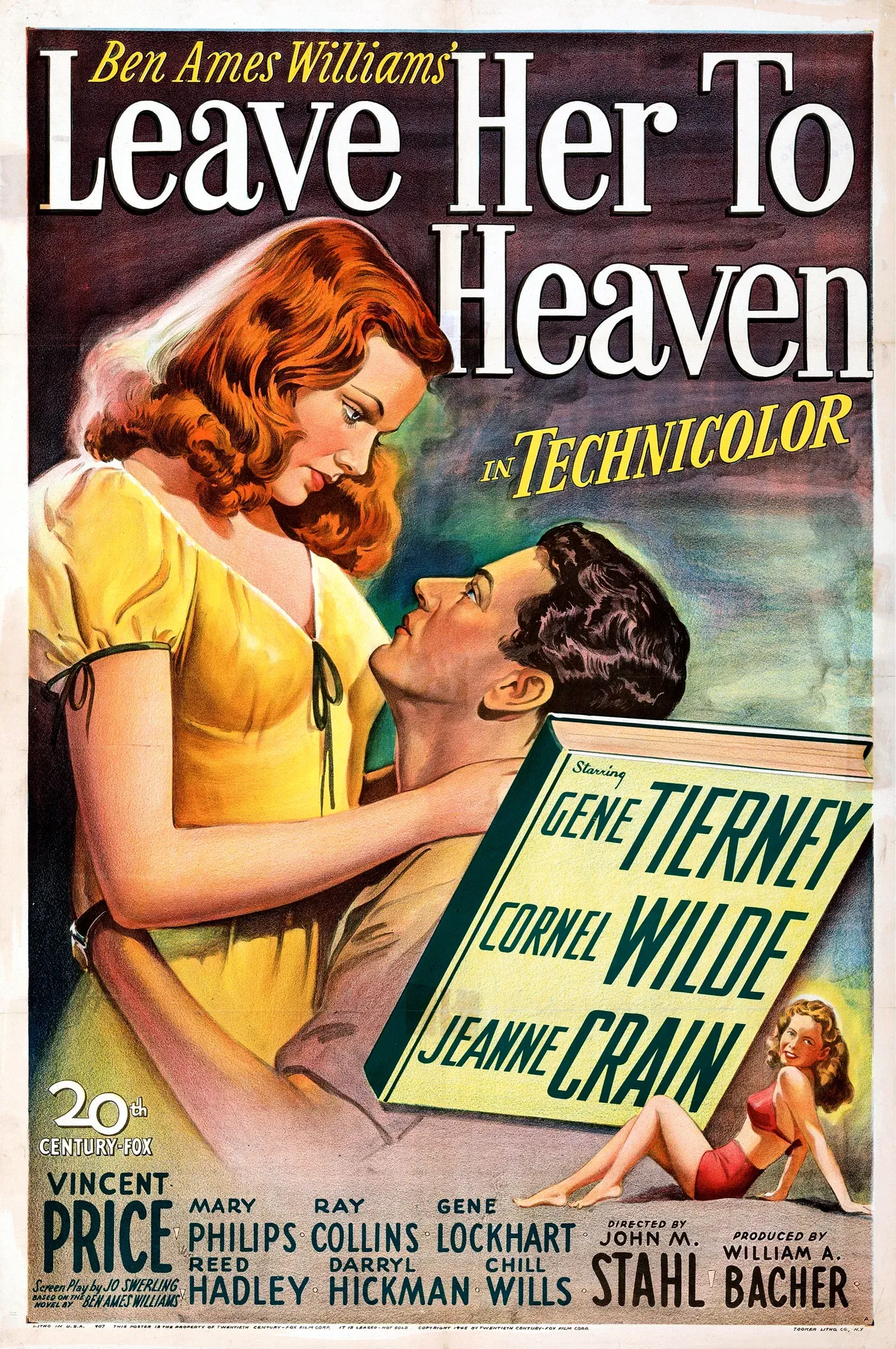
Leave Her to Heaven (1945): Possession, Color, and the Cruelty of Perfect Love
An in-depth analysis of Leave Her to Heaven, focusing on Gene Tierney's unnerving performance, Technicolor noir, and the film's sharp portrait of jealousy, family pressure, and postwar femininity.
Editorial Notes
Anna edits BucketMovies criticism and essay packages, with a steady interest in classic Hollywood, literary adaptations, and repertory programming.
Leah Carter
Research Editor
Leah handles source checks, release-date verification, awards coverage, and the reporting framework behind BucketMovies news and industry pieces.
Some noirs hide cruelty in alleyways and venetian blinds. Leave Her to Heaven does the opposite. John M. Stahl puts it in clean air, on lakes, in expensive rooms, under skies so blue they almost feel rude. That choice is not a gimmick. It is the point. The film takes jealousy, vanity, grief, and possession, then lights them so clearly that nothing can pretend to be mysterious.
That is why the picture still feels so strange. People often call it the first great Technicolor noir, and I understand the urge, but the label only gets you halfway there. Leave Her to Heaven is also a melodrama, a woman’s picture, a psychological horror story, and a study in how family life can start to feel like an invasion. Its elegance is real. So is its malice.
Criterion’s Megan Abbott writes beautifully about the battle of gazes in the opening train sequence, and that is where the movie locks in. Ellen Berent does not drift into Richard Harland’s life like a fantasy woman waiting to be discovered. She looks first. She chooses. The stare comes before the romance, and in some ways it is the real romance. Gene Tierney makes that opening unnerving because she does not play Ellen as fluttery or impulsive. She plays her as composed, exact, and slightly too sure of what she wants.
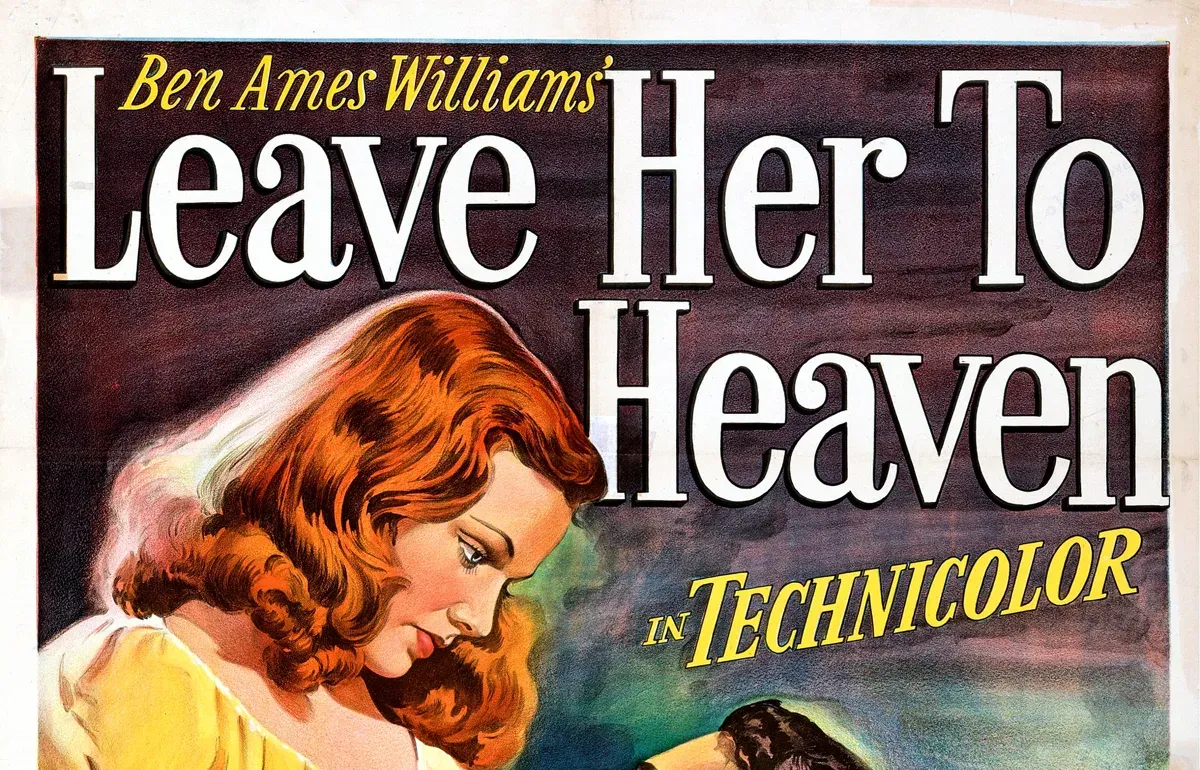 Upper section of the original release poster for Leave Her to Heaven, preserved via Wikimedia Commons.
Bright Color, Bad Intentions
The Library of Congress describes the film as a rare exception inside noir because it rejects the usual black-and-white claustrophobia and goes out into vivid Technicolor landscapes. That feels exactly right. Leon Shamroy’s cinematography, which won the Oscar for color cinematography, does not soften the material. It makes it crueler. Every mountain, lake, pine cabin, and polished room seems to promise health and good taste. Then Ellen poisons the promise from within.
I love how little Stahl does to reassure us. He never says, in effect, “look, darkness hiding under beauty.” He lets beauty stay beauty. The reds are lush. The skies really are gorgeous. Gene Tierney really does look impossibly poised. The tension comes from the gap between surface and behavior. TCM is especially good on this point in its Blu-ray essay, noting how color works as counterpoint rather than decoration. The film is pretty, yes, but it is not innocent for a second.
That matters because Leave Her to Heaven understands something many noirs do not have room for: evil can be domestic, tasteful, and carefully groomed. It can wear the right clothes. It can arrange flowers. It can smile at dinner. The film’s nastiness grows out of that exact mismatch. Ellen never needs to slink through shadow like a classic underworld figure. She can be perfectly visible. Visibility is part of her power.
BFI, writing about Technicolor melodrama, points out how Stahl blurs the border between melodrama and noir. You feel that blur in almost every scene. The emotions are large, even feverish, but the movie refuses the release that melodrama sometimes offers. It keeps tightening. Even the outdoor sequences feel airless. A lake, a mountain path, a horse ride, a family home: all of them turn into little arenas of control.
Gene Tierney’s Stillness Is the Scariest Thing in the Film
Tierney’s performance is the reason the movie keeps its balance. If Ellen were played as a cackling monster, the film would collapse into camp. If she were played as pure victim, it would lose its bite. Tierney does something much harder. She makes Ellen’s emotional violence look self-evident to Ellen herself. Ellen is not hatching elaborate schemes in the style of a master criminal. She is removing obstacles from the life she believes should belong to her.
That difference is everything.
Abbott argues that Ellen is one of the most sympathetic and dangerous femmes fatales in American movies, and the contradiction makes sense once you watch Tierney closely. She is terrifying, but the film also lets us see how badly she fits the role of dutiful wife, cheerful hostess, forgiving sister, future mother. She tries some of those costumes on, briefly. None of them hold. Criterion’s essay makes a sharp point about Ellen as a figure of agency in a postwar world demanding female compliance, and you can feel that pressure all through the movie.
I do not mean that the film excuses her. It does not. Ellen commits acts so cold that the word “jealous” almost sounds too mild. But the movie is interested in the shape of her desire before it is interested in diagnosis. She wants exclusivity. She wants a closed circuit. Richard, and only Richard. No brother, no sister, no child, no social duties, no claims from the living world. That wish is childish, erotic, narcissistic, and impossible. The film lets all those meanings sit together.
Tierney’s face is central to that effect. She can look luminous and exhausted at once. Her composure never feels like calm; it feels like pressure held in place by force. When Ellen becomes angry, Stahl does not ask Tierney to explode very often. He asks her to harden. That hardening is worse. It gives the impression that Ellen has already made up her mind before anyone else in the room realizes there is a decision to be made.
Family Is the Real Threat
Most thrillers would treat Ellen as the danger entering a healthy household. Leave Her to Heaven is more complicated than that. From the beginning, the family structure around her feels like a series of demands disguised as love. Richard brings obligations. Danny brings pity and attention. Ruth brings comparison. Marriage brings performance. Motherhood brings surrender. None of this makes Ellen right, but it does make the movie sharper than a simple “mad woman” cautionary tale.
That is one reason the film still feels modern. It knows that intimacy can become a competition over access, time, and care. Ellen cannot bear divided feeling. She experiences other people’s needs as theft. When Richard’s disabled younger brother Danny comes into the marriage, Ellen does not read him as a child who needs help. She reads him as a rival. It is an awful reaction, and the film does not soften it, but it is also brutally clear about where the reaction comes from. In Ellen’s mind, love is a scarce resource that must be monopolized or lost.
The movie’s men are not exactly innocents here, either. Richard is handsome, decent enough, and profoundly slow to grasp what he has married. Cornel Wilde plays him with a softness that borders on passivity. He likes Ellen’s intensity when it flatters him. He likes being chosen. He likes the fantasy that he has stumbled into an ideal devotion. What he does not understand is that he has entered a system built around endless proof. Ellen will always need another demonstration. There is no amount of reassurance that can settle her.
I think that is why the movie remains more disturbing than the average story about obsession. The point is bigger than one destructive woman. It is about the idea of perfect emotional possession, and how vicious that idea becomes once it enters the ordinary rooms of marriage and family.
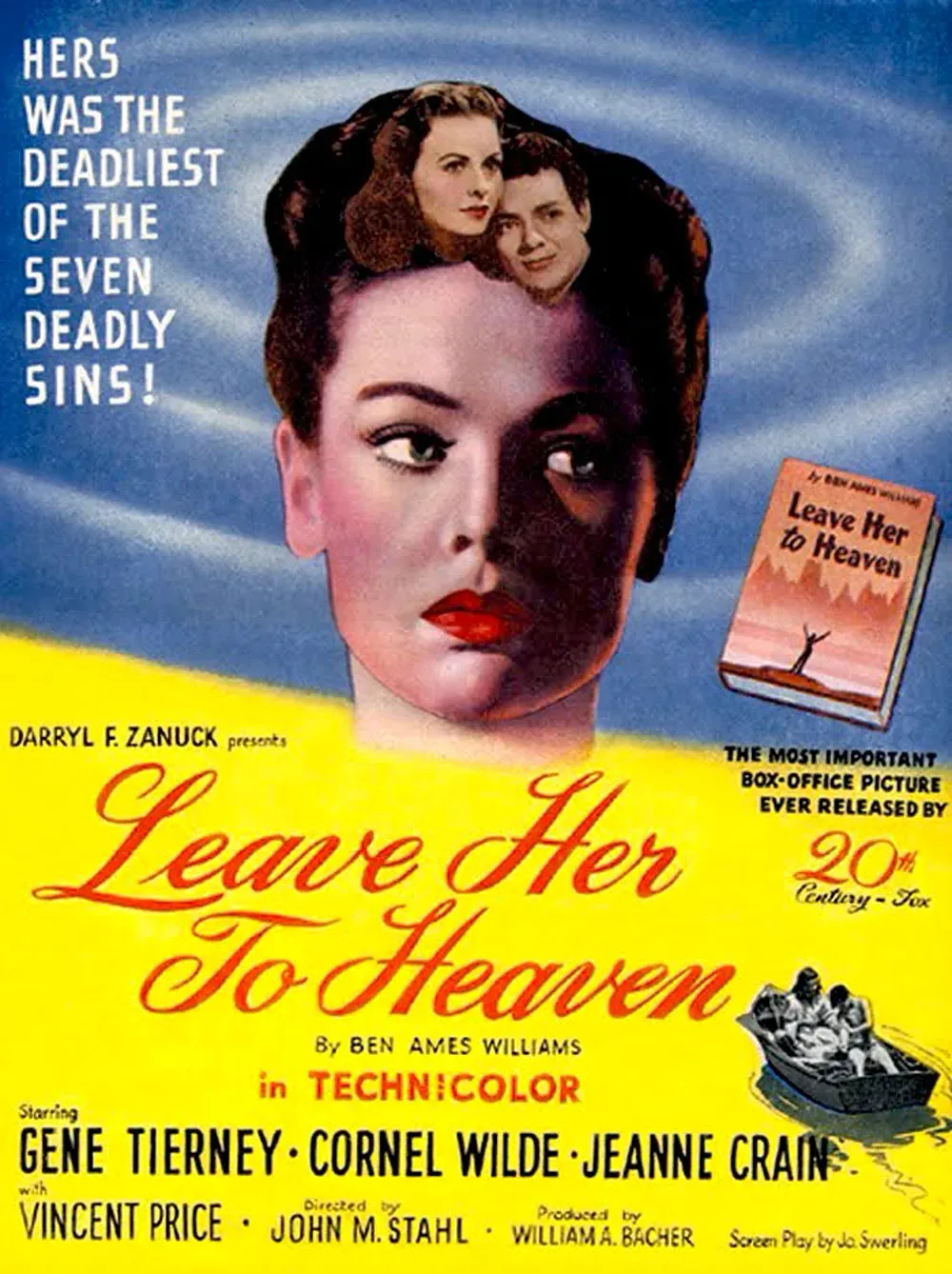 Original one-sheet poster artwork for Leave Her to Heaven, used here as a second period illustration.
The Lake Scene Works Because the Film Refuses to Look Away
Everyone remembers the lake scene, and they should. It is one of the bleakest sequences in studio-era Hollywood, partly because Stahl stages it without hysteria. Ellen watches. Danny struggles. The water stays beautiful. The day stays bright. Nothing in the image asks for permission to be this cruel.
I keep coming back to how long the moment lasts. A lesser film would rush it or underline it with frantic cutting. Stahl lets the duration do the damage. We are forced into the time of the act itself, into waiting, into the awful fact that intervention is possible and will not come. TCM’s writing on the production notes how carefully the scene was prepared, and you can feel that precision. The terror is choreographed down to stillness.
That stillness is what makes the scene different from many noir murders. It has none of the usual frenzy. No alley, no gunshot, no sudden lunge. Instead we get observation. Choice. Delay. Ellen’s crime lies in the refusal as much as the act itself. She lets time do her work for her.
Because the film is so visually open, the scene also strips away easy moral distance. There is nowhere to hide in it, including for the audience. If a darker film lets us imagine that evil belongs to shadowy corners, Leave Her to Heaven replies with a nasty correction: maybe the worst thing is the thing done in plain view, under perfect weather, by someone who still looks immaculate.
Noir, Melodrama, and the War Over Femininity
Calling the film noir is useful, but not enough. Calling it melodrama is useful, but not enough either. The film’s power comes from the way it jams those modes together until each makes the other meaner. The melodrama gives the emotions their swollen pitch. The noir current turns those emotions into menace. The result is a movie that feels feverish even when everyone is speaking politely.
That collision also shapes the film’s politics of gender. Abbott’s Criterion essay is especially valuable here because it refuses to reduce Ellen to a diagnosis and instead places her inside the postwar demand that women return to domestic submission. Ellen tries to inhabit that role, at least cosmetically, and fails in spectacular fashion. She wants the privileges of marriage without accepting its dispersal of attention. She wants desire to remain as total after the wedding as it was before. Hollywood in 1945 could imagine that desire, but only as pathology.
And yet the movie keeps leaking sympathy toward her. Not approval. Sympathy. The difference matters. Stahl sees that Ellen’s monstrosity is inseparable from a social order that has no real place for a woman who acts first, chooses openly, competes aggressively, and refuses to become maternal on command. Britannica notes that the film was once debated as a true noir because of its Technicolor beauty and outdoor scale. I would put it differently. Those very qualities are what let it diagnose the era’s fantasy of healthy normal life so mercilessly.
Even the flashback structure matters. The story is largely narrated through male institutions: lawyer, court, judgment, orderly explanation. But Ellen keeps resisting full explanation. She is more legible than Richard thinks and less legible than the culture wants her to be. That gap is where the film lives.
Why Leave Her to Heaven Still Feels Mean in 2026
Some classics age into respectability. This one does not. It still has a mean streak. The film knows exactly how to lure you with polish before showing you the rot underneath, and it never apologizes for enjoying the trap.
It also remains one of the clearest examples of how color can intensify psychological unease rather than relieve it. We are used to reading noir through black-and-white geometry, venetian blinds, cigarette smoke. Leave Her to Heaven finds another route. Sunlight, expensive clothes, scenic America, a face that looks sculpted for magazine covers. Then it turns all of that into pressure.
For readers moving through our run of classic cinema about desire and control, this makes a sharp companion to Pandora’s Box (1929): Louise Brooks and the Scandal of Modern Desire and Sunset Boulevard (1950): Hollywood’s Most Ruthless Mirror. Those films also understand that male fantasy and female image can be fatal combinations. But Leave Her to Heaven is its own kind of poison. It is cleaner, brighter, more socially respectable, and therefore harder to shake.
The Library of Congress added it to the National Film Registry in 2023, which feels overdue rather than generous. The film has been sitting in plain sight for decades, quietly proving that American studio cinema could be vicious without losing elegance and psychologically jagged without sacrificing audience pleasure.
Final Thought
Leave Her to Heaven lingers because it builds an entire visual world around the fantasy that love can be purified down to two people and then shows how ugly that fantasy becomes the minute other lives intrude.
Stahl directs the film with unnerving confidence. Shamroy photographs it as if beauty itself were a trap. Tierney, meanwhile, gives one of those performances that do not grow smaller with time. She stays strange. She stays hard to settle. That is the right kind of immortality for a movie like this. Leave Her to Heaven does not ask to be loved. It asks to be watched closely, and it rewards that attention with something nastier than comfort: recognition.
Sources and Further Reading
- Leave Her to Heaven (1945) - The Criterion Collection
- Leave Her to Heaven: The Eyes of Ellen Berent - The Criterion Collection
- 10 Things I Learned: Leave Her to Heaven - The Criterion Collection
- Leave Her to Heaven - Encyclopaedia Britannica
- Leave Her to Heaven on Blu-ray - Turner Classic Movies
- Critics’ Corner: Leave Her to Heaven (1945) - Turner Classic Movies
- Brief Descriptions and Expanded Essays of National Film Registry Titles - Library of Congress
- 10 Great Technicolor Melodramas - BFI
- File:Leave Her to Heaven (1945 poster).jpg - Wikimedia Commons
- File:Leave Her to Heaven (1945) one-sheet.jpg - Wikimedia Commons
Share This Article
Comments
.jpg)
_one-sheet.jpg)