The Crowd (1928): King Vidor and the Terror of Becoming Ordinary
An in-depth analysis of The Crowd, focusing on King Vidor's city imagery, James Murray's everyman performance, the pressure modern life puts on marriage, and the film's uneasy vision of the American dream.
Editorial Notes
Anna edits BucketMovies criticism and essay packages, with a steady interest in classic Hollywood, literary adaptations, and repertory programming.
Leah Carter
Research Editor
Leah handles source checks, release-date verification, awards coverage, and the reporting framework behind BucketMovies news and industry pieces.
Some silent films still feel grand, but distant. The Crowd feels uncomfortably near. Nearly a century later, King Vidor’s 1928 film still lands with a force that has not gone stale, maybe because it goes after a fear that never leaves modern life for long: the fear that you were promised importance and will end up as one more interchangeable body in a line.
That idea sounds bleak when you reduce it to a sentence. On screen, though, The Crowd is not just bleak. It is restless, intimate, funny in places, and much more tender toward its characters than its reputation sometimes suggests. John Sims is not a great man brought low. He is an ordinary office worker who has been raised on the fantasy that ordinary life is for someone else. He moves to New York, falls in love, marries, has children, fights over money, loses work, loses dignity, loses far more than dignity, and slowly learns that the world will not reorganize itself around his idea of who he was meant to be.
That story still stings because Vidor refuses two easy exits. He does not turn John into a heroic rebel against the system, and he does not reduce him to a fool who deserves what he gets. He shows how modern city life can flatten a person without ever fully erasing the hope that keeps that person moving. That is what makes the film feel so alive in 2026. It is not just about urban anonymity. It is about the emotional damage done by the promise of exceptionalism.
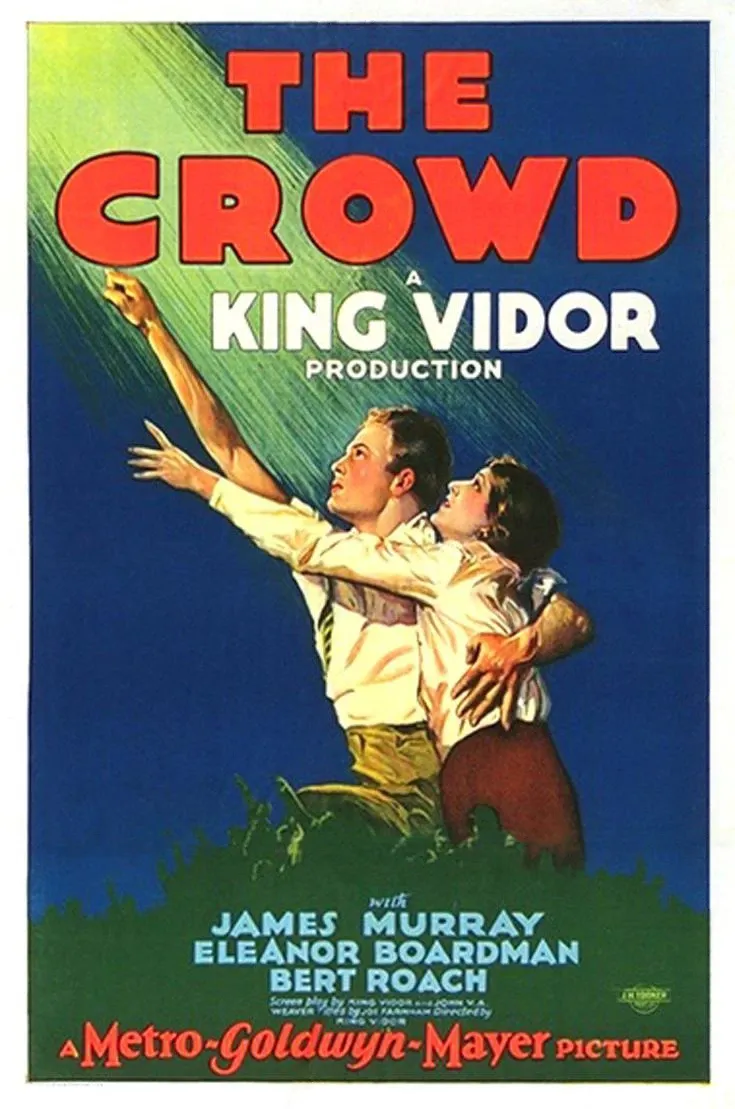
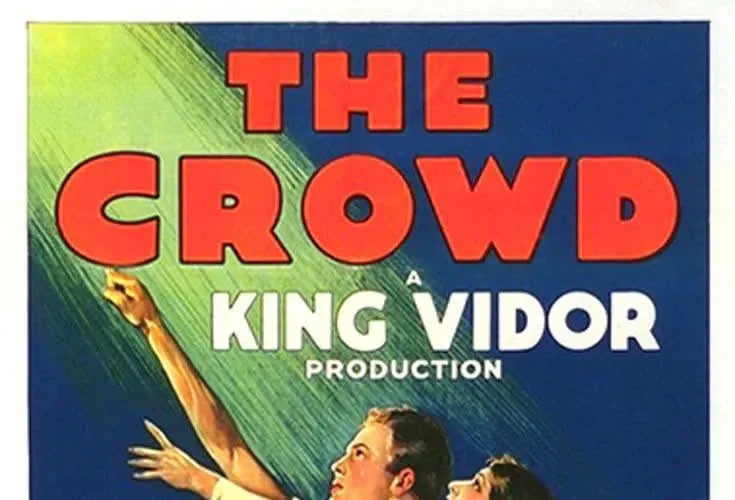 Top section of the original release poster for The Crowd, preserved via Wikimedia Commons.
A Movie About the Lie of Special Destiny
The Crowd begins with one of the cruelest set-ups in American silent cinema. John is born on the Fourth of July, and his father confidently announces that the world is going to hear from him. Vidor is not mocking parental hope. He is showing how early the fantasy starts. John is not merely taught to work hard. He is taught to expect singularity, to believe that a giant city is somehow waiting for his arrival.
That expectation is what makes the rest of the film so painful. Britannica describes the picture as a study of a young couple struggling amid the callousness of big-city life, and that is true. But the callousness is not only outside the apartment door. It is already inside John’s head. He cannot bear to be one of many, and that private humiliation poisons almost every setback that follows.
This is what makes James Murray so crucial. Vidor needed someone who did not already look like a star, and both AFI and the San Francisco Silent Film Festival note how deliberately he searched for an unknown actor with an everyman quality. Murray gives the film exactly that. He is not glamorous enough to float above the material, and he is not stylized enough to turn John’s disappointments into a set of noble poses. He is eager, vain, loving, foolish, proud, and thin-skinned in a way that feels terribly recognizable.
There is something sad about how small John’s victories are and how large they feel to him. A date at Coney Island, a little apartment, a new baby, a slogan contest, a bouquet, a pair of theater tickets. These are modest things, yet the film treats them seriously because ordinary lives are built out of modest things. Vidor’s boldest move was not just making a movie about an office clerk. It was insisting that such a life could hold the full weight of tragedy and aspiration.
Vidor Turns the City Into a Machine
The most famous images in The Crowd are still astonishing. The camera moves through the canyon of Manhattan buildings and into that endless office grid where John becomes desk number after desk number, row after row, until he is nearly lost in the pattern. BFI calls the film a shattering indictment of the American dream, and I think that phrase holds because Vidor never needs a speech to make his point. He builds the point into scale.
The office shot is often remembered as a bit of technical bravura, which it is, but its power comes from how emotionally exact it feels. John does not look oppressed because a villain leans over him. He looks oppressed because the room has been designed to erase distinction. The desk layout, the repetition of bodies, the overhead perspective, all of it tells him he is replaceable before the plot ever has to say so.
Senses of Cinema is especially good on the way Vidor combines naturalistic street shooting with expressionistic set design. That mix is part of what gives the movie its strange bite. The New York sequences, some of them shot with concealed cameras according to AFI and Britannica, give the film a documentary roughness. But when emotional crisis hits, Vidor shifts into something sharper and more distorted. Stairs stretch into dread. Corridors seem to run forever. Crowds stop feeling like a public and start feeling like pressure itself.
That blend matters because The Crowd is not a plain social realist film. It is too alert to psychology for that. The city is real, but it is also experienced. Vidor is always showing us how urban life feels from inside a mind that wants more than the world is prepared to give. The result is one of the first great films about modern overwhelm. Not noise in the abstract, but the specific exhaustion of trying to stay singular in a system that runs on sameness.
You can see the film’s long afterlife in other directors. BFI notes the famous office image turning up again in Billy Wilder’s The Apartment, and the connection makes sense. Both films understand the office not as a neutral workspace but as a geometry of humiliation. What Vidor adds is a tenderness toward the people trapped there.
Mary Is the Film’s Moral Intelligence
For all of its visual boldness, The Crowd would not survive on city imagery alone. The film hurts because Mary matters. Eleanor Boardman gives the movie its emotional center, and she is better than the usual description of “the supportive wife” allows. She is practical, funny, irritated, loving, wounded, and at times fed up in a way that keeps the marriage from becoming a sentimental refuge.
John thinks of life as a test of whether he will become somebody. Mary has to think about rent, children, relatives, drinking, exhaustion, and what happens when pride turns into paralysis. She is not less ambitious than John. She is more adult about what survival costs. That difference is what makes their arguments so sharp. He experiences setbacks as insults to identity. She experiences them as immediate threats to the household.
This is where the film feels more modern than many later domestic dramas. Vidor does not romanticize struggle. He shows how money trouble and wounded vanity corrode intimacy one humiliating scene at a time. There are no grand declarations to save the marriage, just small injuries piling up. John’s habit of turning every disappointment inward and then outward, into self-pity or stubbornness, makes him difficult to live with. Mary knows it, and the film knows it too.
At the same time, Vidor does not flatten John into a bad husband and call the analysis finished. He understands the peculiar shame of male failure inside a culture that keeps equating worth with visible success. That is one reason the marriage scenes have such a sting. Mary is not only living with a man who cannot get ahead. She is living with a man who cannot stop measuring himself against a fantasy that is ruining him.
Tragedy Shrinks the Dream Down to Human Size
The middle of The Crowd is where the film stops being merely observant and becomes devastating. The family tragedy does not arrive as melodramatic excess. It arrives as the worst possible proof that life is not interested in John’s timetable for becoming important. The crowd gathers, stares, moves on. The city absorbs grief with terrifying speed.
Senses of Cinema writes powerfully about the crowd as a force that briefly notices suffering and then closes ranks again, and that seems exactly right. What destroys John is not only loss. It is the discovery that private catastrophe changes nothing in the larger flow around him. The street keeps moving. The office keeps moving. The queue for work keeps moving. Modern life does not pause long enough to recognize the scale of one person’s pain.
There is a hard lesson there, but Vidor does not present it with coldness. If anything, the film is radical because it lets John remain weak. He quits badly. He looks for work badly. He rejects help badly. He edges toward self-annihilation badly. Nothing about his collapse is elegant. That is one reason the movie still feels honest. It does not stage despair as tragic grandeur. It stages despair as embarrassment, delay, stubbornness, panic, and fatigue.
The San Francisco Silent Film Festival essay makes a useful connection to Vittorio De Sica, who openly admired the film. You can feel the influence in the attention to ordinary humiliation, but I think The Crowd is even harsher in one respect. It is not just about economic pressure. It is about the psychic wreckage caused by ambition itself. John has been built to believe that average life is a personal defeat. Once that belief collapses, he has almost nothing left to stand on.
The Ending Refuses Both Despair and Consolation
One of the reasons The Crowd keeps returning in film history is that its ending does not close the wound. AFI notes that the studio worried about the grim theme and pushed for alternate endings, while Senses of Cinema and the SFSFF essay both describe the uncertainty around release and the multiple conclusions previewed. Vidor’s preferred ending survived, and the film is immeasurably better for it.
The last scene is often described as hopeful, but I think that word only gets part of it. John and Mary laugh at the theater. They are together. Their son is with them. The film allows relief. Yet Vidor frames that relief inside the same mass that has haunted the story from the beginning. John is not rescued from the crowd. He is reabsorbed into it.
That is why the ending feels so mature. The film does not pretend John has finally beaten the system, and it does not pretend that private love makes the social world harmless. What it offers instead is smaller and, in its way, more moving: the possibility that a life does not have to be exceptional to be real. John has not become the man his father imagined. He has not conquered New York. He has not secured any final victory over anonymity. What he may have learned, if only for the moment, is that survival can begin when the fantasy of being singled out finally loosens its grip.
That ambiguity is probably why the ending has lasted. If Vidor had delivered clean triumph, the film would feel false. If he had delivered utter ruin, it would feel programmatic. Instead he gives us a compromise that is not a compromise at all. It is the truth of most lives: damaged, unfinished, intermittently funny, and still moving.
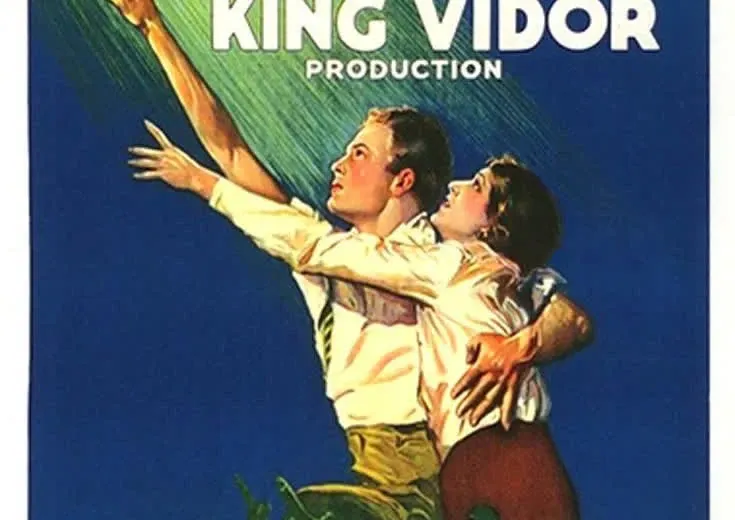 Middle section of the original poster, preserving the film’s scale and urban verticality.
Why The Crowd Still Feels Current
The easiest way to praise an old movie is to call it ahead of its time. The Crowd deserves something more exact. It feels current because the pressure it describes has only become more familiar. We still live inside cultures that tell people they are destined to stand out, then punish them for failing to do it spectacularly enough. We still confuse visibility with value. We still build cities, offices, and digital systems that promise individuality while sorting people into endless patterns.
That is also why the film pairs so well with our pieces on Sunrise: A Song of Two Humans (1927): Temptation, Motion, and the Last Silent Dream and The Third Man (1949): Why Vienna Haunts Every Frame. Each film turns space into pressure. In Sunrise, movement carries unstable feeling. In The Third Man, streets and sewers become moral traps. In The Crowd, offices, sidewalks, stairwells, and theater seats tell the story of what modern life does to the dream of uniqueness.
The Library of Congress placed The Crowd in the National Film Registry in 1989, and that recognition makes sense. The film is historically important, but it is more than a landmark. It still has the power to embarrass us a little, because it sees through one of the most flattering stories America tells about itself. Work hard, stay hopeful, keep pushing, and the world will eventually notice. Vidor’s film asks a ruder question: what if the world does not notice, and what if the person you become under that pressure is still worth looking at?
Final Thought
What makes The Crowd great is not that it condemns the city or pities the little man. It does something harder. It shows how ordinary life can feel epic when lived from the inside, and how crushing the demand to be special can become when it collides with rent, grief, labor, marriage, and time.
Vidor does not rescue John from ordinariness. He rescues ordinariness from condescension. That is why the film remains so piercing. It understands that becoming one of the crowd is not only a social fact. For many people, it is the hardest emotional truth they will ever have to accept.
Sources and Further Reading
- The Crowd (1928) - AFI Catalog
- The Crowd - Encyclopaedia Britannica
- Complete National Film Registry Listing - Library of Congress
- The Crowd - San Francisco Silent Film Festival
- The Crowd - Senses of Cinema
- King Vidor: 10 essential films - BFI
- Category:The Crowd (film) - Wikimedia Commons
Share This Article
Comments