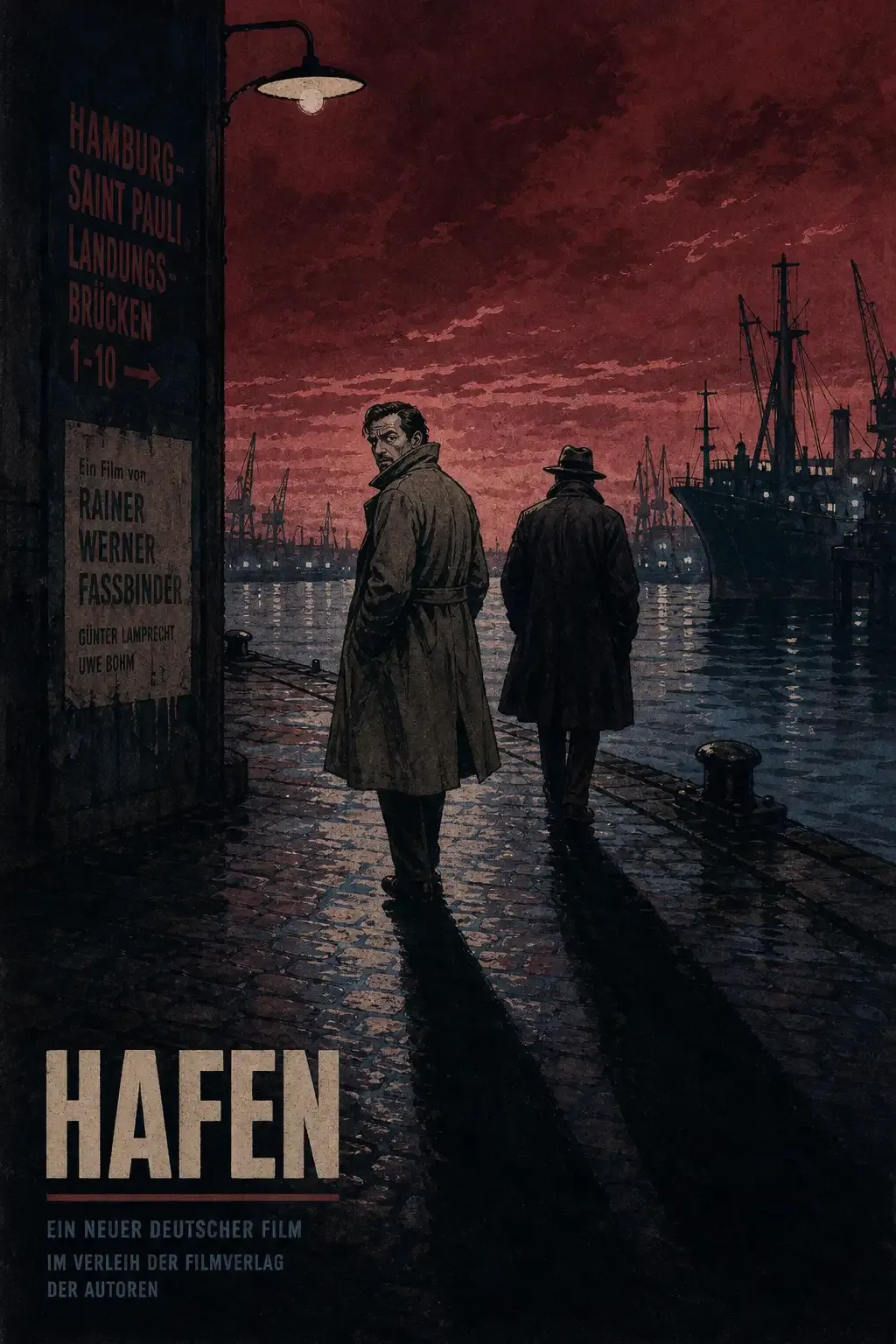
The American Friend (1977): Wim Wenders Turns Ripley Into an Arthouse Tragedy
Dennis Hopper and Bruno Ganz play a deadly game of manipulation and unlikely friendship in Wenders' gorgeous adaptation of Patricia Highsmith. A film about Americans, Europeans, and the poison between them.
Editor’s note (November 10, 2026): We corrected serious errors in this analysis. Jonathan does not drive into the sea at the end: he speeds off with his wife, abandoning Ripley, and dies at the wheel, and she survives by pulling the emergency brake. His wife is Marianne, not Sarah. Robby Müller is Dutch, not American, and several of the directors cast as gangsters are European. We also removed two lines of dialogue we could not verify, a reference list and a numerical rating, and added sourced production and reception details.
Our angle: The American Friend is often described as a film about American culture seducing Europe. That is there. The film’s most human idea is smaller: a man who sets up a stranger out of spite and then cannot stop himself from liking him.
Wim Wenders has always been obsessed with America—the America of Edward Hopper paintings, of noir films, of rock and roll and endless highways. But he’s equally obsessed with how America looks from the outside, from a Europe both seduced and threatened by American culture.
The American Friend is the perfect expression of this obsession. It’s a German film about an American con man, shot in Hamburg and Paris and New York, adapted from a Patricia Highsmith novel about moral corruption. And somehow it’s also one of the most beautiful films about friendship ever made—even though that friendship is built on betrayal.
The Setup: A Con Man and His Mark
Tom Ripley (Dennis Hopper) is living in Hamburg, driving up auction prices for “newly found” paintings by an artist who has faked his own death. At an auction he is introduced to Jonathan Zimmermann (Bruno Ganz), a picture framer dying of leukemia, who refuses his hand with a cold “I’ve heard of you.”
Ripley’s response to this small insult is disproportionate. When the French criminal Raoul Minot (Gérard Blain) wants an American gangster killed, Ripley suggests Jonathan, and spreads rumors that his illness has worsened. Minot arranges falsified medical results in Paris so that Jonathan expects the worst, and Jonathan agrees to kill for money to leave his wife and son.
But here’s the complication that makes The American Friend more than a crime film: Ripley also seems to genuinely like Jonathan. His manipulation is cruel, but he keeps returning to watch, to help, to complicate his own scheme. By the end, they’re killing together—bound by blood in both senses.
Dennis Hopper: Ripley as Lost American
Patricia Highsmith’s Tom Ripley is one of literature’s great sociopaths—charming, murderous, utterly without conscience. Wenders’ Ripley is something stranger: a lost soul in a cowboy hat, wandering through European cities, unable to connect with anyone except through manipulation.
Hopper plays him with an undertone of sadness that Highsmith never allowed. This Ripley doesn’t enjoy his schemes—he seems almost compelled to them, as if corruption is the only way he knows to relate to people. When he records himself talking into a tape recorder, trying to articulate his loneliness, it’s genuinely moving, and it is a kind of confession the book’s Ripley would never make. Highsmith herself initially disliked the film and rejected Hopper. According to Wenders, she wrote to him months later, after a second viewing in Paris, with much warmer feelings and praise for Hopper (film history).
Bruno Ganz: The Innocent Corrupted
Ganz’s Jonathan is Ripley’s opposite: sincere, loving, dying. He adores his wife Marianne (Lisa Kreuzer) and son Daniel. He takes pride in his craft. He’s everything Ripley isn’t—rooted, genuine, moral.
Until he isn’t.
Watching Jonathan’s transformation is the film’s heart. The first assassination, in a Paris Métro station, is horrifying for him. The second, on an express train with a garrote, nearly goes wrong. By the end, he’s killing alongside Ripley with something like partnership.
Ganz makes this trajectory believable. We watch his face as morality erodes, as terminal illness combines with sudden wealth to unmoor him from everything he valued. He doesn’t become a monster—he becomes someone capable of monstrous things, which is worse.
Wenders’ Hamburg: Neon and Emptiness
One of Wenders’ great gifts is location. Hamburg in The American Friend is a city of glass and water, train stations and industrial docks, American diners and German formality. It’s both real and dreamlike—a space where identities blur.
The color palette shifts throughout the film. Early scenes are cold—blues and grays, the colors of Jonathan’s ordered life. As the crimes begin, red bleeds into the frame: neon signs, blood, the flush of fever and guilt.
Robby Müller’s cinematography finds beauty in ugly spaces: a metro station, a train corridor, the docks. Müller, Wenders’s regular Dutch cinematographer, creates a Europe already colonized by American aesthetics.
The Train Murder: Hitchcock Filtered Through Art Film
The second assassination—set on a moving train—is often read as Wenders’ tribute to Hitchcock. The scenario echoes Strangers on a Train, the suspense mechanics are pure genre, the set piece is classically constructed.
But Wenders adds something Hitchcock wouldn’t: duration. The sequence runs long enough for discomfort to become meditation. We watch Jonathan’s fear, his hesitation, his final violent action, and then we keep watching. The aftermath matters as much as the act.
The gangster nearly overpowers Jonathan. Then Ripley appears out of the shadows, unexpected and uninvited, and joins the violence he set in motion. The two men finish the job together and throw the body and a bodyguard from the train. In that shared crime, something like genuine connection forms. Back in Hamburg, Ripley confesses that he suggested Jonathan to Minot, and he refuses his share of the money.
Cameos: The Directors as Criminals
Wenders first wanted John Cassavetes as Ripley. Cassavetes declined and suggested Hopper, himself a director. Wenders then cast the gangster roles with directors: Gérard Blain, Samuel Fuller, Peter Lilienthal and Daniel Schmid. Nicholas Ray plays the painter Derwatt, and Jean Eustache appears as a friendly Frenchman (casting history).
These aren’t stunt castings—they’re statements. American, French, German and Swiss filmmakers share the underworld, suggesting that cinema itself, and American cinema above all, is a kind of seduction Europe can’t resist.
Ray, especially, is moving here. The Rebel Without a Cause director, who died in 1979, plays a painter whose death has been faked to sell forgeries, in scenes about art and authenticity.
The Ending: No Clean Resolutions
⚠️ Spoiler Warning: Discussion of the ending follows.
After Ripley and Jonathan ambush the gangsters sent to Ripley’s mansion, Marianne arrives and tells Jonathan the French medical reports were fake. The three drive to the sea, Ripley in the gangsters’ ambulance full of bodies. On an isolated beach, Ripley sets the ambulance on fire. Jonathan gets into his car and speeds away with Marianne, abandoning Ripley. Moments later he blacks out and dies at the wheel. Marianne pulls the emergency brake and survives. Alone on the beach, Ripley speaks to his absent friend: “Oh well. We made it anyway, Jonathan. Be careful.”
The friendship ends the way it began, with one man walking away from the other. This time, it is Jonathan who leaves.
It’s not the thriller ending the plot demands. It’s the ending the characters require.
Strengths and limits
What works:
- Hopper and Ganz create genuine chemistry
- Hamburg becomes a character
- The slow corruption is psychologically convincing
- Robby Müller’s cinematography
What doesn’t:
- Pacing will frustrate thriller expectations
- Some plot elements don’t fully resolve
If You Liked This, Try:
- Paris, Texas (1984) — Wenders’ American masterpiece
- The Talented Mr. Ripley (1999) — Minghella’s more faithful Highsmith adaptation
- Wings of Desire (1987) — Wenders’ Berlin angels
- Purple Noon (1960) — Clément’s earlier, sunnier Ripley
- Until the End of the World (1991) — Wenders’ globe-spanning epic
The American Friend looks like a crime film, but its real subject is contamination—how American culture infiltrates European identity, how friendship can emerge from betrayal, how moral corruption spreads like the disease already killing Jonathan.
Ripley and Jonathan are bound together by the worst things they’ve done. In Wenders’ vision, that binding is also a form of love—the only form these broken men can manage.
By the end, Ripley has his friend’s last trick played on him, and he takes it with something like grace.
Critical reception and making
Wenders adapted Ripley’s Game, which Highsmith offered him in manuscript before its 1974 publication. He also borrowed, without the rights, from the earlier Ripley Under Ground. He shot it under the title Framed, and the film premiered at the 1977 Cannes Film Festival. Roger Ebert gave it three stars out of four: “he gives us so much atmosphere we’re almost swimming in it.” Barry Gifford wrote that it succeeds among noir homages “because of the spaces, the sputters, and sudden shifts of energy.” Rotten Tomatoes lists 88% positive reviews (details as collected in the film’s reference page).
How this was compiled: plot, production and critics’ quotations come from the linked reference page and the reviews named. Bucket Movies did not interview anyone for this piece. See how we work.
worth a spot on the list?
Reader notes
Join the discussion
No account needed — leave your take on this film below.
Add these to your list
Night Moves (1975): The Private Eye Who Couldn't See
Arthur Penn's neo-noir put Gene Hackman in a mystery he can't solve—because the mystery is himself. A post-Watergate detective story where finding the truth doesn't help.
10 Rillington Place (1971): The True Crime Film That Still Haunts
Richard Attenborough's chilling portrayal of serial killer John Christie—and the innocent man who hanged for his crimes. Documentary-style horror that argues against capital punishment more powerfully than any polemic.
Bring Me the Head of Alfredo Garcia (1974): Sam Peckinpah's Most Personal Apocalypse
A washed-up piano player in Mexico pursues a severed head through a desert of greed and death. Peckinpah's most reviled and most revealing film—a masterpiece of self-destruction.
The Day of the Jackal (1973): The Procedural Thriller That Defined the Genre
Fred Zinnemann's meticulous assassination thriller follows a killer we know will fail—and makes it unbearably tense anyway. The blueprint for every procedural that followed.
Loading comments...