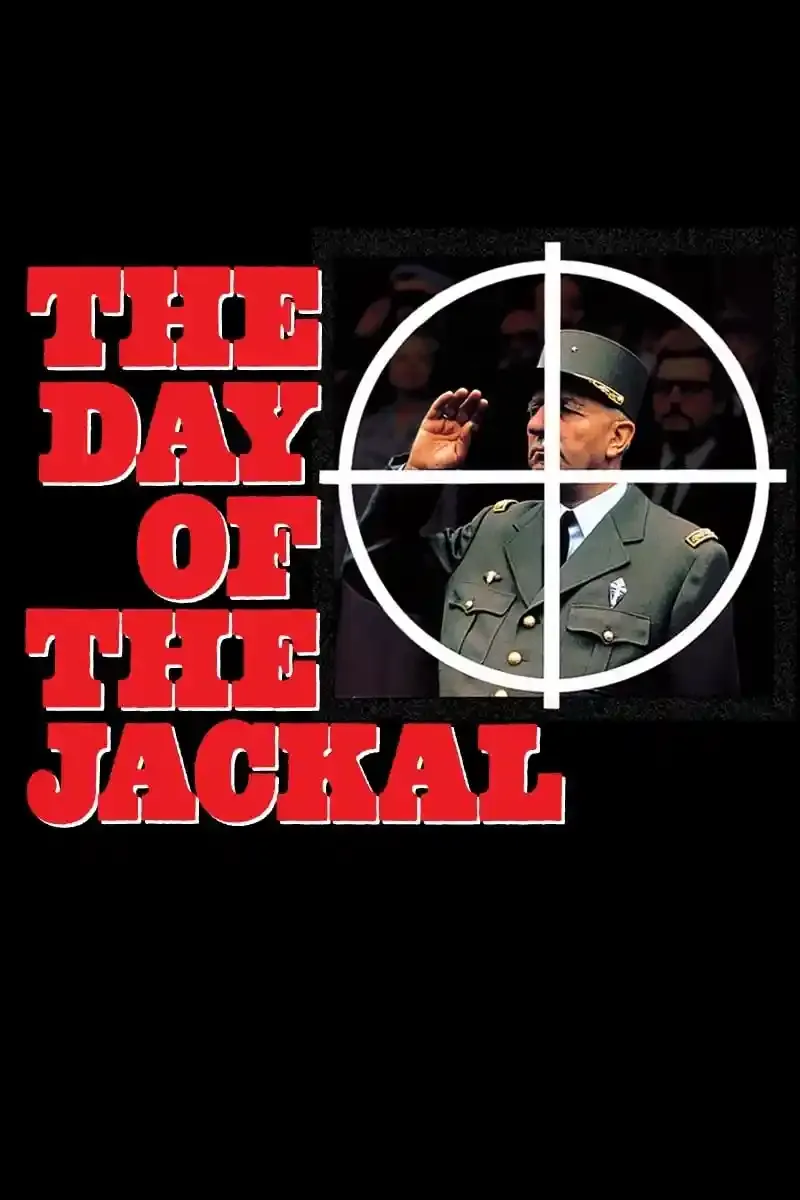
The Day of the Jackal (1973): The Procedural Thriller That Defined the Genre
Fred Zinnemann's meticulous assassination thriller follows a killer we know will fail—and makes it unbearably tense anyway. The blueprint for every procedural that followed.
Editor’s note (November 10, 2026): We corrected several errors in this analysis. The Jackal’s first shot misses because de Gaulle leans forward to present a medal, not because Lebel interrupts him. Lebel never interviews a witness who has seen the Jackal’s face. The film runs 142 minutes and was shot in France, Britain, Italy and Austria. We also removed a numerical rating and a reference list we could not verify, and added sourced production and reception details.
Our angle: the usual praise for The Day of the Jackal is that it creates suspense despite a known outcome. Our interest is narrower. The film treats two professionals, an assassin and a policeman, with the same patience, and makes the state’s bureaucracy as much a character as either man.
Here’s the challenge Fred Zinnemann set himself in 1973: make a thriller about an assassination attempt that the audience knows will fail. Charles de Gaulle wasn’t killed by a sniper in the 1960s. History tells us the Jackal doesn’t succeed. So why should we care?
By the end of The Day of the Jackal, you’ll be on the edge of your seat watching a man we know won’t hit his target. That’s the magic of this film—it proves that tension comes from execution, not outcome.
The Dual Structure
The film follows two parallel tracks that slowly converge:
The Jackal (Edward Fox): A professional assassin hired by the OAS—a French paramilitary group angry about Algerian independence—to kill President de Gaulle. We watch him plan: forging identities, acquiring weapons, testing his custom-made rifle, establishing escape routes.
Lebel (Michael Lonsdale): A French police detective assigned to find and stop the assassin. He starts with nothing—not even knowing the killer’s nationality—and builds his investigation through patient, methodical police work.
Neither story is more important than the other. Zinnemann cuts between them, building two kinds of competence: the competence of the hunter and the hunted.
The Procedure Is the Plot
What makes The Day of the Jackal revolutionary is its commitment to process. We watch the Jackal:
- Meet with a forger to create French identity documents
- Commission a custom rifle that disassembles into innocent-looking parts
- Test-fire the rifle before moving into France
- Create multiple backup identities
- Scout escape routes across France
We watch Lebel:
- Work from the single code word, “Jackal,” extracted from an OAS clerk
- Coordinate with Special Branch in London, which turns up the name Charles Calthrop
- Follow the Jackal’s trail to a hotel in Nice
- Launch a public manhunt after a murder lets him drop the secrecy
- Predict that the Liberation Day ceremony is the target
| Jackal’s Progress | Lebel’s Progress |
|---|---|
| Commissions rifle and false papers in Genoa | Gets the code word “Jackal” |
| Learns the plot is compromised, presses on | London identifies a suspect name |
| Escapes Nice, changes identity | Launches a public manhunt |
| Reaches Paris as a Danish teacher | Predicts the Liberation Day ceremony |
| Gets into position disguised as a veteran | Hunts for him around the ceremony |
Each step is shown in detail. There are no shortcuts, no “movie logic” jumps. The pleasure is in watching professionals work.
Edward Fox: The Perfect Killer
Fox’s Jackal is a remarkable creation: charming when necessary, cold when efficient, entirely without psychology. We never learn his real name. Beyond a wish to retire comfortably, we never learn why he kills for money. We never get a backstory or a motivation beyond professionalism.
This blankness is the point. The Jackal is a function, not a character. Fox plays him with the precision of a surgeon—every movement economical, every emotion controlled. When he kills (and he does kill, when obstacles appear), there’s no pleasure in it. It’s simply problem-solving.
The test-firing of his custom rifle, built for him in Genoa by the gunsmith Gozzi (Cyril Cusack), tells you everything. He adjusts the sights and moves on. The violence is technical. The killing is work.
Michael Lonsdale: The Rumpled Detective
Against the Jackal’s elegance, Lonsdale’s Lebel is deliberately ordinary. He’s not a brilliant maverick detective. He’s not handsome or dynamic. He works slowly, follows procedure, coordinates with bureaucracies.
But he’s tenacious. And he’s patient. And when he finally corners the Jackal, it’s not through genius—it’s through the accumulated weight of good police work.
Lonsdale plays Lebel as a man who knows his limitations and works within them. There’s something almost heroic in his ordinariness.
Zinnemann’s Rigor
Fred Zinnemann was one of Hollywood’s master craftsmen, and The Day of the Jackal shows his style at its purest: no flash, no unnecessary style, complete confidence in the material.
The film runs 142 minutes, and none of it is wasted. Zinnemann shot in studios and on location in France, Britain, Italy and Austria. French producer Julien Derode secured access to places usually closed to filmmakers, including the Ministry of the Interior. The finale used hand-held cameras inside police lines at the real Bastille Day parade on the Champs-Élysées. According to Zinnemann, some onlookers mistook the actor playing de Gaulle for the real one (production history).
His direction is invisible in the best sense—you’re never aware of a camera, a cut, a directorial choice. You’re simply watching events unfold with the clarity of observed reality.
The Ending: Known and Still Tense
⚠️ Spoiler Warning: Discussion of the ending follows.
The final sequence is masterfully constructed. De Gaulle is at a ceremony. The Jackal is in position—a room overlooking the parade route. Lebel is racing to find him.
We know the Jackal will fail. We know de Gaulle will live. History has already written this ending.
And yet the tension is genuine. Disguised as an elderly veteran, with his rifle hidden in a crutch, the Jackal takes aim. De Gaulle leans forward at the last instant to present a medal, and the shot misses. As the Jackal reloads, Lebel and a gendarme break in. The Jackal kills the gendarme, and Lebel shoots him dead. Zinnemann makes us forget what we know through sheer technique.
The Jackal dies anonymously. In London, the real Charles Calthrop walks into his flat to find police going through his belongings, so the name was never the killer’s own. The assassin is buried in an unmarked grave. The professional disappears without a trace.
The Procedural Legacy
Every procedural thriller since 1973 owes something to The Day of the Jackal. The patient accumulation of detail. The parallel structure of hunter and hunted. The focus on how rather than why.
Its influence is visible in:
- Munich (2005) — Spielberg’s assassination procedural
- Zodiac (2007) — Fincher’s obsessive investigation
- Zero Dark Thirty (2012) — Bigelow’s intelligence-gathering epic
- Tinker Tailor Soldier Spy (2011) — Another spy procedural with similar rigor
These films work because The Day of the Jackal proved that procedure itself could be dramatic. You don’t need explosions. You need competence, stakes, and time.
Strengths and limits
What works:
- Fox and Lonsdale are perfect opposites
- The procedural detail is fascinating, not tedious
- Builds tension despite a known outcome
- Zinnemann’s direction stays out of the way
What doesn’t:
- The length requires patience
- No emotional arc for any character
If You Liked This, Try:
- Three Days of the Condor (1975) — Political thriller with similar paranoid energy
- All the President’s Men (1976) — Procedural journalism
- Munich (2005) — Spielberg’s spiritual successor
- Zodiac (2007) — Investigative procedural with similar obsessiveness
- No Country for Old Men (2007) — Another unstoppable professional
The Day of the Jackal proves that knowing the ending doesn’t eliminate suspense—it transforms it. We watch not to see if the Jackal succeeds but to see how close he gets, how many obstacles he overcomes, how nearly history might have been different.
That “nearly” is the whole film. And it’s enough.
Critical reception
Roger Ebert gave the film four stars, calling it “one hell of an exciting movie” that was “put together like a fine watch,” and ranked it seventh among the films of 1973. Time’s critic praised how the adaptation cut through Frederick Forsyth’s novel, calling the film “a textbook on reels in the near-forgotten subject of concise moviemaking.” Rotten Tomatoes lists a 91% positive score, and its consensus calls the film “a meticulously constructed thriller with surprising irreverence and taut direction” (reviews as collected in the film’s reference page).
Casting was part of the film’s realism. Universal wanted an American star, and Robert Redford and Jack Nicholson were flown to Europe to audition. Zinnemann secured an agreement that only European actors would be cast and chose Edward Fox, then little known, over names such as Michael York.
How this was compiled: plot, production and critics’ quotations come from the linked reference page and the reviews named. Bucket Movies did not interview anyone for this piece. See how we work.
worth a spot on the list?
Reader notes
Join the discussion
No account needed — leave your take on this film below.
Add these to your list
Night Moves (1975): The Private Eye Who Couldn't See
Arthur Penn's neo-noir put Gene Hackman in a mystery he can't solve—because the mystery is himself. A post-Watergate detective story where finding the truth doesn't help.
10 Rillington Place (1971): The True Crime Film That Still Haunts
Richard Attenborough's chilling portrayal of serial killer John Christie—and the innocent man who hanged for his crimes. Documentary-style horror that argues against capital punishment more powerfully than any polemic.
Bring Me the Head of Alfredo Garcia (1974): Sam Peckinpah's Most Personal Apocalypse
A washed-up piano player in Mexico pursues a severed head through a desert of greed and death. Peckinpah's most reviled and most revealing film—a masterpiece of self-destruction.
The American Friend (1977): Wim Wenders Turns Ripley Into an Arthouse Tragedy
Dennis Hopper and Bruno Ganz play a deadly game of manipulation and unlikely friendship in Wenders' gorgeous adaptation of Patricia Highsmith. A film about Americans, Europeans, and the poison between them.
Loading comments...