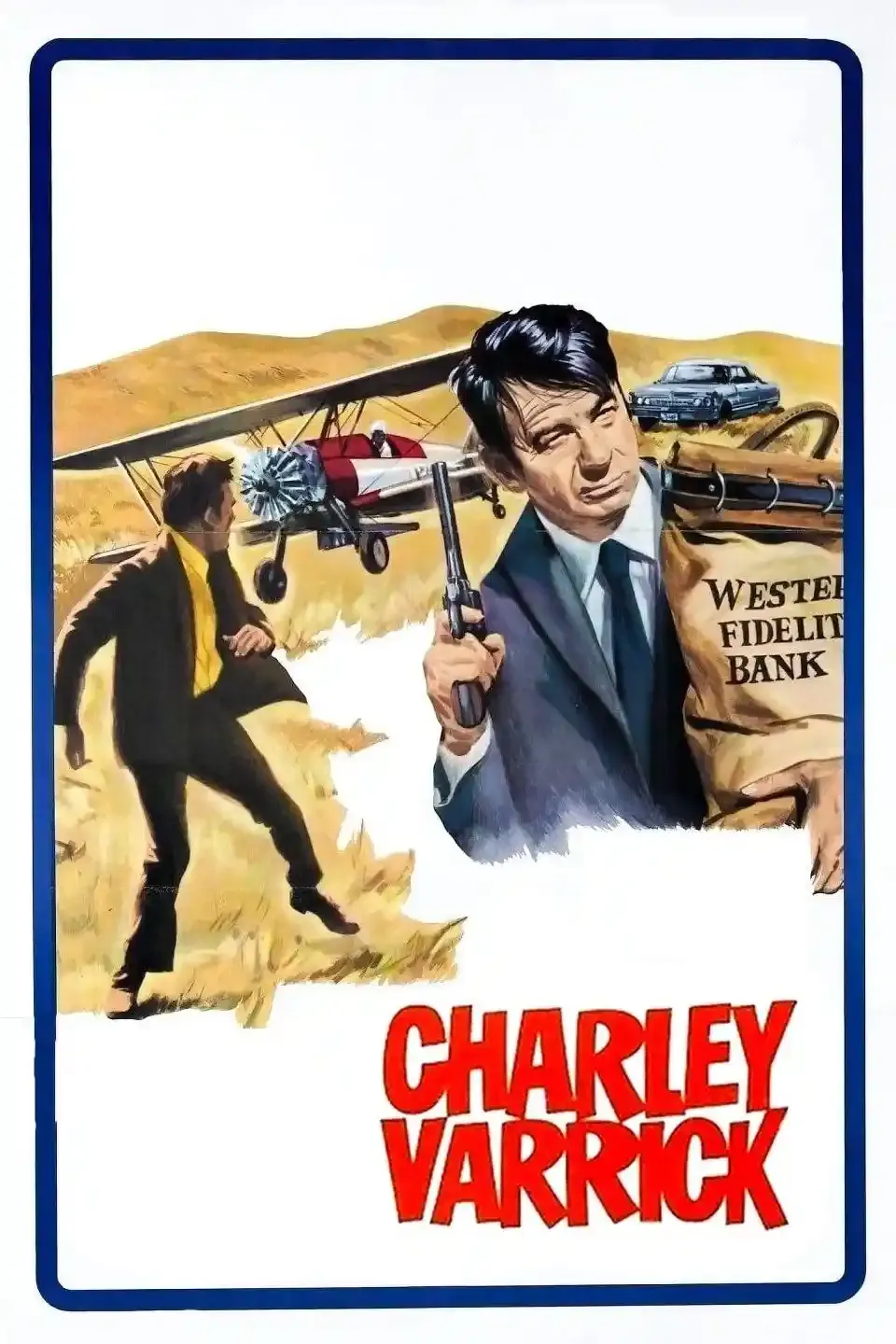
Charley Varrick (1973): The Working-Class Heist Film That Outsmarts Everyone
Don Siegel's 1973 crime thriller Charley Varrick, with Walter Matthau as a bank robber who steals Mafia money: how it was made, what critics said, Matthau's BAFTA, and its influence on Tarantino.
Editor’s note: This article is a retrospective built from published reviews, production histories and other reporting, with analysis by the Bucket Movies Editorial Team. See how we work.
Editor’s note: an earlier version of this article included first-person commentary, scene details we could not check against a source, a numerical rating and a reference list that did not point to specific sources. It has been rewritten from the sources linked below.
Our angle: Charley Varrick is now best known as a film that influenced Quentin Tarantino. The record shows that its reputation was shaped first by a strange contradiction: the film won its star a BAFTA, yet the star publicly said he did not understand it.
What the film is
Charley Varrick is a 1973 American crime thriller produced and directed by Don Siegel for Universal. Dean Riesner and Howard Rodman wrote the screenplay from John H. Reese’s 1968 novel The Looters. Walter Matthau stars, with Andrew Robinson, Joe Don Baker, John Vernon, Felicia Farr, Sheree North, Norman Fell, Woodrow Parfrey and Jacqueline Scott. Michael C. Butler shot it, Frank Morriss edited it, and Lalo Schifrin wrote the score. It was released on October 19, 1973, and runs 111 minutes. It has also been known as The Last of the Independents and Kill Charley Varrick.
It was the first of four consecutive films in which Matthau, then best known for comedies such as The Odd Couple, played mostly non-comic roles.
The premise (no ending)
Charley Varrick is a crop duster and former stunt pilot who robs small banks on the side. He, his wife Nadine (Scott) and two partners rob a bank in rural New Mexico. The robbery goes wrong and costs lives, including Nadine’s. When Charley and his young partner Harman (Robinson) count the money, they find more than three-quarters of a million dollars. The next day, the news reports that less than $2,000 was taken. Charley realizes the bank was a drop for laundered Mafia money and that the mob will come after them. A Reno associate of the mob, Maynard Boyle (Vernon), hires a hitman known as Molly (Baker) to get the money back. The rest of the film follows Charley’s methodical preparations while Molly closes in.
Nathan Rabin of The A.V. Club summarized the story’s tension: “the noose gradually tightens around Matthau and Robinson’s necks as the feds close in and the long tentacles of organized crime make their presence felt as far as sunny New Mexico.”
How it was made
- Written for Eastwood. The role of Varrick was written for Clint Eastwood, Siegel’s collaborator on Dirty Harry. Eastwood first accepted the part and then turned it down, reportedly because he felt the character had no redeeming features. He went on to make Thunderbolt and Lightfoot instead. The film contains a joke at his expense: when Molly introduces himself to a photographer, she replies, “I didn’t figure you for Clint Eastwood.”
- The title. Siegel wanted to call the film The Last of the Independents, the slogan on Varrick’s crop-dusting company. The slogan still appears on the poster, on the company’s jumpsuits and on Varrick’s truck.
- Nevada for New Mexico. Although the story is set in New Mexico, it was shot mostly in northern Nevada. The opening robbery was filmed in Genoa, at the old Douglas County Court House. The trailer park scenes were shot in Dayton, other scenes in Gardnerville, Minden and Reno, and the final sequence at a wrecking yard near Lockwood.
- The plane. Varrick’s aircraft was a converted Boeing-Stearman Kaydet crop duster flown by the Hollywood aerial pilot Frank Tallman.
- A cameo. Siegel himself appears in a small role as a character named Murphy, and Lalo Schifrin, who had scored Dirty Harry for Siegel, again provided the music.
Matthau’s doubts
Matthau was reportedly unimpressed with the finished film. Siegel later claimed that Matthau hurt its box office by saying publicly that he neither liked the film nor understood it. According to accounts of the production, Matthau sent Siegel a note saying he had seen it three times, was “of slightly better than average intelligence (IQ 120),” and still did not “quite understand what’s going on.”
That reaction is ironic given what happened next. Matthau won the 1974 BAFTA Award for Best Actor for the role, and Frank Morriss was nominated for Best Editing.
What critics said
The reviews were strongly positive, though the film did only modest business.
- Vincent Canby of The New York Times treated it as both an action film and a mystery. He wrote that “an intelligent action melodrama is probably one of the most difficult kinds of film to make,” and that intelligence in such a film “has to do with movement, suspense, and sudden changes in fortune that are plausible enough to entertain without challenging you to question basic premises.”
- John Simon of New York magazine called it one of the more accomplished examples of the gangster genre.
- Siegel’s biographer Judith M. Kass, writing in 1975, argued that in this film “the straight world is as phony, dishonest and evil as the criminal’s,” except that the criminals “are honest about their lawlessness.”
- Reviewing the DVD in 2005, Rabin called it “a low-key, tough little thriller punctuated by casual bursts of brutality and deadpan humor.” He said the film “is informed by a quiet professionalism that suits a movie about feds and criminals doing their jobs, whether that means laundering money, making fake passports, or robbing banks.”
- Paul Tatara called it “intelligent, commercial filmmaking at its finest.”
Today the film has an 82% approval rating on Rotten Tomatoes from 28 reviews. The site’s consensus credits Matthau with “adding hangdog soul to Don Siegel’s propulsive direction.”
Joe Don Baker and John Vernon
Rabin argued that “the film’s real revelation comes from Baker, whose racist, sexist, ass-kicking brute of a henchman oozes malevolent magnetism.” Matthau, in Rabin’s words, “delivers his usual sterling performance as a savvy operator working doggedly to finagle his way out of a seemingly impossible situation.” The contrast between Matthau’s careful planner and Baker’s blunt enforcer drives the second half of the film.
John Vernon’s Boyle has had a longer afterlife than his screen time suggests. He delivers a threat about going to work on someone “with a pair of pliers and a blowtorch,” a line that later turned up in Pulp Fiction.
The Tarantino connection
According to Rabin, the film “is known mainly for its influence on Pulp Fiction.” Besides the pliers-and-blowtorch line, he notes that Vernon’s character’s first name, Maynard, was used for a minor character in Tarantino’s film. Rabin also cautioned that Pulp Fiction “doesn’t borrow anywhere near as much from Charley Varrick as, say, Reservoir Dogs does from The Killing.” In his reading, Siegel’s film is one piece of the “vast crazy-quilt of forgotten and half-remembered violent, lurid genre movies” that shaped Tarantino. The 2013 action film 2 Guns, while not a remake, has been described as borrowing many of its plot elements from Charley Varrick.
Rory Gallagher’s 1978 song “Last of the Independents” was inspired by the film, according to Gallagher’s longtime bassist Gerry McAvoy.
Where it sits in Siegel’s career
Siegel was known for lean, efficient genre films, from Invasion of the Body Snatchers (1956) to Dirty Harry (1971) and Escape from Alcatraz (1979). Charley Varrick is one of his most admired late works. Rabin’s point about “quiet professionalism” describes the film’s characters as well as its direction: nearly everyone in it, on both sides of the law, is good at a job, and the plot turns on who plans better.
How to watch
The film was released on DVD in 2004 and on Blu-ray in Germany in 2015, with a 72-minute documentary, Last of the Independents: Don Siegel and the Making of Charley Varrick. Kino Lorber released a Blu-ray from a new 4K remaster in the United States in 2019, with the documentary, a video essay and a new commentary track. Streaming availability varies by region. For a related 1970s crime film, see our retrospective on Thunderbolt and Lightfoot, the film Eastwood made instead, or browse the reviews section.
Our read
The sources describe a modest hit that critics admired from the start and that later found a second audience through Tarantino. The most consistent points of praise are Matthau’s calm, calculating lead, Baker’s menace and the film’s matter-of-fact view of crime as work. The most revealing detail may be Matthau’s note: a film this concerned with how its characters think did not seem, even to its star, to explain itself, and much of its appeal lies in letting the audience work it out.
How this was compiled: credits, production and release details come from Universal release records and published production histories; critics’ quotes come from The New York Times, The A.V. Club, Judith M. Kass’s 1975 study of Siegel and Rotten Tomatoes. Bucket Movies did not watch the film for this article. See how we work.
Sources & further reading
- 1. Charley Varrick (DVD review) — The A.V. Club (archived)
- 2. Charley Varrick — Rotten Tomatoes
- 3. The Screen: Robbers vs. Robbers — The New York Times
worth a spot on the list?
Reader notes
Join the discussion
No account needed — leave your take on this film below.
Add these to your list
Thunderbolt and Lightfoot (1974): Michael Cimino's Debut and the Last American Innocence
Before The Deer Hunter, Michael Cimino made his debut with this 1974 buddy heist film starring Clint Eastwood and Jeff Bridges. How it was made, what critics said then and now, and why it lasts.
Frenzy (1972): Hitchcock Returns to London for One Last Kill
Hitchcock's 1972 return to London: how Frenzy was made, what critics said on release and since, and why it remains his most violent and divisive late film.
The Last House Review Roundup: Greta Lee and Wagner Moura Trapped in Netflix's Sci-Fi Lockdown Thriller
Louis Leterrier's The Last House seals a Seattle family inside their home during a mysterious endless rain. Critics were mostly negative. What they praised, what they faulted, and how it was made.
The Conversation (1974): Coppola's Paranoid Masterpiece of Surveillance and Isolation
A deep dive into Francis Ford Coppola's 1974 masterpiece 'The Conversation,' exploring its haunting portrayal of surveillance expert Harry Caul and its enduring relevance in our modern surveillance society.
Loading comments...