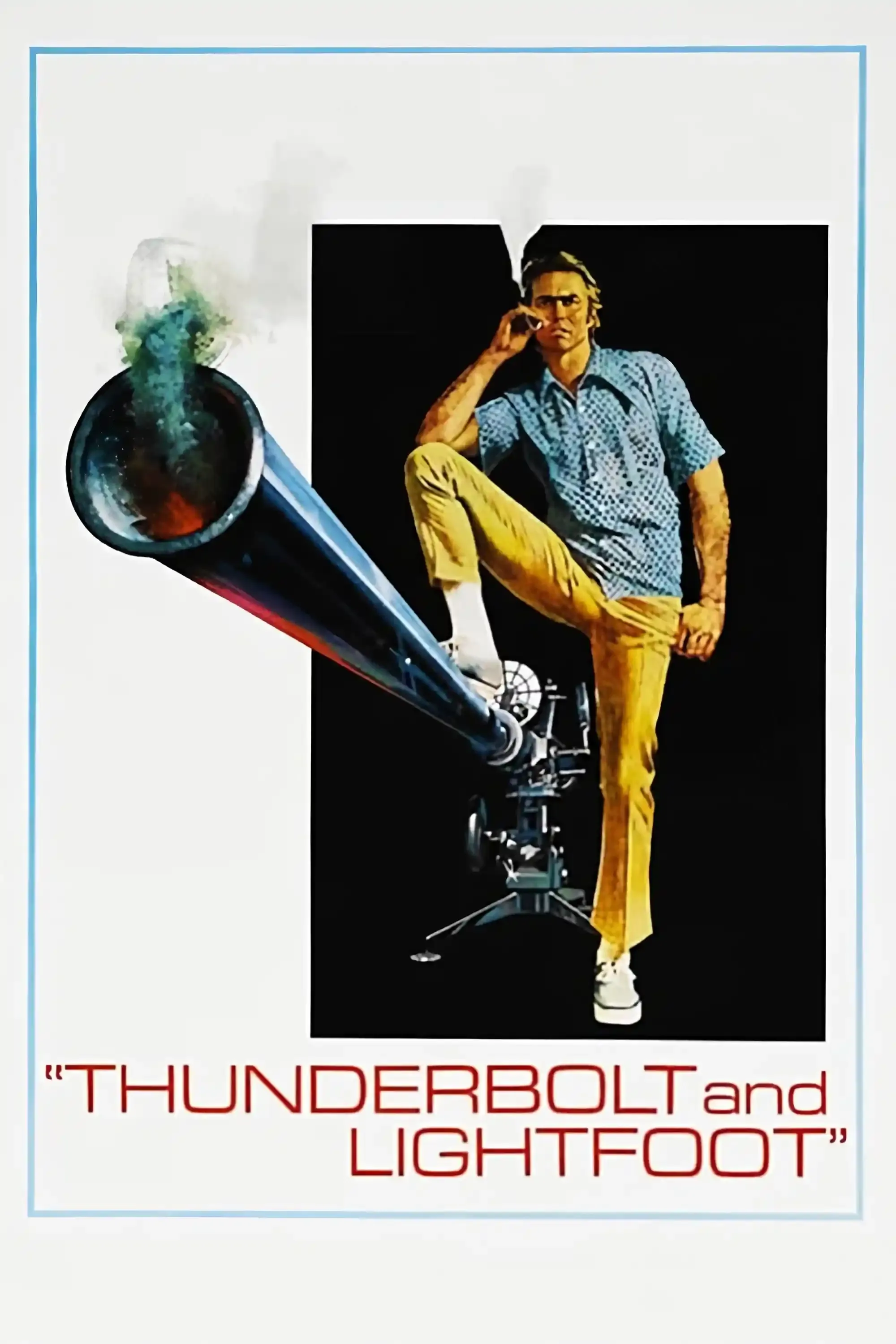
Thunderbolt and Lightfoot (1974): Michael Cimino's Debut and the Last American Innocence
Before The Deer Hunter, Michael Cimino made his debut with this 1974 buddy heist film starring Clint Eastwood and Jeff Bridges. How it was made, what critics said then and now, and why it lasts.
Editor’s note: This article is a retrospective built from published reviews, production histories and other reporting, with analysis by the Bucket Movies Editorial Team. See how we work.
Editor’s note: an earlier version of this article described the heist and the ending inaccurately, quoted a line of dialogue we could not verify, and included first-person viewing impressions and a numerical rating. It has been rewritten from the sources linked below.
Our angle: Thunderbolt and Lightfoot is usually remembered as the film Michael Cimino made before The Deer Hunter and Heaven’s Gate. The contemporary reviews show that critics were split even in 1974, and that the split was over the same quality later critics came to admire: the film’s refusal to settle on one genre.
What the film is
Thunderbolt and Lightfoot is a 1974 crime comedy written and directed by Michael Cimino, his first film as a director. Clint Eastwood plays John “Thunderbolt” Doherty, a bank robber hiding out as a preacher. Jeff Bridges plays Lightfoot, a young drifter and car thief who saves him by accident. George Kennedy and Geoffrey Lewis play Red Leary and Eddie Goody, Thunderbolt’s old partners, and the supporting cast includes Catherine Bach, Gary Busey, Vic Tayback and Dub Taylor. Eastwood’s company, Malpaso, produced it, with Robert Daley as producer. United Artists released it on May 22, 1974. It runs 115 minutes.
The premise (no ending)
An assassin interrupts a preacher’s sermon, and the preacher runs. Lightfoot, speeding past in a stolen car, picks him up. Lightfoot soon learns that the “minister” is Thunderbolt, a robber famous for using a 20mm cannon to break into safes. His old gang believes he kept the money from their last job. The loot was hidden in a one-room schoolhouse that has since disappeared. When the gang catches up with them, Lightfoot proposes a new plan: rob the same target again. Richard Brody of The New Yorker summarized the structure: the film “withholds the crime story until midway through” and is, before that, “a rough-and-tumble, back-road Northwest adventure that’s also a buddy comedy, even a proto-bromance.”
How it was made
- The script. Cimino wrote the screenplay on spec with Eastwood in mind. He had co-written Magnum Force (1973) for Eastwood with John Milius. He named the characters after two early-19th-century Irish bandits and loosely based the story on them, a detail Brody also notes.
- The deal. Cimino’s agent, Stan Kamen of the William Morris Agency, packaged the film with Eastwood and Bridges. Eastwood liked the script enough to consider directing it himself, but after meeting Cimino he gave him the job. Cimino later said he would not have had a film career without Eastwood.
- The locations. Cimino and Daley scouted thousands of miles of Montana before settling on the Great Falls area. The film was shot in 47 days, from July to September 1973, in and around Great Falls, Fort Benton, Hobson and Wolf Creek. The fictional “Warsaw” exit was in reality an Interstate 15 exit near Dearborn.
- The pace. Bridges has recalled that Eastwood rarely wanted more than three takes. When Bridges asked for another, Cimino would check with Eastwood, who would say, “Give the kid a shot.” Cimino later said the fast schedule on this film showed he could shoot efficiently, an argument he made during the troubled production of Heaven’s Gate.
- The music. Dee Barton composed the score, and Paul Williams wrote and performed the end-title song, “Where Do I Go From Here?”
The supporting cast and small details
The film is full of character actors who became familiar faces. George Kennedy, an Oscar winner for Cool Hand Luke, plays Red as a menacing, resentful counterweight to Eastwood’s calm. Geoffrey Lewis, a regular in Eastwood’s films of the period, plays the gentle and slow-witted Goody. Gary Busey, billed as “Garey Busey,” appears early in his career, and Catherine Bach, later of The Dukes of Hazzard, has a small role. Bill McKinney, Vic Tayback, Dub Taylor and Gregory Walcott fill out the roadside world.
Some details show Cimino’s literary interests. In a diner scene, Thunderbolt recites the opening lines of “Poor John Luck…” by the poet Thomas McGrath, who had worked with Cimino on early projects. During the robbery itself, Lightfoot disguises himself as a woman to distract a guard. This is the kind of comic turn that Variety called “hilariously vulgar” and that later critics have read as part of the film’s playful approach to masculinity.
What critics said in 1974
The original reviews were mixed to positive, and they disagree in revealing ways.
- Howard Thompson of The New York Times called it “a funny, tough-fibered crime comedy with an unobtrusive edge of drama,” and said the picture is “consistently entertaining and interesting.”
- Arthur D. Murphy of Variety called it “an overlong, sometimes hilariously vulgar comedy-drama” with a “rambling, anticlimactic script.” He also said Cimino “obtained superior performances from Eastwood, George Kennedy, Geoffrey Lewis and especially Jeff Bridges, outstanding as a young drifter.”
- Kevin Thomas of the Los Angeles Times called it “a rambunctious and surprisingly touching movie” and praised Cimino’s “clear, concise style and very impressive control.”
- Jay Cocks of Time called it “one of the most ebullient and eccentric diversions around.”
- Gene Siskel of the Chicago Tribune gave it two and a half stars out of four. He felt the brotherly relationship between Eastwood and Bridges “is lost… amid all the killings and explosions.”
- Gary Arnold of The Washington Post called it “a weirdly kinked-up, trumped-up exercise in formula moviemaking” with “almost schizoid variations in tone and style.”
- John Raisbeck of the Monthly Film Bulletin found the script “packed with excellent moments,” but said “the whole never amounts to more than the sum of its parts.”
What Siskel and Arnold criticized, the shifts between road comedy and violent crime film, is what Thompson and Thomas enjoyed.
How it is seen now
Later assessments have been warmer. Rotten Tomatoes lists 89% approval from 35 reviews, and Leonard Maltin’s guide gives it three out of four stars, saying “Bridges steals the picture.” Writing for The New Yorker in 2017, ahead of a BAM Cinématek series of heist films co-programmed by Edgar Wright, Brody called it “one of the great directorial débuts of the New Hollywood era.” He described the four men preparing the robbery as living in “a simulacrum of domesticity that seethes with ambient violence and erotic tension.”
That reading, of a male friendship that is affectionate, competitive and never quite stated, has become the most common way critics approach the film today. It is also why the film is so often discussed alongside other 1970s road and buddy films about men drifting through a changing country.
Bridges’s Oscar nomination
Bridges received his second Academy Award nomination, for Best Supporting Actor, for the role. His first had been for The Last Picture Show (1971). Variety singled him out as “outstanding,” and Maltin’s verdict that he “steals the picture” reflects the most common view of the film. Eastwood, by most accounts, was less pleased. According to biographer Marc Eliot, he felt upstaged by Bridges.
Box office and aftermath
The film earned $9 million in rentals on its first release and eventually grossed about $25 million in the U.S. against a budget variously reported at $2.2 million to $4 million. It was among the top 20 earners of 1974. United Artists profited, but Eastwood vowed not to work with the studio again because he felt it had promoted the film poorly. Cimino went on to make The Deer Hunter (1978), which won the Academy Award for Best Picture, and then Heaven’s Gate (1980), whose cost overruns damaged United Artists.
Where it sits in Cimino’s career
Thunderbolt and Lightfoot is the smallest and most good-humored of Cimino’s best-known films, but critics have long seen in it the themes he would develop later. Those include friendship between men under pressure, the American landscape as both beautiful and indifferent, and violence breaking into ordinary life. The Deer Hunter expanded those themes into an epic about the Vietnam War. Thunderbolt and Lightfoot keeps them inside a caper, which may be why audiences in 1974 were unsure how to take it.
How to watch
The film was released on DVD by MGM in 2000 and on Blu-ray by Twilight Time in 2014. Streaming availability varies by region. For more 1970s crime films, see our retrospectives on Charley Varrick, Bring Me the Head of Alfredo Garcia and The Conversation, or browse the reviews section.
Our read
The record shows a debut that divided critics on release and has grown in reputation since. Contemporary reviewers who disliked it objected to its tonal swings and violence, while those who liked it praised its humor and the warmth between its leads. Later critics have mostly sided with the second group, and Bridges’s performance is the one point on which almost everyone agrees.
How this was compiled: credits, production and release details come from United Artists records and published production histories; contemporary critics’ quotes come from reviews in The New York Times, Variety, the Los Angeles Times, Time, the Chicago Tribune, The Washington Post and the Monthly Film Bulletin, as compiled in published reception histories; later assessments come from The New Yorker, Rotten Tomatoes and Leonard Maltin’s guide. Bucket Movies did not watch the film for this article. See how we work.
Sources & further reading
- 1. Thunderbolt and Lightfoot (review, 1974) — Variety
- 2. Clint Eastwood and Jeff Bridges's Modern Western — The New Yorker
- 3. Thunderbolt and Lightfoot — Rotten Tomatoes
worth a spot on the list?
Reader notes
Join the discussion
No account needed — leave your take on this film below.
Add these to your list
Charley Varrick (1973): The Working-Class Heist Film That Outsmarts Everyone
Don Siegel's 1973 crime thriller Charley Varrick, with Walter Matthau as a bank robber who steals Mafia money: how it was made, what critics said, Matthau's BAFTA, and its influence on Tarantino.

'Minions & Monsters' Review Roundup: Illumination's Best-Reviewed Film Goes to Early Hollywood
Pierre Coffin's Minions & Monsters sends the Minions into silent-era Hollywood and Lovecraftian monster movies. What critics said, who voices whom, how it was made and why its box office split opinion.
Frenzy (1972): Hitchcock Returns to London for One Last Kill
Hitchcock's 1972 return to London: how Frenzy was made, what critics said on release and since, and why it remains his most violent and divisive late film.
Godzilla Minus Zero Review Roundup: What Critics Said About Takashi Yamazaki's Sequel
Takashi Yamazaki's Godzilla Minus Zero pits Godzilla against King Ghidorah in 1949 Japan. Critics praised its effects and scale and debated whether it tops Minus One. Reviews, production, box office.
Loading comments...