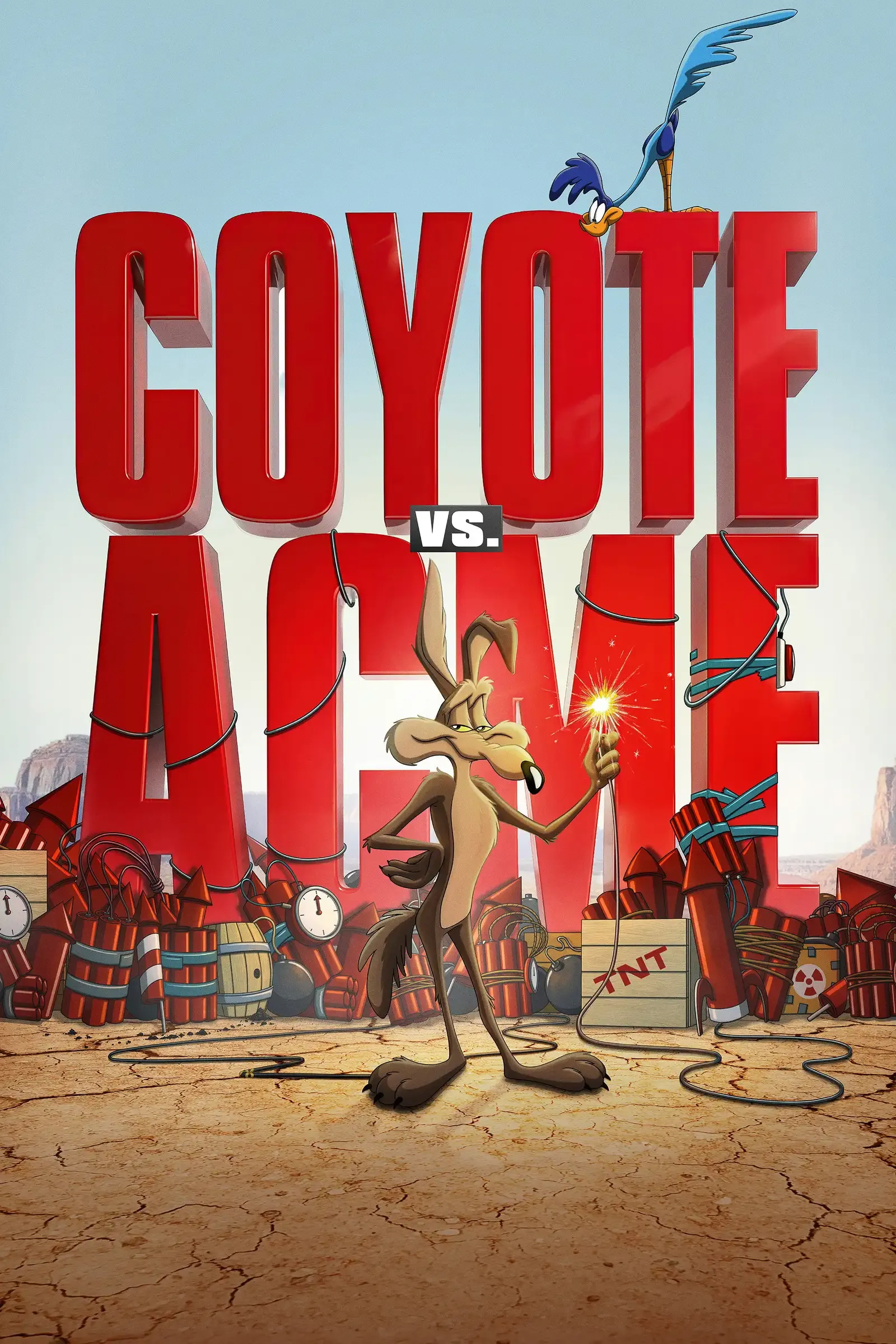
Coyote vs. Acme (2026): The Looney Tunes Courtroom Comedy That Refused to Die
Will Forte and John Cena bring Wile E. Coyote's lawsuit against ACME to life in this 96% Rotten Tomatoes hit. Our review of the film Warner Bros tried to bury.
Editorial Notes
BucketMovies Editorial covers classic cinema, repertory discoveries, and context-rich film criticism with an emphasis on source-backed reporting and careful editorial review.
Warner Bros once tried to delete this movie from existence. They shelved Coyote vs. Acme as a tax write-off, the kind of corporate accounting move that treats art as a line item to be erased. The fact that it exists at all — and that it now holds a 96% Rotten Tomatoes score across 104 reviews — is the kind of Hollywood resurrection story that makes you believe in something, even if the movie itself only occasionally lives up to that backstory.
Dave Green’s film takes a 1990 Ian Frazier gag from The New Yorker and stretches it into a full-length courtroom comedy where Wile E. Coyote sues the ACME Corporation for years of defective products. It sounds like a sketch that should wear thin in 20 minutes. Instead, it becomes something weirder and more interesting: a film about corporate greed, litigious American culture, and the absurdity of a cartoon coyote seeking justice through the legal system.
The Setup: A Coyote Walks Into a Law Office
The premise is deceptively simple. After countless failed attempts to catch the Road Runner — rocket-powered boots that malfunction, ACME-brand boulders that roll the wrong way, an endless catalog of gadgets that backfire spectacularly — Wile E. Coyote is ready to quit. Then a late-night infomercial introduces him to Kevin Avery (Will Forte), a down-on-his-luck attorney who sees an opportunity.
Avery convinces Coyote that the problem isn’t his hunting skills. It’s ACME. The corporation has been selling him defective products for years, and someone should pay. So Wile E. does what any red-blooded American would do in his position: he files a lawsuit.
John Cena plays Buddy Crane, ACME’s smooth-talking legal counsel who initially tries to buy Avery and Coyote off with a settlement. When that fails, the case goes to trial, and what starts as a slapstick comedy about a cartoon coyote gradually reveals a darker corporate conspiracy that threatens both the animated and human worlds.
Will Forte Does the Heavy Lifting
The biggest challenge facing any Coyote adaptation is that the character doesn’t speak. Wile E. Coyote has always communicated through expressions, gestures, and the occasional handwritten sign. In a courtroom drama, that’s a problem. Will Forte solves it by essentially becoming Coyote’s voice, delivering arguments, reacting to testimony, and performing for both characters in every scene.
Forte has always been an underrated actor. His work in MacGruber and Booksmart showed a range that his Saturday Night Live tenure only hinted at. Here, he brings genuine pathos to a lawyer who’s half con artist, half true believer. There’s a scene where Avery explains to Coyote why the case matters — not for the money, but for accountability — that lands with more emotional weight than it has any right to. Forte plays it straight, without winking at the audience, and it works.
The comparison to Bob Hoskins in Who Framed Roger Rabbit is inevitable, and it’s not entirely unfair. Hoskins had the advantage of playing opposite an animated character who could talk back. Forte doesn’t have that luxury, yet he makes the partnership feel real. When Coyote puts a reassuring hand on Avery’s shoulder after a rough day in court, you feel the bond. That’s acting, even when one half of the duo is drawn on a tablet.
John Cena Steals Every Scene He’s In
If Forte is the heart of Coyote vs. Acme, John Cena is the engine. His Buddy Crane is the kind of corporate lawyer who smiles while delivering bad news, who shakes your hand while his other hand reaches for your wallet. Cena plays him with a charisma that borders on dangerous — you almost understand why ACME keeps getting away with selling defective products when their lawyer is this good at making you forget to be angry.
Cena has quietly become one of the most reliable comedic actors working today. His timing is razor-sharp, and he has an instinct for knowing exactly when to dial up the charm and when to let the menace show through. A scene where he interrogates Tweety Bird — squeezing the canary like a stress toy while maintaining eye contact with the jury — is the kind of physical comedy that reminds you this man was a professional wrestler before he was an actor.
Jim Cummings voices Foghorn Leghorn as ACME’s CEO, bringing that character’s good-old-boy charm and layering it with something sinister. It’s a smart bit of casting that turns a beloved Looney Tunes character into a surprisingly effective corporate villain without ever losing the character’s essential Foghorn-ness.
The Mixed Animation Approach Works Better Than It Should
Coyote vs. Acme uses a hybrid approach: live-action humans interacting with traditionally animated Looney Tunes characters. This has been done before — most famously in Who Framed Roger Rabbit — but the technique has aged unevenly in the decades since. Films like Looney Tunes: Back in Action and Space Jam showed how jarring the combination can look when the integration isn’t seamless.
Green’s film doesn’t try to hide the seams. The animated characters exist in their own 2D visual language, and the live-action world has a slightly heightened quality that makes the collision feel intentional rather than cheap. When Wile E. Coyote sits in a courtroom chair that’s clearly too small for him, or when Road Runner zips through a chase scene that spills into the real world, the contrast is part of the joke.
It helps that the animation itself is excellent. The Looney Tunes characters move with the same manic energy they had in the Chuck Jones era, and the film’s action sequences — particularly a climactic set piece involving ACME’s latest product line — are choreographed with the precision of classic cartoon gags. There’s a sequence involving an ACME-brand net launcher that callbacks to decades of Coyote failures while introducing genuinely inventive new gags. It’s fan service, but it’s fan service done with craft.
The Satire Lands More Often Than Not
Beneath the slapstick, Coyote vs. Acme is making a point about corporate accountability. The film’s version of ACME is a thinly veiled stand-in for any company that prioritizes profits over product safety, that lawyers up when customers get hurt, and that uses its legal department as a weapon rather than a safeguard. The Guardian’s review described the film’s “obsessive and hyperactive pedantry” as “exhausting, but arguably part of the point,” and that’s a fair assessment.
The courtroom scenes are where the satire works best. Avery’s opening arguments — delivered to a jury that includes both humans and animated characters — riff on real legal language while never losing the absurdity of the premise. A cross-examination of a road runner who can only respond with “meep meep” is the kind of joke that shouldn’t work but does, largely because the actors commit to it completely.
Where the satire falters is in the film’s third act, which shifts from courtroom comedy to a more conventional action set piece. The corporate conspiracy subplot, while thematically appropriate, introduces stakes that feel at odds with the lighter tone of the first two acts. A scene where ACME deploys its entire product line as weapons is visually spectacular but narratively generic — it’s the kind of climax you’d expect in any studio comedy, not the kind of idiosyncratic oddity that made the first hour so distinctive.
The Box Office Question
The film’s opening weekend is estimated between $12 and $18 million, according to industry tracking. That’s modest by superhero standards, but consider the circumstances: a movie that was literally canceled and then un-canceled, released without the full marketing muscle of a traditional Warner Bros tentpole, competing against established franchises.
The real story isn’t the opening number. It’s the 96% Rotten Tomatoes score, which makes Coyote vs. Acme the highest-rated wide release of 2026. It beats Toy Story 5, which sits at 89%. It beats the Super Mario Galaxy Movie at 42%. For a film that Warner Bros tried to turn into a tax deduction, those numbers are a middle finger to every executive who thought audiences wouldn’t care about a cartoon coyote suing a fictional corporation.
What Doesn’t Work
The film’s 105-minute runtime stretches thin in places. The courtroom scenes, which are the film’s strongest material, occasionally give way to subplots involving Avery’s personal life that feel obligatory rather than organic. A romantic subplot with a paralegal (played by Martha Kelly in a role that deserves more screen time) is introduced and resolved so quickly it barely registers.
Luis Guzmán appears in a supporting role that feels like it was cut down from something larger. Every scene he’s in has the energy of a performer who knows there’s a better version of this movie where his character has an arc instead of just punchlines.
The film also struggles with its own mythology. The Looney Tunes universe operates on cartoon logic, where gravity is optional and consequences are temporary. The courtroom operates on real-world logic, where evidence matters and rulings have weight. Coyote vs. Acme spends most of its runtime balancing these two systems effectively, but the occasional moment where the film needs both to work at the same time — particularly in the climax — exposes the tension.
The Verdict
Coyote vs. Acme is not a masterpiece. The Guardian’s review is right that it’s “not” one, despite the film’s extraordinary backstory inviting you to hope otherwise. But it is something rarer: a studio comedy with an actual personality, made by people who understand that the best Looney Tunes material has always been a little bit cruel, a little bit smart, and a lot bit absurd.
Will Forte and John Cena form one of the most unexpectedly effective comedy duos in recent memory. The animation is gorgeous. The satire, when it lands, lands hard. And the fact that this movie exists at all — that fans rallied, that critics showed up, that Warner Bros reversed course on a decision that would have erased it from history — is itself a kind of victory.
Go see it. Not because it’s perfect, but because it’s the kind of movie Hollywood doesn’t make anymore, and the fact that it almost didn’t get made at all should make you angry enough to buy a ticket.
Coyote vs. Acme (2026) is directed by Dave Green, written by Jon Silk and Jeremy Railton, and stars Will Forte, John Cena, and Jim Cummings. Now playing in theaters nationwide. Rated PG.
Share This Article
Comments