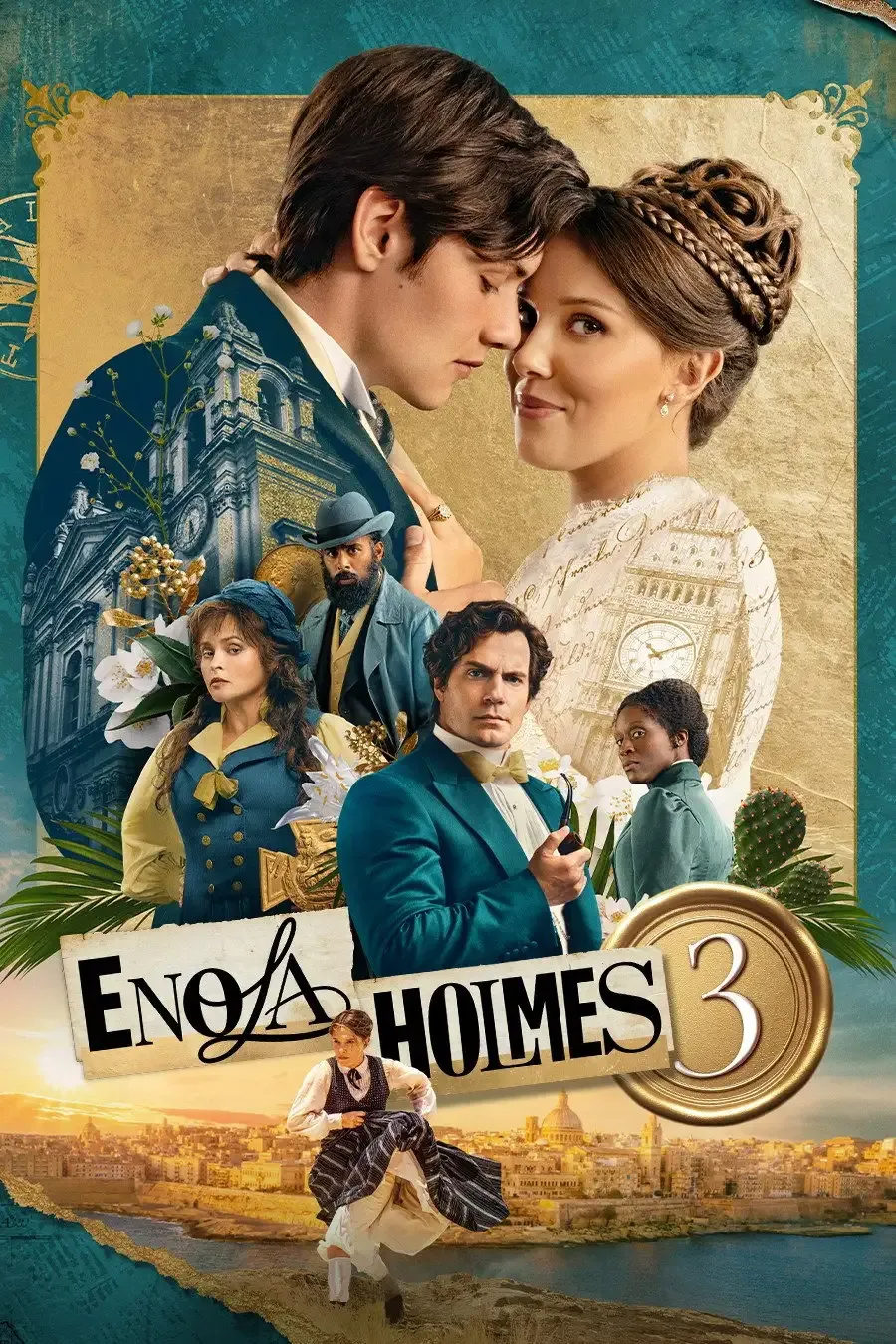
Enola Holmes 3 Review: Millie Bobby Brown's Detective Grows Up and Takes on the British Empire
The third installment trades Victorian whimsy for colonial critique, sending Enola to Malta on a rescue mission that's more ambitious — and messier — than anything the franchise has attempted before.
Editorial Notes
BucketMovies Editorial covers classic cinema, repertory discoveries, and context-rich film criticism with an emphasis on source-backed reporting and careful editorial review.
The first “Enola Holmes” gave us a teenage detective breaking the fourth wall and outsmarting her famous brother. The sequel sent her into London’s labor movement with an actual case to solve. Now, in its third outing, the franchise does something genuinely unexpected: it grows up alongside its heroine, trading the scrapbook aesthetic for a sun-bleached Malta-set mystery that takes direct aim at the British Empire’s legacy of colonial plunder.
Directed by Philip Barantini — whose 2021 single-take kitchen nightmare “Boiling Point” made him one of Britain’s most promising indie directors — “Enola Holmes 3” is his first swing at a big-budget studio picture. The result is a film that feels torn between the franchise’s established charm and the director’s instinct for something rawer. It doesn’t always work, but when it does, it’s the most interesting thing the series has done.
A Detective at a Crossroads
The film opens on Enola (Millie Bobby Brown, who also produces) facing a crisis more existential than criminal: Lord Tewkesbury (Louis Partridge) has proposed, and suddenly she’s staring down a future of country estates and dinner parties. The franchise has always been about Enola carving her own path against Victorian expectations, and here the threat isn’t a villain but a wedding ring. It’s a sharper, more personal setup than the previous films attempted, and Brown plays the internal conflict with real weight — you can see her struggling to reconcile genuine affection for Tewkesbury with the suffocating vision of what marriage would mean for her career.
The personal crisis is interrupted when Sherlock Holmes (Henry Cavill, in what amounts to an extended cameo) is kidnapped during an investigation in Malta. Enola follows the trail to the Mediterranean, where the mystery expands from a simple rescue into something involving stolen artifacts, a shadowy antiquities ring, and a long-buried secret that connects the Holmes family to the uglier corners of British imperial history.
A New Director’s Mark
Barantini brings a distinctly different visual language to the franchise. Gone are the illustrated flourishes and direct-address asides that defined the first two films. Instead, the camera stays tight on Brown’s face during moments of uncertainty, and the Maltese locations — limestone alleys, harbor-front markets, crumbling forts — are shot with a dusty, tactile quality that grounds the adventure. The chase sequences, particularly one through the narrow staircases of Valletta, have a physical, almost desperate energy that the previous films’ more choreographed set pieces lacked.
The tradeoff is that some of the franchise’s personality gets lost in the transition. The fourth-wall breaking, which was the defining stylistic choice of the series, is largely absent here. What replaces it is a more conventional period mystery, and while Barantini executes it well, there are moments — particularly in the film’s saggy second act — where you miss Enola’s conspiratorial glances at the camera.
Supporting Cast and New Faces
Helena Bonham Carter returns as Eudoria, Enola’s radical suffragette mother, in a role that’s smaller this time but lands with impact. Her presence ties the film’s anti-colonial themes back to the franchise’s roots in progressive politics. The standout newcomer is Sharon Duncan-Brewster as a version of Moriarty that’s refreshingly different from the brooding masterminds we’ve seen before — she’s theatrical, almost cartoonish, and clearly having the time of her life.
Himesh Patel joins the cast as a Maltese historian who becomes Enola’s local ally, and while the character is thinly written, Patel brings enough charm to make the dynamic work. Louis Partridge’s Tewkesbury is given less to do than in the previous film, reduced mostly to worried looks and telegraph correspondence.
What Works and What Doesn’t
The film’s ambition is its greatest asset and its biggest liability. The decision to engage seriously with colonial history — including a scene where a character bluntly states that the British Museum is “the largest crime scene in the world” — gives the mystery stakes that feel relevant rather than merely decorative. The franchise has always worn its politics on its sleeve, but this is the first time those politics form the actual spine of the plot rather than providing window dressing for a chase sequence.
Where the film stumbles is in pacing. At just over two hours, the middle section sags noticeably, bogged down by exposition about ancient Maltese artifacts that never quite becomes as gripping as the film seems to think it is. The central mystery — who kidnapped Sherlock and why — resolves in a way that’s satisfying on a thematic level but creaky on a plot one, relying on coincidences and revelations that strain credibility even by the generous standards of the genre.
The film also inherits a problem common to third installments: it introduces a new villain (Moriarty) and a new mythology (the stolen artifacts conspiracy) simultaneously, and neither gets quite enough oxygen to fully breathe. Moriarty, in particular, feels like she’s being set up for a fourth film rather than being fully integrated into this one.
The Verdict
“Enola Holmes 3” is the most grown-up entry in the series, and the most politically pointed. It’s also the most uneven, caught between a director trying to make something grittier and a franchise that built its identity on charm and cleverness. The result is a film that’s easier to admire than to love — but admiration is still a worthwhile response to a Netflix franchise that could have coasted on formula and chose not to.
Millie Bobby Brown continues to be the series’ greatest asset. At 22, she’s already a more commanding screen presence than most actors twice her age, and watching Enola navigate the tension between love, ambition, and identity gives the film an emotional core that holds steady even when the plot wobbles. If the series continues in this direction — more complex themes, less reliance on gimmickry — it has room to become something genuinely distinctive in the YA-adaptation landscape. For now, “Enola Holmes 3” is a promising step that doesn’t quite stick the landing, but earns real credit for attempting a jump the first two films never tried.
Share This Article
Comments