A Minecraft Movie Review: Against All Odds, a Blocky Adventure with Heart
Jared Hess and Jack Black turn the world's bestselling video game into a surprisingly entertaining family adventure that respects the source material.
Editorial Notes
BucketMovies Editorial covers classic cinema, repertory discoveries, and context-rich film criticism with an emphasis on source-backed reporting and careful editorial review.
The video game movie has been a punchline for decades. For every Detective Pikachu or Sonic the Hedgehog that works, there are a dozen Super Mario Bros. (1993) disasters that make you wonder why studios keep trying. A Minecraft Movie, somehow, lands firmly in the former camp. It shouldn’t work—the game has no story, no characters, no dialogue. It’s just blocks. And yet Jared Hess has made something that respects the spirit of the world’s best-selling video game while functioning as an actual movie with jokes, stakes, and a Jack Black performance that holds the whole thing together.
The Setup
The plot is straightforward in the way children’s adventure films tend to be. Four misfits—a struggling single mother (Danielle Brooks), her imaginative son (Sebastian Eugene Hansen), a former gaming champion turned deadbeat (Jason Momoa), and a pragmatic teenager (Emma Myers)—get pulled through a glowing portal into the Overworld. They land in a landscape made entirely of cubes, and before they can process what’s happened, they meet Steve (Jack Black), who has been trapped here for what appears to be years and has gone slightly odd as a result.
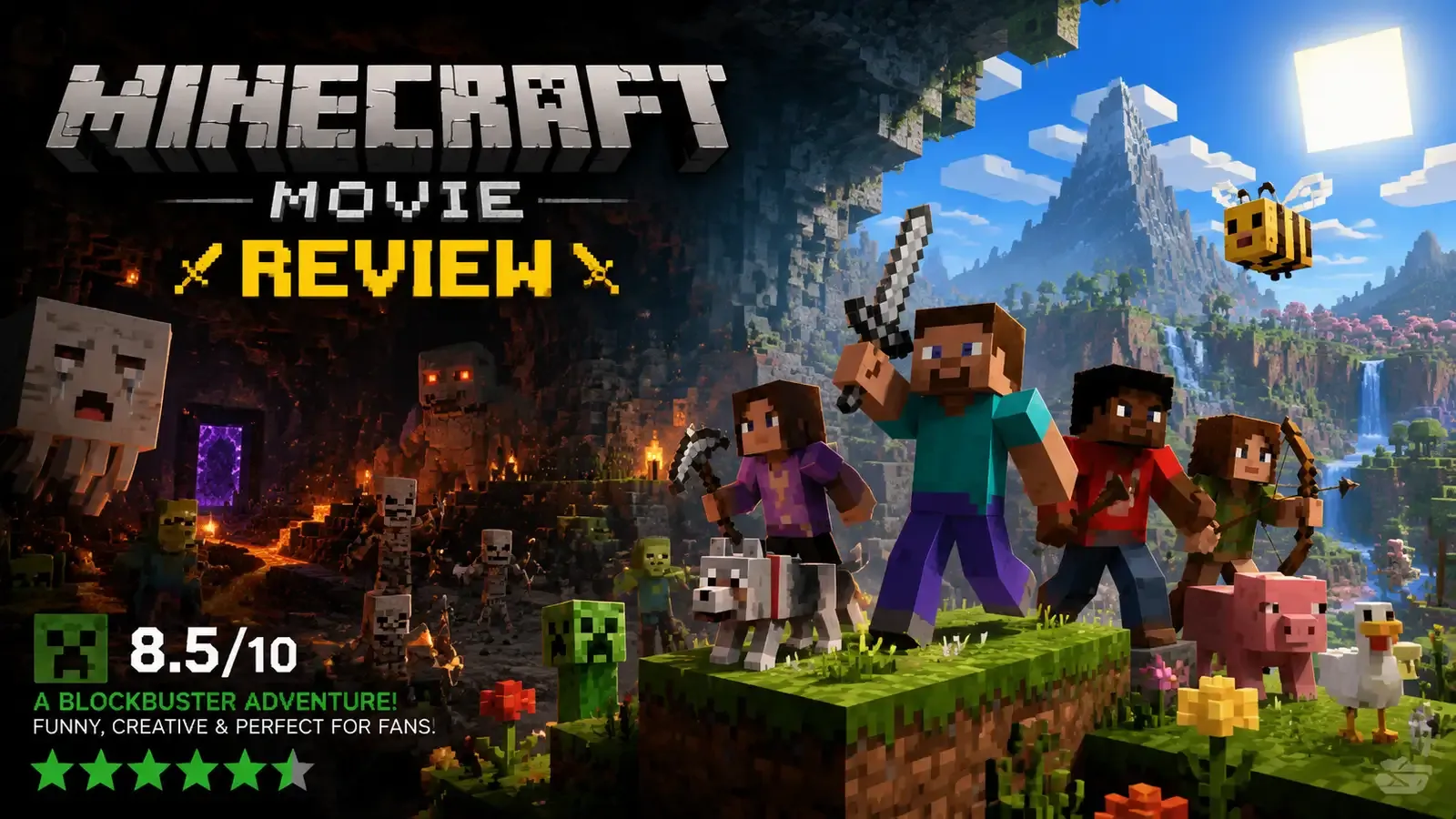
Steve explains the rules: everything is made of blocks that can be broken down and rebuilt. The world operates on crafting logic. Nightfall brings hostile mobs—creepers, skeletons, zombies—and the only way home is to reach a distant portal before the Ender Dragon destroys the Overworld entirely. The group must learn to mine, craft, build, and fight, transforming from confused outsiders into a functional team over the course of their journey.
What Works
Jack Black is the movie’s most valuable asset. His Steve is a man who has spent too long alone in a world of infinite possibility—he’s part survivalist, part unhinged artist, part philosopher of building. Black plays him with the manic energy of a man who’s been talking to sheep for a decade and has forgotten how human conversation works. When he delivers a monologue about the spiritual importance of placing torches to prevent monster spawns, it’s somehow both ridiculous and weirdly moving.
Hess, working from a script he co-wrote with Chris Bowman and Hubbel Palmer, leans into his signature sensibility: the humor comes from characters who take absurd situations completely seriously. The film’s best running gag involves Jason Momoa’s character, Garrett, who was once the world’s greatest Minecraft speedrunner but hasn’t touched a controller in years, trying to translate his virtual expertise into actual survival. Watching Momoa attempt to punch a tree in real life, genuinely expecting it to break into wooden planks, is the kind of deadpan physical comedy Hess has been perfecting since Napoleon Dynamite.
The visual design deserves real credit. The production team made the smart decision to animate the Overworld with a tactile, stop-motion-inspired quality rather than going for hyperrealistic CGI. Blocks click together with a satisfying weight. Crafting tables glow with a warm, inviting light. The creepers are legitimately menacing when they first appear, their hissing build-up translating surprisingly well to a theatrical setting. The Ender Dragon, when it finally appears in the third act, is a genuine spectacle—a massive, shifting creature made of purple particles and black scales that fills the IMAX frame.
Where It Stumbles
The film’s biggest limitation is that its emotional beats are exactly what you expect. The single mother learns to trust her son’s creativity. The deadbeat rediscovers purpose. The pragmatic teenager learns that sometimes the irrational choice is the right one. These arcs are functional but never surprising. For younger viewers, that’s probably fine. Adults accompanying their kids might find themselves checking the runtime.
The second act also drags. Once the characters have learned the basics of the Overworld, the film spends about twenty minutes on montages of building increasingly elaborate structures. It’s fun to look at—the creativity on display is genuinely impressive—but the narrative stalls while the visual team shows off. A tighter edit would have trimmed this section and given the final confrontation more room to breathe.
The supporting cast, while game, doesn’t get enough to do. Danielle Brooks brings warmth to the single-mother role but is underserved by a script that reduces her arc to learning to believe in her son’s imagination. Emma Myers, so sharp in Wednesday, gets a character who’s defined almost entirely by her skepticism, and when that skepticism predictably melts away, the character has nothing left to do. Jason Momoa fares better—his physical comedy instincts are genuinely good, and his arc from washed-up gamer to actual hero is the film’s most satisfying—but even his screentime feels rationed in the back half as the spectacle takes over.
Technical Achievement
The sound design deserves a paragraph of its own. The Overworld has an acoustic signature that’s going to be studied in sound design programs: the crunch of mining, the crackle of a placed torch, the distinct hiss of a creeper priming itself. Composer Mark Mothersbaugh contributes a score that shifts cleverly between orchestral adventure and chiptune homage, using 8-bit flourishes during crafting sequences that will make anyone who’s played the game smile.
The film was shot partially with IMAX-certified cameras, and the third-act confrontation with the Ender Dragon genuinely earns the format. The dragon is rendered at a scale that fills the frame, its particle effects catching light in ways that feel designed for a giant screen. For a movie based on a game whose graphics are intentionally crude, the visual ambition is surprising—and largely successful.
The Video Game Adaptation Bar
A Minecraft Movie arrives at an interesting moment for video game adaptations. The Last of Us and Fallout have proven that prestige television can emerge from game properties. The Super Mario Bros. Movie made over a billion dollars by embracing its source material’s aesthetic. Detective Pikachu and Sonic demonstrated that live-action game adaptations don’t have to be embarrassing.
Hess’s film sits somewhere between the Mario and Sonic models: it invents a narrative framework around the game’s mechanics without trying to adapt a specific storyline, and it trusts that the game’s visual language is distinctive enough to carry a feature. It’s the right call. Minecraft doesn’t have a story to adapt, and any attempt to impose one—the early development process went through several abandoned scripts that tried exactly this—would have felt forced. Instead, the film functions as an introduction to the game’s core loop: explore, collect, build, survive. It’s a feature-length tutorial wrapped in a hero’s journey, and that’s exactly what it should be.
The Verdict
A Minecraft Movie succeeds because it understands what makes the game compelling in the first place: the joy of creation, the satisfaction of incremental progress, and the strange bond that forms when people build something together. It’s not high art, and it doesn’t need to be. It’s a family film with genuine humor, a committed lead performance, and visuals that honor the blocky aesthetic without feeling like a cheap concession.
At 101 minutes, it doesn’t overstay its welcome. Hess keeps the pace lively even through the draggier middle section. The ending leaves room for sequels—this is Warner Bros., after all—but earns its emotional conclusion on its own terms. For families looking for something to see this April, it’s an easy recommendation. For anyone who’s ever spent a Saturday afternoon building something stupid and magnificent in Minecraft, it’s the movie you hoped they’d make.
Share This Article
Comments