The Streaming Wars Are Over — The Free vs. Paid Battle Just Started
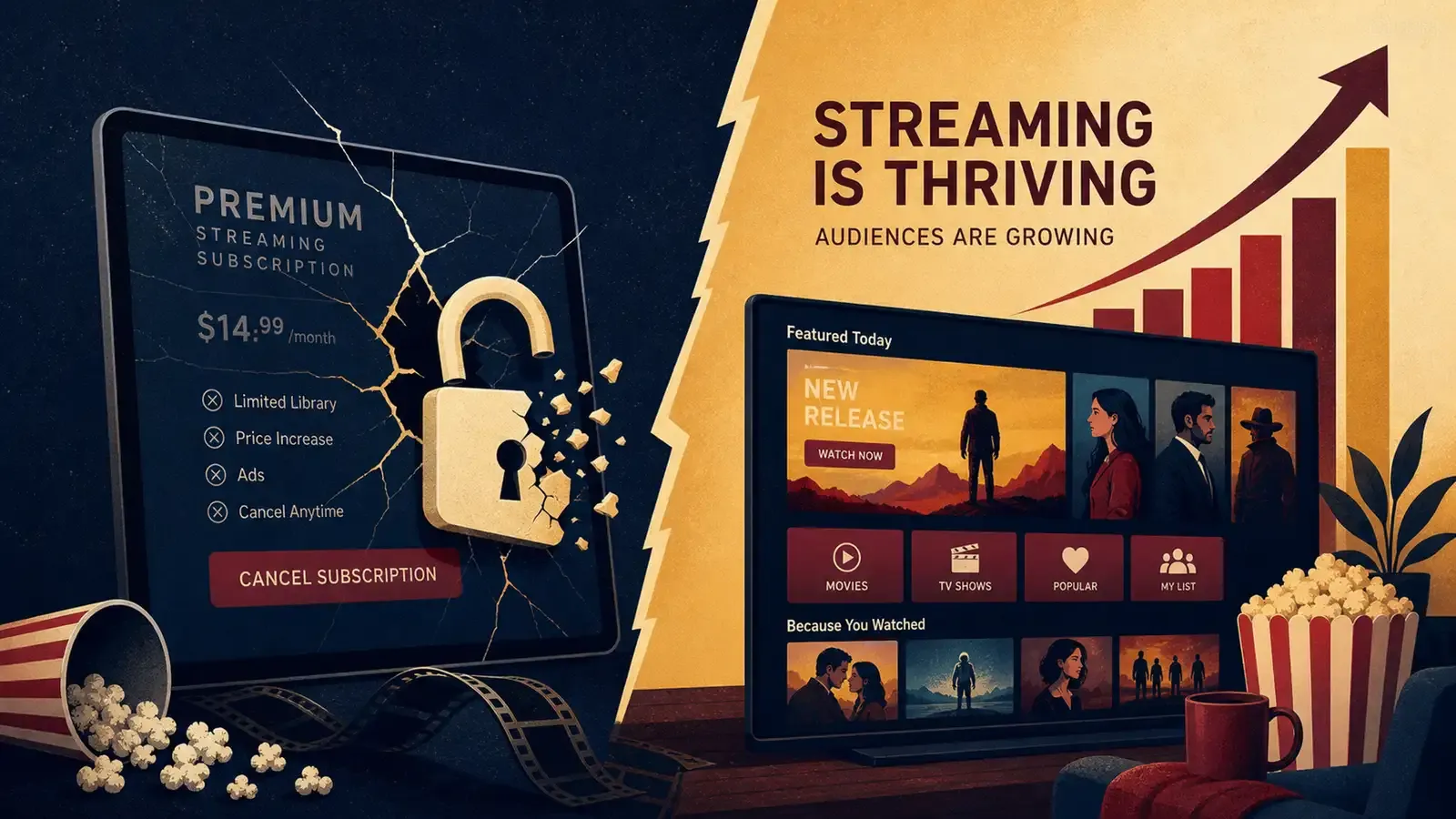
Disney+ is exploring a free tier while Netflix bets $72 billion on premium content. Nielsen data shows free streaming services now command nearly 19% of U.S. TV time, and the trend line only goes one way.
Editorial Notes
BucketMovies Editorial covers classic cinema, repertory discoveries, and context-rich film criticism with an emphasis on source-backed reporting and careful editorial review.
For a decade, the streaming business told one story: subscribers are everything. Churn rate. ARPU. Monthly active users. Every earnings call was a scorecard, and the only question that mattered was who had more people paying every month.
That story just cracked in half.
Last week, Disney confirmed it is internally discussing a free, ad-supported tier for Disney+. The same week, Nielsen reported that free streaming services — YouTube, Tubi, Pluto TV, the Roku Channel — now account for 18.7% of all U.S. television viewing time (TechCrunch, July 10). Two years ago that number was 12.7%. At the current growth rate, free streaming could overtake paid streaming in total watch time before the end of the decade.
Meanwhile, Netflix is doing something that looks like the opposite: spending $72 billion to buy Warner Bros.’ movie studio and HBO, the crown jewel of premium television, in a deal that stunned its own shareholders (Reuters, July 15).
Two companies at the top of the industry, two completely different readings of where things are going. One of them is probably wrong.
Disney+ Wants to Be Free (Sort Of)
The news broke through Business Insider on July 9: Disney chief product and technology officer Adam Smith raised the possibility of a free tier during an internal town hall (Business Insider, July 9). The details are thin — nobody knows which content would be free, how much of the library would be included, or when it might launch. But the direction is clear.
Disney+ already has an ad-supported tier at a lower price point. A free tier would go a step further, putting select Disney, Pixar, Marvel, and Star Wars content in front of anyone with an internet connection, monetized entirely through advertising.
This is not a small pivot. Disney+ launched in 2019 as a premium-only service, deliberately positioning itself as the antithesis of free, ad-supported platforms. The brand was built on exclusivity. You pay for the magic. A free tier says the calculus has changed.
Apple TV+ and Paramount+ already offer a handful of free episodes to non-subscribers. But a full free tier from Disney would be the most significant move any major streamer has made toward the ad-supported model since the subscription era began. It means the company that built its reputation on premium family entertainment has looked at Nielsen’s charts and concluded that the audience it needs isn’t willing to pay.
The Numbers That Changed Everything
Here is the trend nobody in Hollywood wanted to acknowledge until recently, in three data points from Nielsen:
- April 2024: Free streaming = 12.7% of U.S. TV time
- April 2025: Free streaming = 16.8%
- April 2026: Free streaming = 18.7% (TechCrunch, July 10)
That is a 47% increase in share over two years. Subscription streaming, meanwhile, has been raising prices — Netflix, Disney+, Max, and Apple TV+ have all pushed through increases in the last 18 months — while consumers are adding up the monthly totals and hitting “cancel” on services they use once a week.
The economics are straightforward. The average household now pays for roughly three streaming services, at a combined cost approaching $40 to $50 per month. YouTube and Tubi cost nothing. For the kind of casual viewing that fills most evenings — background TV, comfort rewatches, content for kids — “free” beats “pretty good” almost every time.
Netflix’s $72 Billion Counterargument
While Disney is planning a free tier, Netflix spent December 2025 announcing it would acquire Warner Bros. Discovery’s movie studio and HBO for $72 billion. The deal closed earlier this year, making Netflix not just the largest streaming platform but the owner of the most prestigious content brand in television history.
The logic is defensible. HBO brings an unmatched library — The Sopranos, The Wire, Game of Thrones, Succession — and a production pipeline that has won more Emmys than any other network. Combined with Netflix’s global distribution infrastructure and 280 million subscribers, the scale is staggering.
But Reuters points out the uncomfortable history. Big media mergers have a brutal track record. AOL and Time Warner’s $165 billion union in 2000 is still taught in business schools as a case study in how not to do M&A. Disney spent $71 billion on Fox’s assets in 2019 and is worth about the same today as it was seven years ago. Paramount was valued at $30 billion when the Redstone family reunified it in 2019, then sold to Skydance five years later for $8 billion (Reuters, July 15).
The pattern is consistent: buyers overpay for content libraries at peak valuations, struggle to integrate cultures and technology stacks, and discover that combining two giant organizations creates more friction than synergy. Netflix has been a builder for its entire 28-year history — this is its first acquisition anywhere near this scale. The company that invented DVD-by-mail and then killed it with streaming now has to prove it can absorb a legacy Hollywood studio without becoming what it disrupted.
What YouTube and Tubi Understand That Hollywood Keeps Missing
The free platforms aren’t winning because their content is better. They’re winning because they solved discovery in a way paid streamers still have not.
YouTube’s algorithm is the best recommendation engine in media. It does not ask you to commit to a two-hour movie or a ten-episode season. It serves you something short, learns what you respond to, and feeds you more of it. The average YouTube session is longer than the average Netflix session, not because the content is higher quality, but because the platform removes every possible friction point between finishing one piece of content and starting the next.
Tubi takes a different approach: a massive library of older films and TV shows, organized with a level of curation that makes browsing feel like channel-surfing in the 1990s. It is free, the ads are tolerable, and the catalog is deep enough that you can always find something you have not seen in a decade. Fox Corporation bought Tubi for $440 million in 2020. It now generates over a billion dollars in annual ad revenue and reaches more than 80 million monthly active users.
Paid streamers, by contrast, still treat their interfaces like digital Blockbusters. Rows of thumbnails. Generic category labels. No sense of programming or flow. You spend ten minutes scrolling, get decision fatigue, and open YouTube instead. That is the experience Disney is now trying to fix by exploring free content — but the content is only half the problem. The interface needs to stop treating every viewing decision like a $15 movie ticket and start treating it like what it actually is: someone on their couch deciding whether to watch something or scroll Instagram.
The International Signal Nobody Is Talking About
The free-versus-paid debate looks different if you zoom out from the American living room. In India, the world’s second-largest streaming market by users, free ad-supported platforms like YouTube and MX Player dominate total watch time. Disney+ Hotstar built its massive subscriber base on a hybrid model: live cricket drives paid subscriptions during tournament season, while a free tier with ads keeps users on the platform the rest of the year.
Southeast Asia, Latin America, and large parts of Africa follow the same pattern. In markets where disposable income is lower and credit card penetration is uneven, “free with ads” is not a downgrade — it is the only model that reaches scale. The Nielsen numbers showing 18.7% free streaming share in the U.S. are striking precisely because America has long been the premium subscription stronghold. If the trend is this strong here, the global direction is unambiguous.
Disney, with its theme parks, cruise lines, and consumer products empire, has more reasons than Netflix to want a billion people on its platform even if most of them never pay a dollar. Brand exposure sells toys and fills parks. Netflix, whose entire revenue comes from subscriptions, does not have that safety net. The free tier strategy is not just about streaming economics. It is about which company can afford to give content away.
The split between free and paid streaming is going to reshape what kinds of movies and shows get made.
Premium subscription services will continue to fund the expensive stuff: the Nolan epics, the HBO dramas, the $200 million franchise films. That is where the subscription revenue goes, and Netflix’s HBO acquisition doubles down on that bet.
Free, ad-supported platforms will increasingly shape everything else. Mid-budget comedies. Documentaries. Older catalog titles that have already earned back their production costs. Content designed for shorter attention spans and background viewing.
The concern is real: the $40 million adult drama, the kind of film that used to fill theaters between blockbusters, does not have an obvious home in either model. It costs too much for Tubi to produce profitably and does not drive enough new subscriptions for Netflix to greenlight.
But there is another possibility, and it is the one Disney seems to be betting on: that the line between free and paid blurs. That the same platforms offer both, and consumers move between them depending on what they want at that moment. Pay for The Odyssey on opening weekend. Watch The Incredibles for free with ads on a Tuesday night. The platform keeps you either way. The content budget gets diversified.
The streaming wars, as we understood them, were about who could collect the most monthly credit card charges. That phase is over. The next one is about attention — and the companies that are best at holding it, regardless of whether a paywall stands in the way, are the ones that survive.
Netflix is betting $72 billion that premium content remains the gravitational center of the industry. Disney is hedging with a free tier that acknowledges a growing slice of the audience has already moved on. The fact that both strategies might be right at the same time — for different audiences, at different moments — is probably the most honest summary of where streaming actually is in mid-2026. Nobody has figured out the model yet. Everyone is guessing, and the guesses are getting expensive.
Sources:
- Business Insider: Disney exploring free tier for Disney+ (July 9, 2026)
- TechCrunch: Disney+ is considering a free streaming tier (July 10, 2026)
- Reuters Breakingviews: Supersized media M&A haunts Netflix’s next act (July 15, 2026)
Share This Article
Comments