The Conversation (1974): Coppola's Paranoid Masterpiece of Surveillance and Isolation
A deep dive into Francis Ford Coppola's 1974 masterpiece 'The Conversation,' exploring its haunting portrayal of surveillance expert Harry Caul and its enduring relevance in our modern surveillance society.
Editorial Notes
Daniel covers repertory revivals, American genre films, and performance-led criticism across both new releases and older catalog titles.
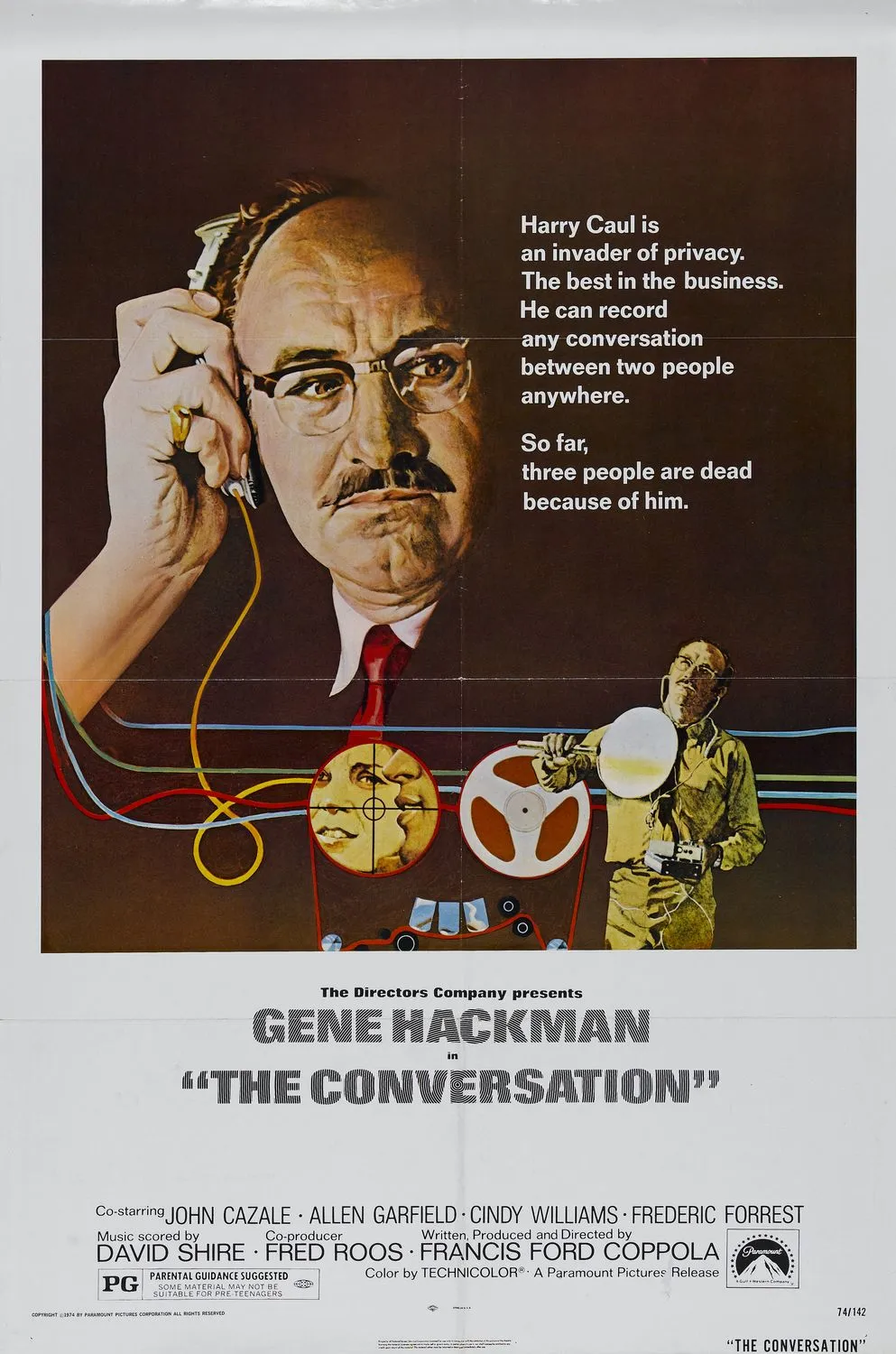
In the shadow of Watergate and amid the lingering trauma of Vietnam, Francis Ford Coppola released what he would later describe as his most personal film. The Conversation (1974) arrived at a cultural inflection point—a moment when American society was grappling with institutional betrayal, the erosion of privacy, and the moral cost of technological advancement. More than five decades later, this quiet masterpiece has lost none of its power. If anything, its examination of surveillance culture feels more urgent now than it did in 1974.
Coppola had already conquered Hollywood with The Godfather (1972) when he turned to this smaller, more intimate project. The film would earn him the Palme d’Or at Cannes and cement his reputation as the defining American filmmaker of his generation. Yet unlike the operatic violence of the Corleone saga, The Conversation derives its tension from silence, from what remains unsaid, from the spaces between words.
The Surveillance Artist
Gene Hackman delivers what may be the finest performance of his illustrious career as Harry Caul, a surveillance expert whose name carries symbolic weight. “Caul” refers both to a spider’s web and the membrane that sometimes covers a newborn’s head—a protective layer that, according to folklore, grants immunity from drowning. Harry Caul has built his life around protection and entrapment, yet he remains profoundly vulnerable.
We first encounter Harry through the film’s legendary opening shot: a slow-motion zoom across a bustling San Francisco plaza, the camera penetrating layers of anonymity until it finds its subject. This virtuoso sequence, filmed by Haskell Wexler, establishes both Harry’s professional capabilities and his fundamental remove from human connection. He observes life through long lenses and directional microphones, extracting secrets from public spaces while remaining invisible himself.
Harry’s obsession is sound—specifically, the recording of a conversation between a young couple (Cindy Williams and Frederic Forrest) walking through that same plaza. The couple believes the crowd provides safety from eavesdropping. Harry knows better. With his team positioned on rooftops and in a surveillance van packed with analog equipment, he captures every whispered exchange. His client, the director of an anonymous corporation (Robert Duvall), wants the tapes. Harry’s payment depends on delivering them.
The Moral Weight of Listening
What distinguishes The Conversation from standard thriller fare is its preoccupation with conscience. Harry Caul is no amoral technician. When his lover Amy (Teri Garr) asks what he does for a living, he cannot answer directly. “I’m a kind of musician,” he finally offers—a revealing choice of words that suggests both artistry and performance, but also evasion.
The film gradually reveals that Harry carries specific guilt from his past. A previous surveillance job in New York apparently led to violence against those he monitored. He confesses to a priest that he fears his current work “will be used to hurt these two young people.” When the priest asks if he feels responsible, Harry insists he is not—yet his voice cracks with the lie. He is responsible, and he knows it.
This moral burden manifests in Harry’s increasingly paranoid behavior. His apartment features three locks, yet his landlord enters freely to leave a birthday present. His mistress knows his unlisted phone number. At a surveillance convention, his chief competitor Bernie Moran (Allen Garfield) tricks him with a bug hidden in a promotional pen. Harry has devoted his life to penetrating others’ privacy while failing to protect his own.
The Ambiguity of Truth
The film’s most celebrated sequence finds Harry alone in a hotel room, listening through the wall as the young couple apparently meets for a rendezvous. He hears sounds of struggle. A scream. Silence. When he eventually enters the adjoining room, it appears pristine—no evidence of violence whatsoever. But when he flushes the toilet, it overflows with blood.
This moment encapsulates the film’s genius for ambiguity. Did Harry witness a murder or imagine one? Coppola and editor Walter Murch (who also designed the film’s groundbreaking soundscape) deliberately withhold definitive answers. The blood may be literal or psychological—a manifestation of Harry’s guilt and mounting hysteria. What matters is Harry’s certainty that something terrible has occurred, and his conviction that he enabled it.
The film’s central puzzle involves eight words from the recorded conversation: “He’d kill us if he had the chance.” Harry plays the tapes obsessively, manipulating three recorders simultaneously in a sequence Coppola modeled after Michelangelo Antonioni’s Blow-Up. Through careful adjustment of frequency and tone, Harry discovers an alternative reading: “He’d kill us if he had the chance.” The difference between “he’d” and “we’d”—between active threat and passive vulnerability—determines everything.
The Sound of Paranoia
Walter Murch’s sound design deserves recognition as a defining element of the film’s artistry. The Conversation treats audio as both narrative device and thematic statement. Harry’s professional obsession with clean recordings—his frustration with intrusive music, wind noise, and audio artifacts—mirrors the film’s own formal concerns. We experience Harry’s world through deliberately distorted soundscapes: conversations bleed into each other, electronic interference creates dissonance, fragments of dialogue repeat with maddening insistence.
The film’s sonic architecture reflects Harry’s deteriorating mental state. As his paranoia intensifies, the boundary between external reality and internal projection dissolves. Sounds carry meanings they cannot possess. The mundane becomes menacing. Even Harry’s refuge—playing saxophone along with jazz recordings—represents another attempt to complete something incomplete, to harmonize with a world that remains stubbornly out of sync.
Isolation as Architecture
Coppola and cinematographer Bill Butler construct Harry’s isolation through visual means. His workspace occupies a corner of an empty warehouse, separated from the vast concrete floor by chain-link fencing. His apartment, though physically secure, feels exposed and temporary. He wears the same plastic raincoat throughout the film—the kind that folds into a travel pouch, suggesting perpetual readiness for departure.
Harry’s relationships follow predictable patterns of suspicion and betrayal. Amy knows him by the sound of his footsteps. Meredith (Elizabeth MacRae), the woman he brings home from the convention, immediately recognizes his professional anxiety: “Forget it, Harry. It’s only a trick—a job. You’re not supposed to think anything about it. Just supposed to do it.” She speaks from her own compartmentalization, and later proves equally capable of betrayal, stealing the crucial tapes.
The film suggests that Harry’s surveillance work has fundamentally damaged his capacity for trust. Every relationship becomes potential surveillance. Every intimacy carries risk. In one extraordinary dream sequence, Harry confesses childhood traumas to the young woman he’s been monitoring—a fantasy of connection that underscores his profound alienation from actual human contact.
The Watergate Connection
The Conversation entered production before the Watergate scandal consumed American politics, yet its release timing seemed almost prophetically aligned with national events. The film opened in April 1974, three months before Richard Nixon’s resignation. Audiences already primed for stories of illegal surveillance and institutional corruption found in Harry Caul a peculiarly sympathetic figure—a working professional caught in machinery larger than himself.
Coppola always maintained that the film’s themes predated Watergate, rooted instead in his own fascination with surveillance technology dating back to the mid-1960s. A conversation with director Irvin Kershner about directional microphones planted the narrative seed. Yet the film’s resonance with its historical moment cannot be overstated. Harry’s employers, represented by the shadowy corporation that employs him, embody the faceless institutional power that Americans were learning to distrust.
The film’s portrayal of surveillance as mundane work—technical, repetitive, occasionally boring—also feels prescient. Harry is no James Bond. His equipment is analog, bulky, prone to failure. His methods require patience and precision rather than glamour. This demystification of espionage anticipated our contemporary understanding of surveillance as bureaucratic process, conducted by ordinary people in ordinary rooms.
A Character Study in Withdrawal
Hackman’s physical transformation for the role deserves particular attention. His Harry Caul appears deliberately nondescript: wire-rimmed glasses, mustache, drab clothing that renders him invisible in crowds. He moves with the slightly stiff gait of someone who has learned to minimize his presence. Even his voice carries hesitation, as if speaking itself feels like exposure.
The performance operates through restraint. Harry rarely raises his voice. His emotional responses manifest in small gestures—a tightening of the jaw, a withdrawal of the eyes, hands that reach for equipment when human contact proves overwhelming. Hackman reportedly found the role exhausting precisely because it required such sustained containment. The character’s emotional constipation creates unbearable tension; we sense the feelings Harry cannot express, the connections he cannot make.
Supporting performances provide essential context. John Cazale, in one of his brief but memorable roles, plays Stan, Harry’s frustrated assistant whose irreverence toward their work highlights Harry’s misplaced solemnity. Teri Garr brings wounded warmth to Amy, recognizing Harry’s damage while lacking resources to address it. Allen Garfield’s Bernie Moran represents Harry’s professional mirror—equally skilled, equally hollow, perhaps more honest about his mercenary nature.
The Enduring Relevance
Watching The Conversation in 2026, one cannot escape its contemporary implications. Harry Caul’s analog equipment has given way to digital surveillance of staggering sophistication, but the fundamental questions persist. Who watches the watchers? What responsibility do technicians bear for how their work is used? Can privacy survive technological progress?
The film’s final moments remain among cinema’s most devastating conclusions. Harry discovers that his own apartment has been comprehensively bugged—his most private space transformed into another surveillance site. He systematically destroys his possessions searching for devices, tears up floorboards, rips into walls. The camera finds him finally, sitting amid the wreckage, playing his saxophone while the camera pulls back to reveal that his privacy was always illusion.
This ending refuses the comfort of resolution. Harry’s violation cannot be undone. The forces that monitored him remain unknown and unaccountable. His saxophone playing—previously a private refuge—now occurs within a panopticon he cannot escape. The film suggests that surveillance culture ultimately consumes everyone, including its practitioners.
Conclusion
The Conversation occupies a unique place in Coppola’s filmography—smaller in scale than his epics, yet perhaps more perfectly realized. It demonstrates that political filmmaking need not sacrifice character complexity or aesthetic sophistication. Its thriller mechanics serve deeper purposes: an investigation of conscience, a meditation on technology’s moral costs, a portrait of isolation in urban America.
The film rewards repeated viewing. Murch’s sound design reveals new layers with each screening. The ambiguous narrative elements—what exactly happened in that hotel room?—resist definitive interpretation while sustaining interpretive richness. Hackman’s performance continues to reveal subtleties decades after its creation.
For contemporary audiences, The Conversation functions as both historical document and urgent warning. Its 1974 setting—analog equipment, San Francisco locations, post-Watergate atmosphere—locates it specifically in time. Its concerns about surveillance, privacy erosion, and institutional power feel utterly current. Harry Caul’s tragedy is not that he lived in a surveillance society but that he helped build one, believing himself protected by professional distance from its consequences.
In an age of smartphones, social media, and ubiquitous data collection, we have all become Harry Caul—simultaneously observers and observed, complicit in systems we barely understand, searching for privacy that may no longer exist. The conversation continues, and we are all listening.
Director: Francis Ford Coppola Screenplay: Francis Ford Coppola Cinematography: Bill Butler (opening sequence by Haskell Wexler) Editing: Walter Murch Sound Design: Walter Murch Music: David Shire Starring: Gene Hackman, John Cazale, Allen Garfield, Cindy Williams, Frederic Forrest, Teri Garr, Harrison Ford, Robert Duvall Runtime: 113 minutes Release: April 7, 1974
Share This Article
Comments