Wake in Fright (1971): The Australian Nightmare That Almost Vanished
Ted Kotcheff's hallucinatory descent into the Australian outback is the most terrifying film about masculinity, alcoholism, and the void at the heart of the frontier. Martin Scorsese helped save it from oblivion.
Editorial Notes
Anna edits BucketMovies criticism and essay packages, with a steady interest in classic Hollywood, literary adaptations, and repertory programming.
Leah Carter
Research Editor
Leah handles source checks, release-date verification, awards coverage, and the reporting framework behind BucketMovies news and industry pieces.
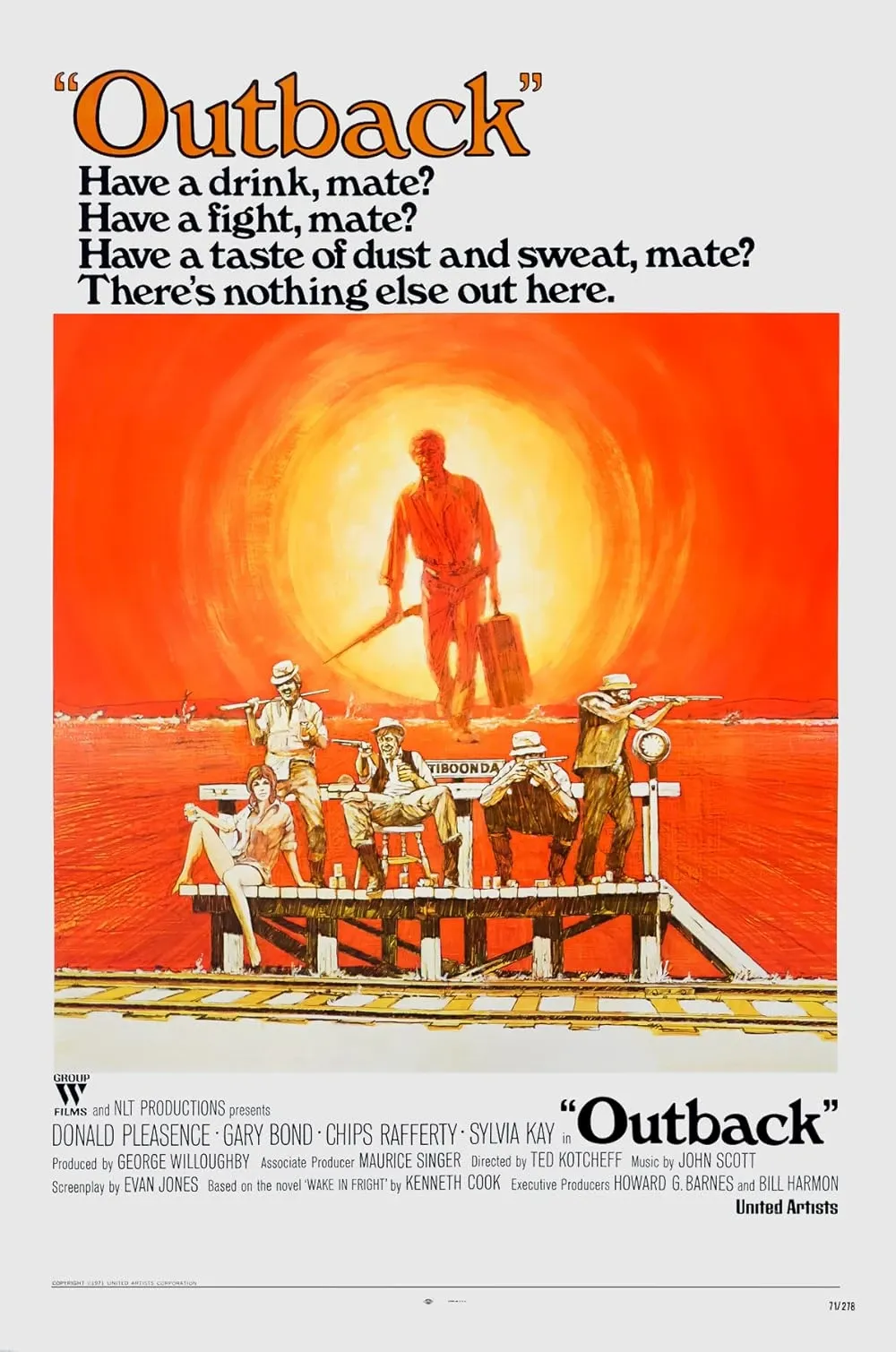
There’s a special category of film that I call “movies I’m glad I saw and never want to see again.” Wake in Fright sits at the top of that list. Ted Kotcheff’s 1971 Australian nightmare is one of the most viscerally disturbing films ever made—not because of monsters or serial killers, but because of beer, heat, and the complete collapse of civilized identity.
I watched it alone, late at night, and I couldn’t shake it for days. The film crawls under your skin and sets up residence there. It’s not horror in any genre sense, but it horrified me more than a thousand slasher films.
The Setup: One Weekend, Total Destruction
John Grant (Gary Bond) is a young, handsome schoolteacher in the remote outpost of Tiboonda. He’s serving out a bond to the government—two years teaching in the middle of nowhere to pay back his education. He’s cultured, refined, contemptuous of the locals. He’s also, crucially, not yet aware of what he’s capable of.
Grant has a Christmas holiday coming. He’s heading to Sydney, to his girlfriend, to civilization. But his train has an overnight stopover in Bundanyabba—“the Yabba”—a mining town in the desert. He plans to have one drink and go to bed.
What follows is five days of alcohol-soaked dissolution that systematically destroys everything Grant thought he was.
The Yabba: Hell as Hospitality
Here’s what makes Wake in Fright so unsettling: the people of the Yabba aren’t malicious. They’re aggressively, inescapably friendly. Every man wants to buy you a beer. Every door is open. Every offer of hospitality is genuine.
And it’s absolutely suffocating.
| Scene | Surface Meaning | Underlying Horror |
|---|---|---|
| Free drinks at the bar | Generosity | You cannot refuse |
| Gambling invitation | Entertainment | Losing everything |
| Staying at someone’s house | Kindness | Trapped, obligated |
| Kangaroo hunt | Male bonding | Participating in slaughter |
Kotcheff understood something about Australian masculinity—and perhaps masculinity in general—that most films ignore: the tyranny of mateship. Grant cannot refuse the drinks without insulting his hosts. He cannot leave without being rude. The entire social structure is built on participation, and participation means surrender.
The Yabba operates on a logic of complete mutual availability. Everyone drinks with everyone. Everyone helps everyone. Everyone is always welcome. There is no privacy. There is no refusal. There is no self.
The Gambler’s Destruction
Grant’s first night in the Yabba, he discovers a gambling game called “two-up”—a simple coin-flipping game that’s entirely about luck. Flush with contempt for these simple miners, certain of his own superiority, he bets everything he has.
He loses.
In one evening, Grant goes from a man with a future to a man trapped in the Yabba with no money for a train ticket, no way out, and an entire weekend stretching before him like a prison sentence.
This is the genius of the film’s structure: Grant is not kidnapped or held captive. He’s simply broke in a town with no options. The prison is economic and social, not physical. He’s free to leave—if only he had anywhere to go.
The Descent
What follows is a controlled demolition of identity. Grant drinks. He drinks more. He accepts hospitality he doesn’t want. He meets Doc Tydon (Donald Pleasence), an alcoholic former doctor who’s given up on everything except getting drunk and articulating his nihilism.
Pleasence is extraordinary here—a shambling, sweaty ruin of a man who sees through Grant’s pretensions immediately. “I’m a doctor,” he explains. “I’m also an alcoholic. The two things aren’t necessarily connected.” His house is a pit of empty bottles and existential emptiness. And Grant keeps coming back.
There’s a sexual encounter that the film presents with deliberate ambiguity—Grant wakes up confused about what happened the night before, and the film refuses to clarify. The uncertainty is the point. Grant is losing track of himself, of his actions, of the boundaries of his body.
The Kangaroo Hunt: The Scene That Almost Didn’t Exist
I need to warn you about the kangaroo hunt sequence. It’s real. The footage of kangaroos being shot is documentary footage from an actual cull, intercut with the actors. It’s brutal, graphic, and disturbing in ways that fiction couldn’t achieve.
Kotcheff has defended the inclusion by noting that the footage already existed—he didn’t kill any animals for the film. But the defense almost doesn’t matter. What matters is what the scene does to the audience and to Grant.
Grant participates. First he watches, horrified. Then he’s given a knife. Then he’s drunk enough, lost enough, empty enough, that he’s stabbing at a dying kangaroo with the same wild abandon as the men he once looked down upon.
This is the film’s thesis: civilized identity is a thin veneer. Put a man in the right conditions—heat, alcohol, peer pressure, the absence of his usual context—and he’ll revert. The kangaroo hunt isn’t about animal cruelty (though it is that). It’s about watching a man discover there’s nothing at his core except what environment makes of him.
The Mirror at the End
⚠️ Spoiler Warning: Discussion of the ending follows.
After days of debauchement, after the hunting, after what may or may not have been a sexual encounter with Doc Tydon, after every boundary has been crossed, Grant tries to kill himself. He takes a rifle, points it at his head, pulls the trigger.
The gun jams.
He wakes up in a hospital, recovers, gets a train ticket, and goes back to Tiboonda. Back to his teaching job. Back to his bond. The final shot echoes the opening: Grant standing in the same spot, looking at the same empty landscape.
But now he knows. He knows what’s underneath his civilized surface. He knows the Yabba isn’t an aberration—it’s a revelation. The man who was so certain of his difference from these rough miners is now someone who gutted a kangaroo while drunk. He has to live with that knowledge.
There’s no redemption. There’s no lesson learned that prevents future mistakes. There’s just continuation, with added self-knowledge that’s worse than ignorance.
The Lost Film, Found
Wake in Fright was released in 1971, shown at Cannes (where it was the first Australian film in competition), and then essentially vanished. The negative was lost. For decades, it existed only in degraded prints and fading memories.
Then, in 2004, editor Anthony Buckley found the negative in a shipping container in Pittsburgh, labeled “for destruction.” He rescued it. The film was restored and re-released in 2009, introduced by Martin Scorsese, who called it “one of the best and most horrifying films I’ve ever seen.”
This history of near-extinction feels appropriate. Wake in Fright is a film that Australia seemed to want to forget—a mirror image too uncomfortable to preserve. That it survived at all feels like the Yabba’s hospitality: inescapable, demanding you confront what you’d rather ignore.
Technical Craft
Kotcheff’s direction is deceptively sophisticated:
Heat as presence: The film makes you feel the temperature. Sweat-soaked faces, harsh sunlight, the oppressive weight of air. You understand why everyone drinks—it’s the only relief.
Sound design: The buzzing of flies, the clinking of glasses, the endless drone of male voices. There’s no escape from sensory input.
Close-ups: Kotcheff frequently shoots faces in tight close-up, often with wide-angle distortion. The effect is claustrophobic and slightly hallucinatory.
Time collapse: The days blur together. We lose track of how long Grant has been in the Yabba, just as he does.
My Rating: 9/10
What works:
- Gary Bond’s committed, physically demanding performance
- Donald Pleasence as the philosopher of oblivion
- Atmosphere so thick you can barely breathe
- Genuinely disturbing without cheap horror tricks
- That ending, forever
What doesn’t:
- The kangaroo footage remains genuinely upsetting
- Some viewers will find the pace too slow
- The ambiguity around certain events may frustrate
If You Liked This, Try:
- Deliverance (1972) — American version of civilized men undone by wilderness
- Straw Dogs (1971) — Peckinpah’s examination of violence beneath the surface
- The Road Warrior (1981) — Australian wasteland as literal apocalypse
- Bad Day at Black Rock (1955) — Another stranger trapped in a hostile town
- Walkabout (1971) — Same year, same continent, different survival
Wake in Fright is a film that doesn’t let you look away. It’s about masculinity as performance, civilization as pretense, and the void that opens up when you remove someone from everything that defines them. John Grant thought he was different from the men of the Yabba. He was wrong.
We all might be wrong.
Have a beer. It’s on the house. Nobody leaves the Yabba unchanged.
References
- Scorsese, Martin. Introduction to 2009 restoration premiere
- Buckley, Anthony. “Rescuing Wake in Fright,” Metro Magazine, 2009
- Cook, Kenneth. Wake in Fright (novel), Text Publishing, 1961 (reprint 2009)
- Stratton, David. The Last New Wave, Angus & Robertson, 1980
- French, Philip. “Wake in Fright review,” The Observer, 2009
Share This Article
Comments