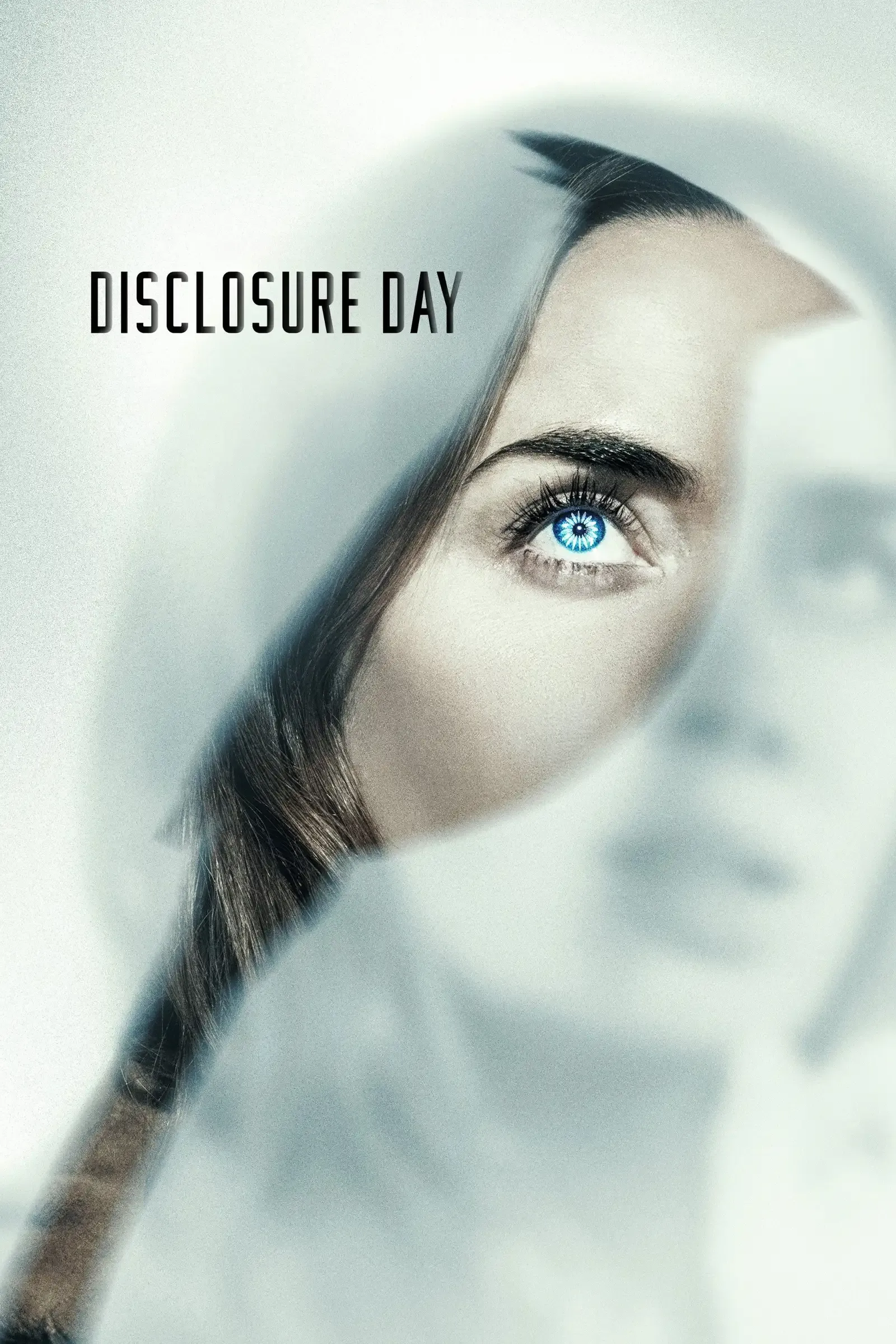
'Disclosure Day' Review: Spielberg's Alien Thriller Is a Sci-Fi Throwback That Nobody Went to See
Steven Spielberg's Disclosure Day is now streaming after a disappointing theatrical run. It's a well-crafted return to the director's sci-fi roots, starring Emily Blunt and Josh O'Connor, with a possibly final John Williams score. So why did audiences stay home?
Editorial Notes
BucketMovies Editorial covers classic cinema, repertory discoveries, and context-rich film criticism with an emphasis on source-backed reporting and careful editorial review.
There’s a scene midway through Disclosure Day where Emily Blunt’s character, a television meteorologist named Margaret Fairchild, stares at a radar screen showing something that shouldn’t be there. The camera holds on her face. No dialogue. No music. Just the hum of equipment and the slow dawning of recognition that everything she knows — everything everyone knows — is about to change. It’s the kind of moment Spielberg has been building toward his entire career, and at 79, he still knows exactly how long to hold it before cutting away.
Disclosure Day arrived on PVOD this week after a theatrical run that can only be described as puzzling. Here are the numbers: $232.9 million worldwide against a production budget of $115 million, with total costs around $195 million once marketing is factored in. An 80% critics’ score on Rotten Tomatoes. A 74 on Metacritic. And a B Cinema Score from opening-night audiences — the polling equivalent of a shrug, not quite bad enough to be interesting but not good enough to generate the kind of word of mouth a movie this expensive needs.
For a Steven Spielberg film about aliens — his first return to the genre since War of the Worlds in 2005 — starring Emily Blunt and Josh O’Connor, shot by Janusz Kamiński for the 21st time and scored by John Williams in what may be their 30th and final collaboration, those numbers don’t add up. Or rather, they add up to something worth examining about where Spielberg sits in a theatrical landscape that has changed dramatically under him.
The premise: a grounded alien story
The setup is vintage Spielberg filtered through a post-Snowden lens. Daniel Kellner (O’Connor), a cybersecurity analyst working for a private contractor, stumbles onto government data confirming decades of extraterrestrial contact. He can’t release it himself — he’d be dismissed as a crank or, worse, arrested. So he tracks down Fairchild, whose job as a local TV meteorologist gives her both a public platform and precisely zero credibility on matters of national security. Together they try to construct a disclosure that can’t be buried.
David Koepp’s screenplay, his fifth with Spielberg after Jurassic Park, The Lost World, War of the Worlds, and Indiana Jones and the Kingdom of the Crystal Skull, leans hard into the procedural mechanics. How do you authenticate something like this? Who do you call first — a journalist, a scientist, a lawyer? What evidence actually holds up under scrutiny? That grounding is the film’s smartest decision. It takes a premise that could easily tip into melodrama and keeps it tethered to the mundane logistics of trying to tell the world something it isn’t ready to hear.
This isn’t Close Encounters of the Third Kind with its cathedral of light and five-note greeting. This isn’t E.T. with its emotional gut punch. It’s closer to The Post in structure and tone: two people holding classified information, navigating institutional resistance, trying to get the truth out before the door slams shut. The alien presence is real in the story’s world, but the movie is far more interested in what happens on the ground once people know.
The performances: Blunt anchors, O’Connor ignites
Blunt has made a career out of playing competent women in high-pressure situations, and Fairchild feels like a natural extension of that line. She’s not an action hero, not a genius, not a chosen one. She’s a professional who knows how to read a room and deliver information clearly, and both of those skills turn out to be exactly what the situation demands. Blunt plays her with a steady, almost unnerving calm — the kind of person who processes existential news by asking practical questions. She reportedly earned $15 million for the role, and she earns every dollar of it in the quiet scenes, particularly a mid-film monologue delivered to a live camera that the film wisely lets play out in a single unbroken take.
O’Connor, coming off Challengers, carries a completely different energy — Kellner as a bundle of frayed nerves held together by obsessive conviction. He’s the one who found the data. He’s the one nobody believes. His performance has a jittery physicality — he’s always moving, always scanning, always one bad interaction away from coming apart — and it provides a necessary counterweight to Blunt’s steadiness.
Their chemistry is professional rather than romantic, and that restraint is one of the film’s quiet strengths. They’re not falling in love. They’re two strangers who realized they’re the only people in the room willing to do the thing that needs doing. The film never forces a love story into that dynamic, and it’s better for it.
The supporting cast is stacked but underused. Annette Bening appears as a skeptical national security advisor and gets maybe three scenes. Timothy Olyphant plays a TV station manager with the kind of weary pragmatism he’s perfected over two decades, and he’s gone before you’ve settled into liking him. These aren’t failures so much as missed opportunities — the film is so focused on its two leads that everyone else feels like set decoration.
The craft: Kamiński and Williams deliver
Kamiński, in his 21st collaboration with Spielberg, shoots the film with a muted, almost documentary texture during the ground-level scenes — handheld cameras, practical lighting, the kind of nervous visual energy that makes you feel like you’re watching something unfold in real time. Then, whenever the subject turns to the skies — a character looking up, a shot of the stars, the brief glimpses of whatever is out there — the frame opens into something wider and more luminous. The contrast is intentional and effective: the world of disclosure is messy and bureaucratic; the world beyond it is vast and indifferent.
And then there’s Williams. At 94 years old, composing his 30th score for Spielberg, he delivers something quieter than you might expect — less the triumphant brass of his adventure scores, more a searching, almost hesitant quality. There’s a recurring four-note motif that plays whenever a character looks at the sky, and by the third or fourth appearance it carries the accumulated emotional weight of every Spielberg-Williams collaboration that preceded it. The New York Post’s critic called it a masterful exit if it proves to be their last. It’s hard to disagree. Williams has nothing left to prove, and this score doesn’t try to prove anything — it simply supports the images the way he’s been doing for half a century.
The problem: a third act that loses its nerve
Koepp’s script is efficient in the first hour. It sets up the stakes, introduces the obstacles, keeps the momentum flowing. The trouble arrives in the third act, where the film seems to lose confidence in its own premise.
There’s a government hearing scene that drags on well past the point of dramatic necessity. There’s a chase sequence — a car pursuit through suburban Virginia — that feels like it was inserted because a studio note said the film needed more action. It’s competently shot, as you’d expect, but it belongs in a different movie. And the very end, without revealing specifics, opts for ambiguity in a story that had been building toward clarity for two hours. The film has spent its entire runtime arguing that the truth matters, that disclosure is worth the cost — and then it hedges on whether the disclosure actually changes anything.
That choice frustrated audiences, and the B Cinema Score tells the story plainly. Cinema Scores operate on a steep curve: A is excellent, B is okay, C is bad. A B from opening-night crowds — the people most excited to see a new Spielberg alien movie — means they walked out feeling fine. Not thrilled. Not angry. Fine. That’s lethal for word of mouth on a $115 million production. For comparison, Spielberg’s West Side Story got an A and still lost two-thirds of its audience the following weekend when Spider-Man: No Way Home opened. A B left Disclosure Day with no defense against the competition.
The film dropped 62 to 65 percent in its second weekend, depending on which tracker you consult. By week three it was hemorrhaging screens. World of Reel’s Jordan Ruimy pointed to Koepp’s screenplay as the primary issue — “clunky” was his word — and while the first hour doesn’t support that criticism, the third act absolutely does. The movie knows what it wants to say but can’t quite figure out how to say it.
The bigger picture: Spielberg in 2026
Disclosure Day is Spielberg’s third consecutive film to lose money theatrically. West Side Story cost $100 million and made $76 million. The Fabelmans was modest at $40 million but barely crossed that threshold. Now Disclosure Day, with solid reviews from critics and a premise that should have been a layup — aliens, Spielberg, Blunt, summer release — couldn’t generate the kind of audience that makes a $195 million investment pay off.
The numbers don’t point to a quality problem. An 80 percent on Rotten Tomatoes is firmly in “well-reviewed” territory. The issue appears to be demographic. Variety reported that the film played strongest with men over 40 who grew up on Spielberg’s filmography. Gen Z — the audience that turns a $100 million opening into a $300 million global run — largely didn’t show up. They were watching Obsession (which has passed $333 million globally) and Backrooms instead, films built by and for a generation that doesn’t associate the name “Spielberg” with an automatic ticket purchase.
None of this means Spielberg is finished as a commercial director. He reportedly wants to make a western next, and at 79, having made Jaws, Raiders of the Lost Ark, E.T., Jurassic Park, Schindler’s List, and Saving Private Ryan, he’s earned the right to make whatever he wants on whatever terms he can secure. But the economics have shifted under him in a way that feels permanent. The name that once guaranteed a blockbuster now guarantees a conversation. Whether that conversation ends with audiences in theater seats is a separate question — and Disclosure Day suggests the answer, for now, is no.
Verdict
If you have any affection for the kind of mid-budget, idea-driven sci-fi that studios barely greenlight anymore — the kind where the spectacle is in the performances and the ideas rather than the explosions — Disclosure Day earns your evening. It’s streaming on Prime Video for $19.99 to rent or $24.99 to buy. The film runs just over two hours, moves briskly through most of it, and lands on a note that, even if it’s not the one you were hoping for, will probably linger longer than a tidier resolution would have.
For Blunt’s performance — steady, intelligent, unsentimental — for Williams’s possibly final collaboration with the director who defined his career, and for the simple, increasingly rare pleasure of watching a master craftsman work in the genre he helped invent, it’s an easy recommendation. Whether it’s worth $25 depends on how much you value seeing a 79-year-old filmmaker still reaching for something genuine in a market that mostly punishes the attempt. I’d argue it’s worth more than that, but the box office already disagreed.
Share This Article
Comments
Join the conversation
0 entriesRelated Articles
'The Dink' Review: Ben Stiller and Jake Johnson Serve Up the Year's Most Surprisingly Charming Sports Comedy

Anora Review: Sean Baker's Unflinching Masterpiece of Class, Desire, and the American Dream