'The Dink' Review: Ben Stiller and Jake Johnson Serve Up the Year's Most Surprisingly Charming Sports Comedy
Apple TV+'s pickleball comedy shouldn't work — a 103-minute film about the world's most ridiculed sport, starring a guy who looks perpetually confused. Yet 'The Dink' lands its shots more often than it misses, thanks to a game cast and a script that knows exactly how silly its premise is.
Editorial Notes
BucketMovies Editorial covers classic cinema, repertory discoveries, and context-rich film criticism with an emphasis on source-backed reporting and careful editorial review.
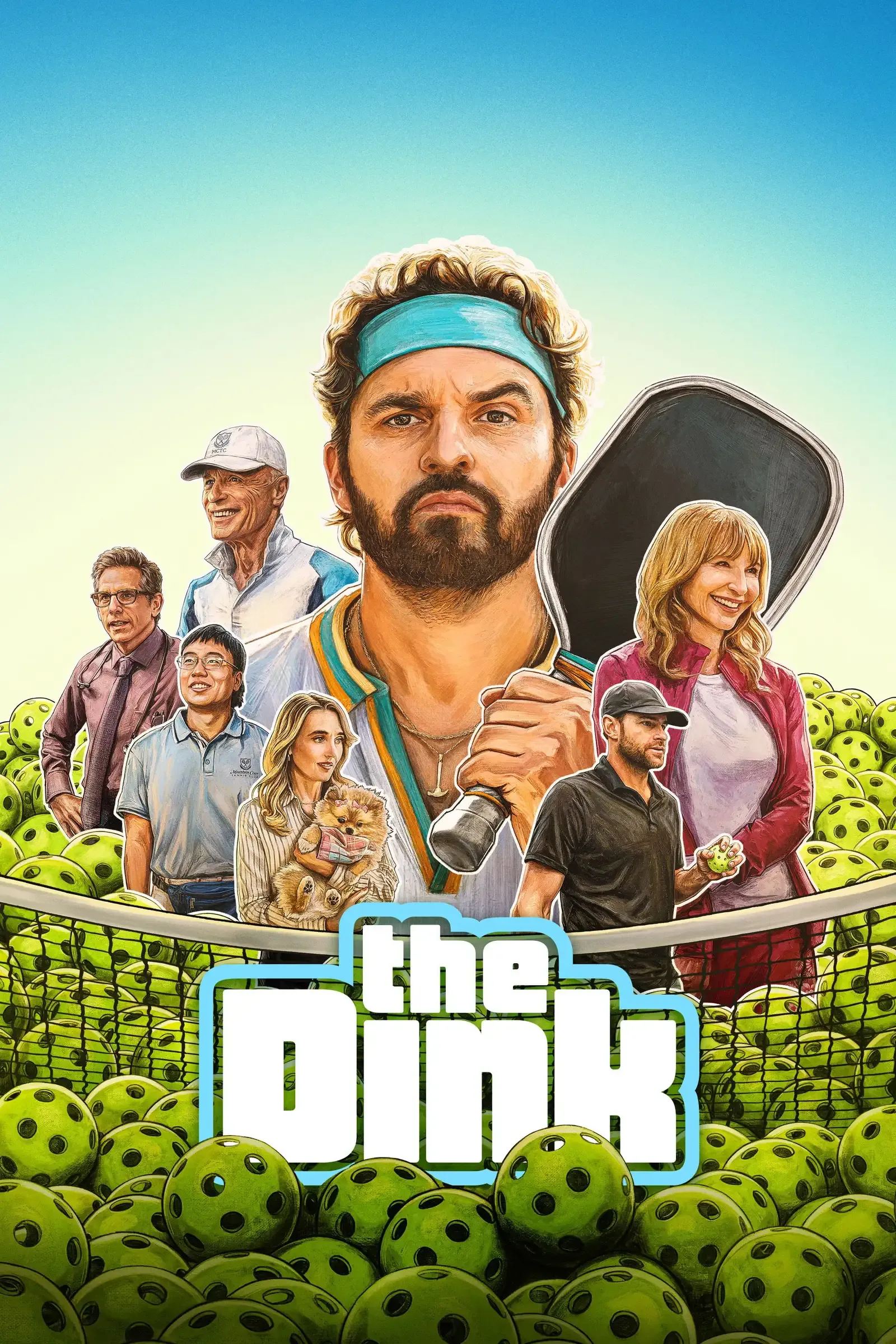
There is a moment early in The Dink where Jake Johnson, playing a washed-up tennis coach named Dusty Boyd, stares at a pickleball paddle like someone handed him a child’s toy and told him it was a weapon. The expression on his face — equal parts disgust and confusion — is basically the face every tennis player makes the first time they hear the hollow pop of a plastic ball. If you have spent any time around a country club in the last three years, you know exactly what I am talking about.
The movie knows it too. That self-awareness is what keeps The Dink from becoming the thing it is mocking. Apple TV+ dropped this 103-minute sports comedy in mid-July with minimal fanfare — no massive marketing push, no Comic-Con panel, no Super Bowl trailer — and watched it climb to number one in multiple countries anyway. Sometimes audiences just decide they want to watch Jake Johnson be grumpy about pickleball for an hour and a half. Source
A premise that earns its runtime
Dusty Boyd was supposed to be a tennis star. Instead, he is coaching kids at his father’s country club in Florida, still wearing the same brand of sweatbands he wore on the junior circuit twenty years ago. His car has a tennis ball stuck under the brake pedal. His dating profile still lists “former ATP prospect” like that means something in 2026. Johnson plays the character with the same shaggy, put-upon energy he brought to Nick Miller on New Girl, but there is a faint undercurrent of genuine sadness here that was never part of that character. Dusty is not just lazy — he is stuck.
His father, played by Ed Harris, runs the club like a monarchy. Harris delivers the kind of performance that reminds you why directors keep casting him as fathers who disapprove of everything: he can communicate more disappointment with a single exhale than most actors can with an entire monologue. When the pickleball craze arrives — four courts painted over the clay, bright yellow balls everywhere, the unmistakable sound of middle-aged accountants arguing about the kitchen rule at seven in the morning — Dusty’s father wages a personal war against it. The club is for real tennis, he insists. Not this plastic nonsense.
Then Dusty injures his wrist during an ill-advised attempt to prove he still has his old serve. His doctor, played by Ben Stiller in a performance that basically amounts to ten minutes of glorified cameo work but somehow still leaves an impression, prescribes the one thing Dusty cannot stomach: pickleball. The lower-impact game is perfect rehab. Stiller plays Dr. Stone as a man who has seen this exact patient a thousand times — the aging athlete who refuses to accept that his body has moved on without him — and he delivers his prescription with the weary patience of someone who knows exactly how the next five minutes of argument will go.
Dusty grits his teeth, picks up a paddle, and discovers something he was not prepared for — he actually likes it. The script, written by Johnson and director Max Winkler, does not pretend this is a profound revelation. Dusty’s arc follows the classic snob-learns-humility template, and the movie does not try to hide that. What elevates it is the ensemble.
A cast that earns its paycheck
Mary Steenburgen plays Glenda, a retiree who discovered pickleball two years ago and has since reorganized her entire life around it. She treats every rec-center game like the Wimbledon final, and her scenes with Johnson — her patiently explaining the finer points of dinking strategy while he rolls his eyes — are the warmest in the film. Steenburgen has been doing this kind of supporting work for decades, and she is so good at it that you almost forget she is acting.
Aaron Chen, the Australian comedian, plays a hyper-competitive Gen Z pickleball influencer who streams his matches on Twitch under the handle @DinkLord. Chen gets some of the biggest laughs without saying much — his character communicates primarily through exasperated glances and the occasional deadpan observation delivered in a monotone that somehow makes everything funnier.
And then there are the tennis pros. Andy Roddick appears as himself, playing an exaggerated version of the retired-athlete-who-now-plays-pickleball-for-fun archetype, complete with a headband that somehow looks expensive. John McEnroe shows up for exactly two scenes and steals both of them. There is a brief exchange between McEnroe and Harris’s character about whether pickleball even counts as a sport that is worth the price of admission by itself. McEnroe, who has spent decades being the angriest man in tennis, suddenly defending pickleball with the same intensity he once used to argue with line judges — it is exactly as funny as it sounds.
Where it wobbles
The movie runs 103 minutes, and the middle section sags. There is a subplot about Dusty’s strained relationship with his father that gets resolved too neatly in a single conversation that takes place, conveniently, on the pickleball court during the film’s climactic tournament. Harris and Johnson sell the moment as well as anyone could, but you can feel the screenplay hurrying to tie a bow on a conflict it spent 80 minutes building.
The romance subplot fares even worse. Dusty develops a tentative relationship with a local coffee shop owner played by Zoey Deutch, who appears in maybe five scenes total. Deutch is charming — she always is — but the role is underwritten to the point of feeling like an afterthought. Their relationship progresses from “they exchanged numbers” to “they are clearly together now” with almost nothing in between. You get the sense that an earlier draft had more for her to do and it was cut for pacing, but the result is a romantic arc that exists mostly in the audience’s imagination.
The tone inconsistencies that Alissa Wilkinson flagged in her New York Times review are also real. Source The movie sometimes wants to be a broad slapstick comedy — there is a sequence involving a golf cart, a water hazard, and a flock of startled geese that belongs in an entirely different film — and sometimes wants to be a sincere story about middle-aged reinvention. The two modes do not always sit comfortably together. Mark Keizer at MovieWeb captured it precisely: the film trades “on likability more than sharp humor or outrageous gags.” Source
The pickleball of it all
You could dismiss The Dink as a cash-in on a trend — pickleball has exploded from a retirement-community curiosity to a multi-billion-dollar industry in less than five years, complete with professional leagues, celebrity investors, and a genuine culture war with tennis. Source The fact that a major studio comedy about the sport exists at all is its own kind of cultural timestamp.
But the film is smarter about this than its premise suggests. It never makes pickleball the butt of the joke — the humor comes from how seriously people take it, not from the sport itself. The movie understands that the line between “this is ridiculous” and “this is the most important thing in my life” is basically invisible once you are standing on the court. Anyone who has ever played a recreational sport with actual emotional stakes will recognize themselves in at least one of these characters.
Why it works anyway
The movie’s 73% Certified Fresh score on Rotten Tomatoes captures something honest about what The Dink is and is not. Source It is not a masterpiece — it does not have the anarchic energy of Dodgeball or the precision of a good Apatow comedy. It is a 103-minute film about pickleball that does not embarrass itself, and that alone feels like a small achievement in an era when streaming comedies often feel algorithmically assembled.
There is a specific quality to Johnson’s performance worth calling out, because it is the thing that holds the movie together when the script wobbles. He has always been good at playing men who are slightly less competent than they think they are, but here he adds a layer of self-awareness — Dusty knows he is a disappointment, knows he peaked at nineteen, knows the pickleball thing is ridiculous. He does it anyway. That is a harder note to hit than it looks, and Johnson hits it without ever tipping into self-pity. In a film full of jokes about a plastic ball, the most affecting moment is silent: Johnson standing alone on an empty court at dusk, paddle in hand, looking at the net like it is either a door closing or a door opening and he cannot tell which.
Johnson, who co-wrote and produced, clearly understands what kind of movie he is making. He never tries to sell it as anything more than a good time — and a good time is what it delivers, with enough genuine warmth to make you forgive the parts that do not work. The film hit number one on Apple TV+ in multiple countries on its opening weekend, which suggests audiences are ready for exactly this kind of thing. Source Not everything needs to be The Odyssey pulling in $124 million. Sometimes you want to watch Jake Johnson learn to dink while Ed Harris fumes in the background and Mary Steenburgen celebrates like she just won the US Open.
Peter Travers gave it 2.5 out of 4 stars, calling it a film with “a lot of heart,” and that feels about right. Source If you go in expecting Dodgeball for the pickleball era, you will be slightly disappointed — the humor here is gentler, built on character rather than humiliation. If you go in expecting an easy watch on a summer evening with a glass of something cold and no desire to think too hard, you will probably have a very good time. The movie knows what it is. Respect to anything that accomplishes that.
For a broader look at the current streaming landscape, our guide to what to watch this July covers more than a dozen new releases across every platform. And if you are in the mood for something considerably darker than a pickleball comedy, our analysis of Ryan Coogler’s horror pivot with Sinners explores a filmmaker working in a very different register.
The Dink is streaming now on Apple TV+.
Share This Article
Comments