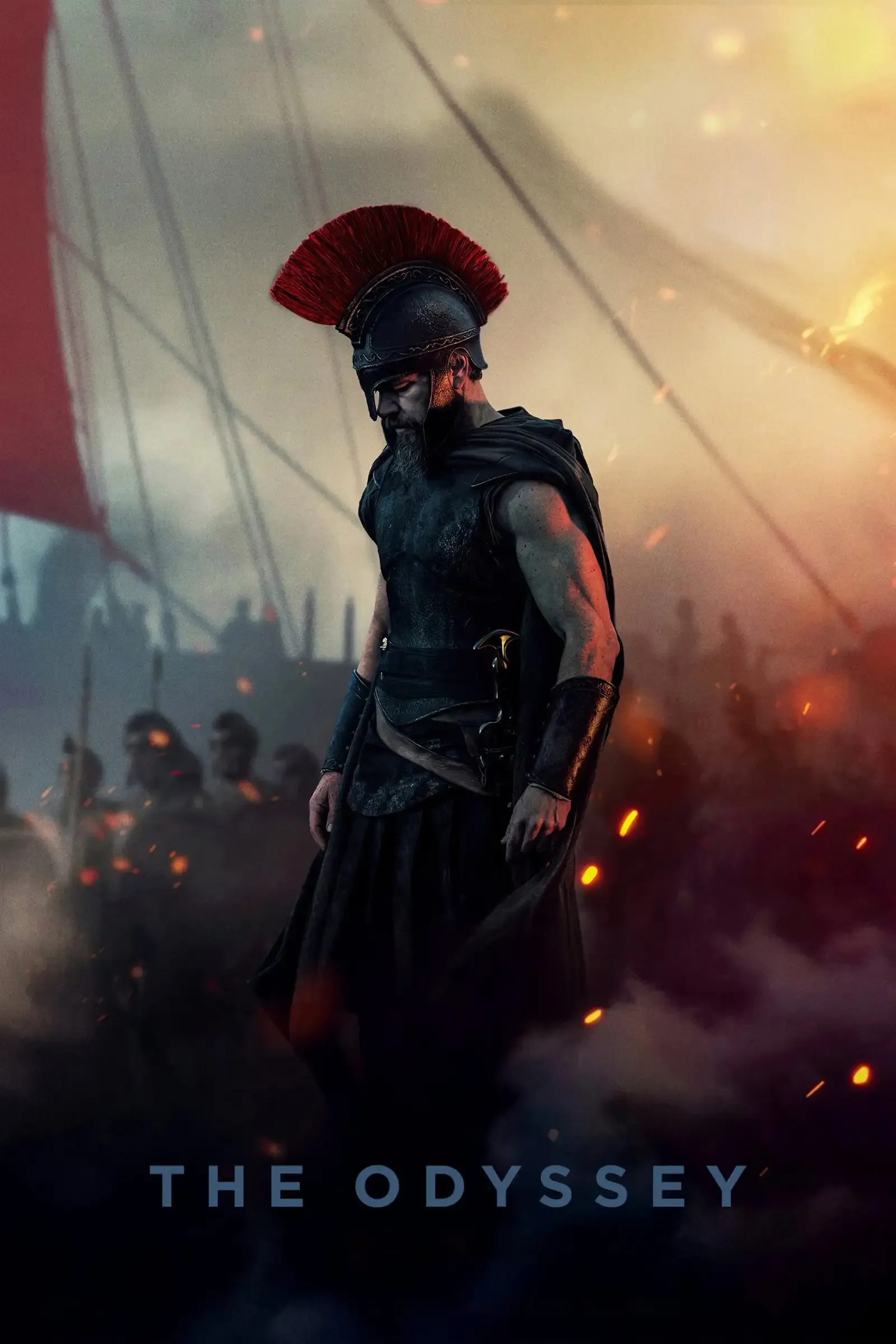
'The Odyssey' Early Reviews Are Unanimous — Can Nolan Top 'Oppenheimer'?
Two rounds of early screenings for Christopher Nolan's The Odyssey have produced universally glowing reactions. With a star-studded cast led by Matt Damon and Zendaya, the film is already being discussed as a major awards contender. But a casting controversy in Greece adds an unexpected wrinkle.
Editorial Notes
BucketMovies Editorial covers classic cinema, repertory discoveries, and context-rich film criticism with an emphasis on source-backed reporting and careful editorial review.
Christopher Nolan does not do small. After Oppenheimer won seven Oscars and grossed $975 million — numbers that should not be possible for a three-hour black-and-white biopic about a physicist — the question was always going to be: what could possibly come next? The answer, arriving in theaters July 17, is Homer’s The Odyssey, a 3,000-year-old poem about a man trying to get home from a war and failing, repeatedly, for an entire decade.
Two invite-only press screenings have now taken place. The first batch of social media impressions dropped last week. The second wave, from a screening held just days before the official premiere, hit Monday. And if you are expecting the typical early-reaction hedging — “ambitious but uneven,” “visually stunning but narratively messy” — you will not find it here. The takes are unanimous. They are also, by the standards of film Twitter, suspiciously glowing.
Two screenings, zero dissent
Forbes senior contributor Paul Tassi summed up the second round of reactions with a single observation: they mirror the first batch exactly. Not a single lukewarm take has surfaced from either screening. Critics who attended the previews have described the film with adjectives usually reserved for career-capping achievements — “monumental,” “overwhelming,” “the kind of movie that reminds you why theaters exist.”
The timing of these screenings is worth noting. Studios typically hold early press screenings months in advance when they are confident in a film’s awards potential. Universal is doing them days before release, which signals something different: they believe word-of-mouth alone can carry the opening weekend. For a film based on a text most people last encountered in a high school English class, that is a remarkable bet.
The reports from both screenings point to a film that does not sand down the source material’s rougher edges. Homer’s Odysseus is not a straightforward hero. He lies, cheats, gets his entire crew killed, and spends seven of his ten lost years as a goddess’s captive lover. Early reactions suggest Nolan leans into the ambiguity rather than smoothing it into a conventional blockbuster arc.
This approach makes sense for a director who has spent his career interrogating unreliable narrators and the stories people tell themselves to survive. The Odyssey, at its core, is a story about storytelling — Odysseus talks his way into and out of every situation, and the poem itself is framed as a tale he recounts after the fact. If any director was going to find the meta-narrative thread in Homer, it was the guy who made Inception.
The technical elements are drawing particular praise. Multiple critics have singled out the Mediterranean location photography — shot across Greece, Malta, and the coast of Turkey — as the most immersive of Nolan’s career since Dunkirk. The Cyclops sequence, reportedly rendered through a combination of large-scale puppetry and selective VFX, has been described in early reactions as genuinely terrifying rather than CGI spectacle. If those descriptions hold, it would mark a return to the practical-effects ethos that made his earlier work feel tactile in a way most blockbusters do not.
The faces carrying a 3,000-year-old story
Matt Damon leads as Odysseus, and the casting is smarter than it looks on paper. Damon has spent two decades oscillating between everyman roles and characters whose competence masks a cold, calculating core — Jason Bourne, Tom Ripley, the astronaut Mann in Interstellar. Odysseus demands both registers. He is charming enough to talk his way out of any situation and ruthless enough to slaughter a room full of men who have done nothing worse than eat his food and flirt with his wife.
Zendaya plays Athena, the goddess who intervenes on Odysseus’s behalf throughout the poem. It is a casting choice that signals something about Nolan’s interpretation. Athena in Homer is not a passive divine assistant. She is strategic, interventionist, and at times more active than Odysseus himself in driving the plot forward. Giving the role to an actor with Zendaya’s screen presence suggests Athena will not be reduced to a voice whispering wisdom from the sidelines. In interviews with IGN, both Damon and Zendaya described the production as unusually demanding even by Nolan’s standards — practical sets built on Mediterranean coastlines, minimal green screen, sequences shot on open water with real ships. The supporting cast reads like an awards-season ballot: Tom Holland, Anne Hathaway, Robert Pattinson, Lupita Nyong’o, and Charlize Theron, with narration from Travis Scott. Every one of them has either won or been nominated for major awards, and Nolan has a track record of pulling career-best work from actors who already have full trophy cases.
Nolan told IGN India in a separate interview that he would “love” to make a horror film someday but has not yet found the right concept. The comment is relevant to The Odyssey because the poem contains genuinely terrifying sequences — the Cyclops, the underworld, Scylla and Charybdis — and early reactions suggest Nolan does not soften them.
Greece has thoughts, and not all of them are welcoming
Not everyone in Greece is celebrating. The small nationalist party Niki formally objected to both the casting choices and the Greek government’s decision to provide roughly €6 million ($6.9 million) in production subsidies. Niki framed the film as an imposition of “woke-type ideology” on Greek cultural heritage, a line that echoes recent American culture-war rhetoric more than any specific complaint about the movie itself.
Culture Minister Lina Mendoni issued a blunt rebuttal. She characterized the subsidies as a standard investment in cultural tourism and local production jobs — the kind of deal dozens of countries offer Hollywood productions every year — and dismissed the ideological objections as a political performance.
For Greek audiences, the relationship with Homer is not abstract. Seventh-graders across the country spend an entire school year studying The Odyssey, debating its moral questions and unpacking its characters. The poem is not a museum piece in Greece. It is living curriculum, and Nolan’s version will inevitably be compared against a text that millions of Greeks know in their bones. That creates both an opportunity and a risk: an audience that arrives with deep familiarity and high expectations, ready to notice every deviation from the source.
The subsidies themselves are not unusual. Greece has been courting international productions for years as part of a broader strategy to build a domestic film industry and boost tourism to locations beyond the Athens-Santorini circuit. What made this particular deal contentious was the cultural sensitivity of the material. When a Hollywood director adapts your national epic with a cast of American and British stars, the conversation shifts from economics to identity faster than any press release can manage.
The Oppenheimer shadow and the box-office question
The comparison to Oppenheimer is both the most obvious lens for evaluating The Odyssey and the least fair. Oppenheimer was a cultural event that caught a specific lightning-in-a-bottle moment — the Barbenheimer phenomenon, a summer where audiences suddenly decided that serious, adult filmmaking was worth leaving the house for. You cannot manufacture that twice.
But the structural similarities are real. Both are long, serious films anchored by a heavyweight lead performance. Both tackle big themes — mortality, power, the stories we tell about ourselves — through the specific lens of one man’s journey. And both arrive with a director working at the peak of his commercial and critical powers.
The box-office ceiling is hard to call. The Batman films are Nolan’s commercial peak at over a billion dollars each, but Oppenheimer proved he can draw audiences without a cape. The Odyssey has the additional advantage of being, at its core, an adventure story — monsters, shipwrecks, gods intervening in human affairs. The material is inherently more accessible than theoretical physics, and the cast alone will pull demographics that a three-hour drama about a scientist cannot.
There is also the IMAX factor. Nolan shoots on IMAX film, his movies dominate premium large-format screens for weeks, and audiences have been trained to treat a new Nolan release as an event that demands the biggest screen available. Premium format tickets cost more, which inflates grosses even if total admissions stay flat. If The Odyssey captures even half of the cultural-event energy that surrounded Oppenheimer, it will have no trouble crossing $500 million globally. If it captures all of it, the comparisons to his Batman numbers will start in earnest.
Awards speculation has already begun. Critics on social media have mentioned Best Picture, Best Director, and multiple acting categories as realistic targets. The Academy has embraced Nolan before, and a film that marries literary prestige with large-scale filmmaking checks every box on the Oscar voter’s wish list.
What it means for Nolan’s filmography
If the early reactions hold — and two unanimous screening rounds make a decent case that they will — The Odyssey will sit at an interesting point in Nolan’s career. His filmography has always pulled in two directions: the puzzle-box precision of Memento, Inception, and Tenet on one side, and the visceral, emotional wallop of Dunkirk and Oppenheimer on the other. The Odyssey sounds like it belongs to the second camp, but with a mythological register that is new territory for him.
The risk is real. Adapting Homer is not like adapting a nonfiction book or a comic. The source material carries cultural weight that a Batman movie does not, and audiences in different countries will bring different expectations. What plays as epic spectacle in Kansas might read as cultural appropriation in Athens.
But Nolan has also rarely made a film that did not reward multiple viewings, and The Odyssey — a story explicitly about the difficulty of returning home, of being changed so thoroughly by experience that home no longer recognizes you — is material built for his particular obsessions. Time, memory, identity, the stories we tell to make sense of who we have become: these are the themes Nolan has been working through his entire career. Homer got there first, three millennia ago. The early word says Nolan has done the material justice. Theaters will tell us the rest starting Friday, when the film opens across more than 4,000 screens in North America alone.
Share This Article
Comments
Join the conversation
0 entriesRelated Articles
Christopher Nolan's The Odyssey Arrives: Shot Entirely on IMAX, 2 Million Feet of Kodak Film, and a 60-Foot Practical Cyclops
'The Dink' Review: Ben Stiller and Jake Johnson Serve Up the Year's Most Surprisingly Charming Sports Comedy