Jumanji: Open World Trailer Drops as Sony Bets $1.7 Billion Franchise Against Dune and Avengers
Sony's trailer for the third and final Jumanji film arrives with the core cast intact, a Christmas release date, and the unenviable task of opening between Dune: Part Three and Avengers: Doomsday.
Editorial Notes
BucketMovies Editorial covers classic cinema, repertory discoveries, and context-rich film criticism with an emphasis on source-backed reporting and careful editorial review.
Sony dropped the first trailer for Jumanji: Open World on July 29, and for a franchise that has earned $1.7 billion by turning a board game into a video game and video game avatars into Dwayne Johnson, the stakes have never looked higher. Not because the film looks bad. Because the release calendar just handed it one of the toughest opening weekends in box office history.
The two-minute teaser gives fans their first look at the third and reportedly final entry in the rebooted Jumanji series. The core quartet is back, the jungle looks deadlier, and the video-game logic that made the 2017 and 2019 films work hasn’t changed. But the real drama surrounding Open World isn’t really about what is in the trailer. It is about what is opening two weeks earlier and the same day.
The Band Is Back Together
Dwayne Johnson, Kevin Hart, Jack Black, and Karen Gillan all return as the in-game avatars of a group of teenagers who keep getting sucked into Jumanji’s increasingly elaborate video game traps. Danny DeVito is back too, along with Nick Jonas, Awkwafina, Marin Hinkle, Bebe Neuwirth, Lamorne Morris, and Rhys Darby. [1]
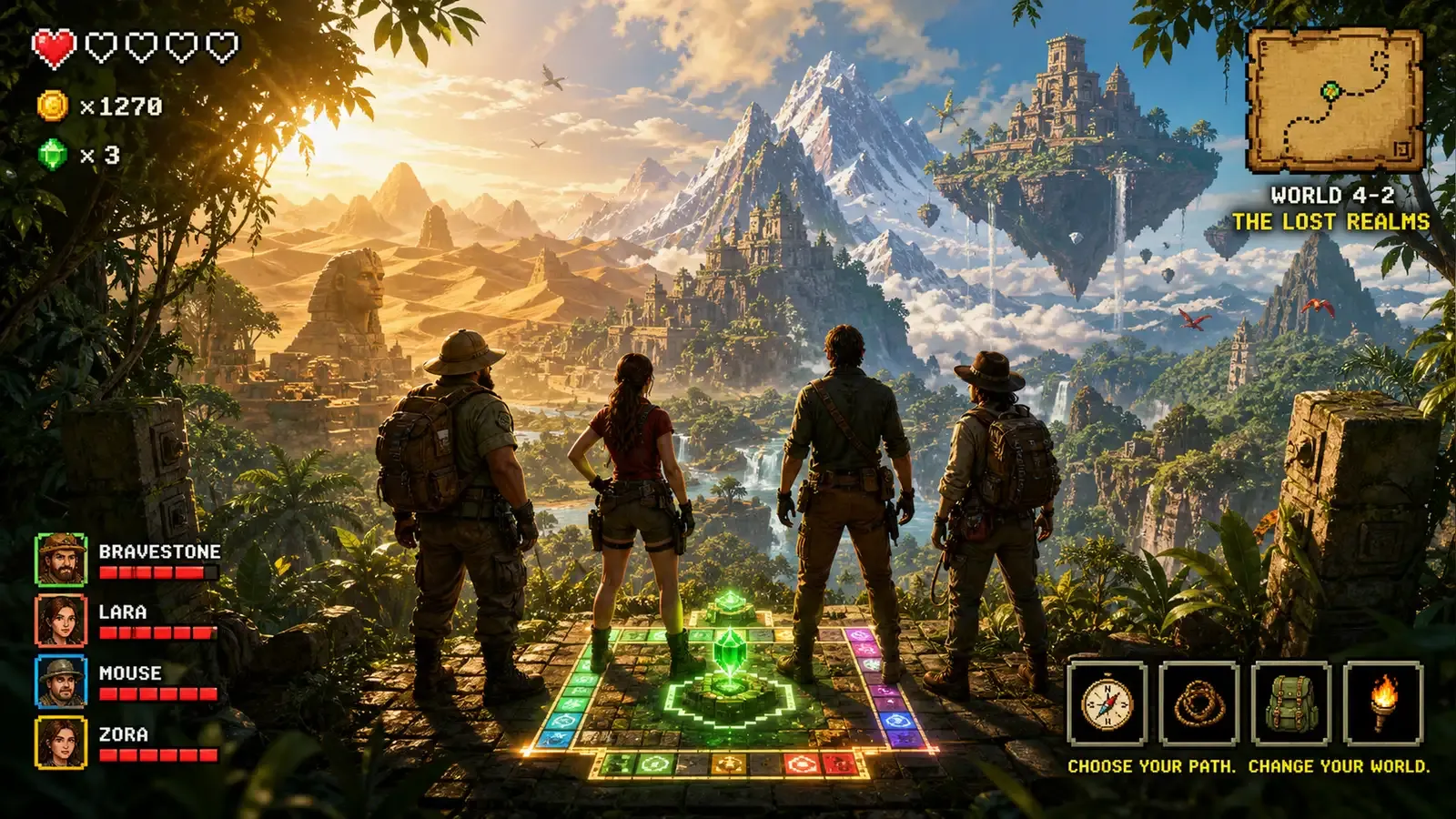
Two newcomers join the ensemble: Dan Hildebrand, best known for Deadwood and Spartacus, and Jack Jewkes, a relative unknown whose casting suggests Sony is betting on the established names to carry the weight. The premise, as the title suggests, expands the game world beyond the jungle biome of the earlier films. The trailer shows desert temples, snowy mountain passes, and what appears to be a floating sky level. If the first two films were about surviving a single map, Open World looks like it is about surviving the entire game.
Jake Kasdan returns to direct, having helmed both Welcome to the Jungle (2017) and The Next Level (2019). He co-wrote the screenplay with Jeff Pinkner and Scott Rosenberg, the same writing team behind the previous entries. Producers Matt Tolmach, Johnson, Dany Garcia, Hiram Garcia, and Kasdan round out the producing team, which has not changed since 2017. [1]
What the Trailer Shows
The teaser opens on a familiar setup: a group of teenagers find an old video game console in a dusty basement, the Jumanji cartridge already loaded. They start playing, and the room around them pixelates and dissolves into the game world. It is the same mechanism that launched the rebooted franchise, and Sony is not pretending otherwise.
What follows is a rapid montage of set pieces. Johnson’s character, Dr. Smolder Bravestone, crashes through a temple wall on a motorbike. Hart’s Franklin “Mouse” Finbar screams while being carried across a chasm by a giant bird. Jack Black’s Professor Sheldon Oberon navigates a puzzle room that looks lifted from a Tomb Raider game. Gillan’s Ruby Roundhouse fights off a swarm of robotic scorpions in what appears to be a desert level. The trailer closes on the four of them standing at the edge of a cliff, looking out at a massive open landscape dotted with biomes. A text overlay reads: “Every game must end.”
It is a confident trailer. Not groundbreaking, but confident. The action-comedy rhythm that made the previous films work is clearly still there. Hart screams. Johnson smolders. Black mugs. Gillan kicks things. The formula is intact, and for a franchise that has made $1.7 billion, that is probably the point.
The Christmas Problem
The film was originally dated for December 11, 2026. Sony has now pushed it to Christmas Day, which sounds like a vote of confidence until you look at what else is opening around it. [1]
On December 18, one week before Jumanji, two of the biggest films of the decade arrive on the same day. Denis Villeneuve’s Dune: Part Three wraps up his adaptation of Frank Herbert’s epic, a trilogy that has already earned $1.5 billion across its first two installments and cemented Timothée Chalamet and Zendaya as the defining screen duo of the 2020s. The Russo brothers’ Avengers: Doomsday launches the next phase of the Marvel Cinematic Universe with Robert Downey Jr. returning not as Iron Man but as Doctor Doom, a casting decision that has been the subject of furious online debate since it was announced at Comic-Con 2024. The internet has already named the date “Dunesday,” and the combined opening weekend projections for the two films — conservative estimates put them at $400 million domestically — would make it the biggest box office weekend in history.
Opening a family action-comedy one week after Dune and Avengers land on the same Friday is the kind of scheduling decision that gives studio executives heartburn, but it also reflects a calculus that has worked for Jumanji before. Counterprogramming during the holidays is a real strategy, not just a word executives say when they are scared. Families who do not want to sit through Villeneuve’s three-hour meditation on religious prophecy or Marvel’s multiverse of returning actors do not have many options in late December. Jumanji is the one film on the calendar that parents can take kids to on Christmas afternoon without worrying about runtime, violence, or whether the plot requires a flowchart and a wiki.
It worked twice already. Jumanji: Welcome to the Jungle opened in December 2017 against Star Wars: The Last Jedi, which was then the most anticipated film on the planet, and still grossed $962 million worldwide by running as the family alternative for the entire month of January. The Next Level opened against Frozen II and Star Wars: The Rise of Skywalker in 2019, two films that together earned over $2.5 billion, and still made $800 million. Sony is betting that audiences who have already seen Dune and Avengers by Christmas morning will still want something lighter in the afternoon. It is the same bet that worked twice before, and $1.7 billion in box office receipts makes it hard to argue.
A $1.7 Billion Franchise Says Goodbye
The Jumanji reboot story is one of the more improbable success stories in recent blockbuster history. When Sony announced in 2015 that it was remaking the 1995 Robin Williams film as a video game comedy starring Dwayne Johnson and Kevin Hart, the reaction was mostly skepticism. The original Jumanji was beloved for reasons that had nothing to do with video games. It was about a man trapped in a board game for 26 years, about childhood wonder and adult regret, about Robin Williams at his most vulnerable.
The reboot ignored all of that and made a different bet entirely: that audiences wanted to watch Dwayne Johnson play a nerdy teenager trapped in an action hero’s body, and Kevin Hart play a football player stuck in a zoologist who is five feet tall. The body-swap comedy at the center of both films turned out to be the secret ingredient nobody saw coming. It gave the action set pieces a reason to be funny, and it gave the comedy a reason to exist inside an action movie. Characters could be terrified and ridiculous at the same time because the person inside the avatar was not the person the audience was looking at. Johnson doing a panic-stricken teenage yelp in his trademark bass register never stopped being funny across two films, and Hart delivering earnest monologues about zoology while three feet off the ground turned out to have more comic mileage than anyone expected.
Welcome to the Jungle opened to $36 million domestically, a number that looked modest for a would-be blockbuster, and then did the thing that studios dream about: it refused to drop. It legged out to $404 million in North America alone, a multiplier over 11x, the kind of hold that signals genuine word of mouth from audiences telling friends they had to see it. By the time it finished its global run at $962 million, it had outgrossed every film in the Fast and Furious franchise except Furious 7 and established Johnson and Hart as a duo that could anchor a series.
The Next Level added Danny DeVito and Awkwafina to the body-swap formula — DeVito playing Danny Glover in Johnson’s body, Awkwafina playing a teenage girl who becomes a cat burglar — and pulled in $320 million domestically despite opening against Frozen II and The Rise of Skywalker. Combined, the two films sit at $1.7 billion globally on combined production budgets of roughly $250 million. That is a return that any studio would greenlight a third film for, and a fourth, and probably a streaming series. [1]
The franchise also quietly reshaped how Hollywood thinks about Dwayne Johnson as a leading man. Before Jumanji, Johnson’s biggest solo hits were disaster movies (San Andreas, $474 million) and Rampage ($428 million). After Jumanji, he anchored the Black Adam rollout, the Red Notice franchise on Netflix, and the Moana live-action adaptation. The Jumanji films proved he could open a movie without a pre-existing character audiences already loved, which is a rarer skill in Hollywood than it sounds. They also proved that Jack Black, an actor whose career high point before 2017 was voicing a panda, could be the emotional center of a billion-dollar franchise.
What “Final” Means
Sony is calling Open World the final Jumanji film, a claim that should be taken with the same skepticism applied to any studio announcing the end of a $1.7 billion franchise. “Final” in blockbuster parlance usually means “final with this cast” or “final until we reboot it in eight years with a new gimmick.”
What is more likely is that Johnson, Hart, Black, and Gillan are done after this one. Johnson is 54 and has shifted into producer mode across his slate. Hart is 47 and increasingly focused on dramatic roles like his turn in Borderlands and producing his own projects. Black is 56 and has spent the last few years oscillating between voice work, The Super Mario Bros. Movie, and his Tenacious D commitments. Gillan, at 38, has the most runway ahead of her and has already diversified into directing. Keeping all four of them on the same schedule for a fourth film would be a logistical headache that even Sony’s checkbook might not solve.
The trailer’s closing tagline, “Every game must end,” reads less like a marketing slogan and more like a cast negotiating position. Whether Jumanji actually ends after Open World depends on whether the film makes enough money for Sony to find a new game to play.
Jumanji: Open World opens in theaters on December 25, 2026.
Sources:
- French, K. (2026, July 29). “‘Jumanji: Open World’ Trailer: Dwayne Johnson, Kevin Hart and Jack Black Return for Third and Final Movie.” Variety Australia. https://au.variety.com/2026/film/news/jumanji-3-trailer-dwayne-johnson-kevin-hart-open-world-38976/
Share This Article
Comments