12 States Just Sued to Block the Paramount-Warner Bros. Merger. Here's What's at Stake
California and 11 other states filed a federal antitrust lawsuit to stop Paramount's $111 billion takeover of Warner Bros. Discovery. We break down the arguments, the numbers, and what this means for the movies you'll actually get to see in theaters.
Editorial Notes
BucketMovies Editorial covers classic cinema, repertory discoveries, and context-rich film criticism with an emphasis on source-backed reporting and careful editorial review.
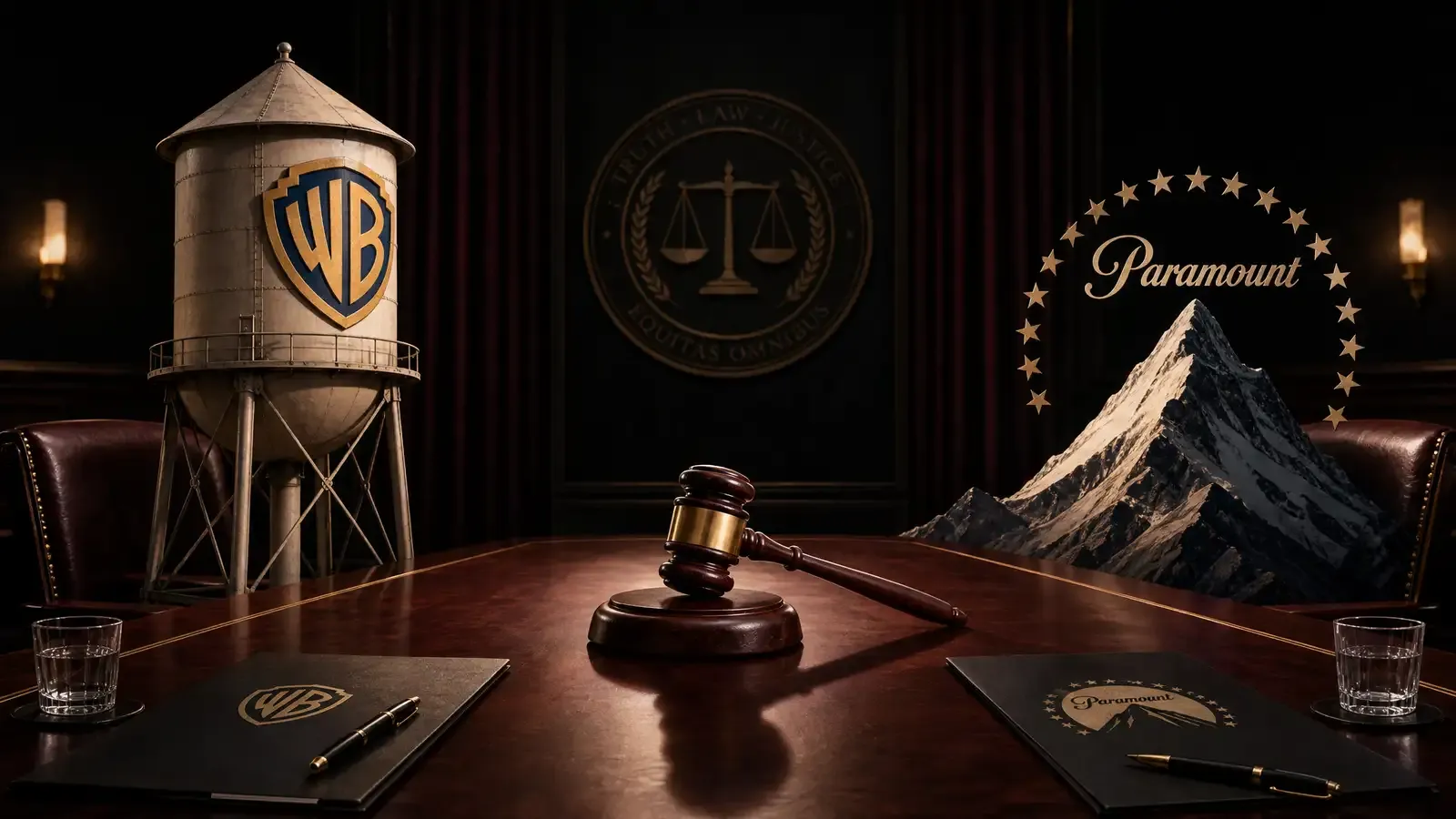
On Monday, July 13, California Attorney General Rob Bonta and 11 other state attorneys general dropped a 37-page federal antitrust lawsuit in Northern California with one goal: stop Paramount’s $111 billion takeover of Warner Bros. Discovery before it reshapes Hollywood into something none of us asked for.
It’s the biggest legal challenge to a media merger since the DOJ sued to block AT&T’s acquisition of Time Warner in 2017 — and it lands in a Hollywood that’s already been through a decade of relentless consolidation. Disney bought Fox. Amazon bought MGM. Discovery swallowed WarnerMedia. Each deal promised synergies and scale; each delivered layoffs and fewer movies.
The Paramount-WBD lawsuit is ambitious, specific, and unusually readable for a legal document. It argues that combining two of Hollywood’s five remaining major studios would squeeze theater owners, drive up your cable bill, and concentrate so much power in one company that everyone else — from indie distributors to the person buying a ticket at the multiplex — loses.
Paramount, for its part, calls the suit “wrong on both the facts and the law” and has hired Jeffrey Kessler, the antitrust litigator who most recently went after Live Nation and Ticketmaster. Both sides are gearing up for a fight that could define the structure of the film industry for the next decade.
Here’s what the case comes down to, in plain terms.
The states’ argument rests on a handful of statistics that are hard to un-see once you’ve seen them.
A combined Paramount-Warner Bros. would control roughly 27% of the domestic box office, according to Bonta’s office. For big-budget wide releases — the tentpole films that play in more than 3,000 theaters — that number climbs above 30%. Those tentpoles accounted for 88% of all box office revenue over the last three years.
After the merger, just four companies would control 86% of all wide-release films: the combined Paramount-WB, Disney, NBCUniversal, and Sony Pictures. That’s not a diverse marketplace. That’s an oligopoly with one very large new member.
The lawsuit puts it bluntly: “For every dollar generated by wide-release theatrical films and basic cable channels in this country, the combined company will pocket more than a quarter.”
It’s not just about movie theaters
The cable argument might actually be the stronger part of the case, and it gets at something most merger coverage misses: the entertainment industry isn’t one market, it’s several stacked on top of each other, and a merger that looks manageable in one layer can be devastating in another.
A combined Paramount and Warner Bros. Discovery would own an absurdly stacked bundle of must-have cable channels: CNN for news, Nickelodeon and Cartoon Network for families, HGTV and Food Network for lifestyle audiences, and TNT and TBS for sports and entertainment. If a cable distributor — say, Comcast or Charter — pushes back on fee increases for any of those channels, the combined company could threaten to pull all of them at once.
“A distributor who rejects the combined company’s fee demands would risk losing CNN for news viewers, Nickelodeon and Cartoon Network for family households, HGTV and Food Network for lifestyle audiences, and TNT and TBS for sports and entertainment viewers,” the lawsuit states. “Faced with this threat, distributors would likely be forced to accept higher fees.”
Those higher fees, the argument goes, get passed directly to your monthly bill. The mechanism is straightforward: the combined company has more leverage in carriage negotiations than either studio had alone, because pulling one channel is a negotiation tactic; pulling six channels that collectively cover news, kids, lifestyle, and sports is an existential threat to a cable package’s value proposition.
This matters even as streaming grows because cable bundles still generate billions in predictable, high-margin revenue that studios use to fund the riskier parts of their business — including theatrical film production. A squeeze on the cable side doesn’t just raise your bill; it redirects money that might have gone toward making movies.
What Paramount says in response
Paramount’s defense hinges on a few key claims. David Ellison, who would lead the combined company, has promised to keep total output at roughly 30 films per year — about what the two studios produce combined right now. The company argues that the merger would actually boost competition by creating a stronger rival to Disney and Netflix, both of which operate at scales that individual legacy studios increasingly struggle to match.
Skydance, Ellison’s production company that engineered the deal, has framed the acquisition as a rescue mission: Paramount, saddled with declining linear TV revenue and a streaming service (Paramount+) that’s hemorrhaging money, needs the scale and the combined IP library to survive. Warner Bros. Discovery, still digesting its own 2022 merger, brings HBO, Max, and the DC universe to the table. Together, the argument goes, they’d have the heft to compete rather than slowly shrink.
The company has also pointed out that the Department of Justice already reviewed the deal under the Trump administration and didn’t block it — though the states’ lawsuit operates independently of federal antitrust enforcement, and the DOJ’s posture toward media consolidation has shifted unpredictably with each administration change.
There’s also the uncomfortable reality of debt. The combined company would carry an enormous debt load — Warner Bros. Discovery alone still carries roughly $40 billion from its 2022 merger — and industry observers expect significant layoffs as the combined entity looks for cost savings. Bloomberg and Variety have both reported that overlapping divisions in distribution, marketing, and home entertainment would be early targets for consolidation. Paramount hasn’t addressed the layoff question head-on in its public statements, focusing instead on the creative upside of the combined IP portfolio.
What the legal experts think
Abiel Garcia, a former California state prosecutor and now a partner at Kesselman Brantly Stockinger, told the Los Angeles Times that “this is a strong case.” The 27% market share figure for wide releases sits near the threshold that typically triggers antitrust scrutiny, and the states have structured their complaint to highlight specific, concrete harms rather than theoretical ones — a strategy that tends to play better with judges than broad “too big” arguments.
But Guggenheim Securities analyst Michael Morris told the Times that “each side is taking risks with this case. The states risk spending a lot of money and having their arguments rejected. And Paramount risks having a prolonged negotiation.”
That prolonged timeline might be the real story. Antitrust cases don’t move fast. The states need to prove not just that the merger would create a large company — bigness alone isn’t illegal — but that it would substantially lessen competition in specific, definable markets. The cable carriage market is one. The theatrical distribution market is another. The states will need expert economic testimony, internal company documents, and witnesses from both sides of the negotiating table. That takes time and money, and the states are betting they have enough of both to outlast Paramount’s shareholders.
What this actually means for moviegoers
Strip away the legal filings and the market-share math, and the question is simpler: would you get better movies, or fewer of them?
The states argue fewer. When four companies control nearly all wide releases, the incentive to take risks drops. Why greenlight a $50 million original drama when the safe bet is another franchise installment that’s guaranteed 3,000 screens? The lawsuit’s logic is that competition — real competition between five major studios — is what forces each of them to occasionally gamble on something weird, something original, something that might fail spectacularly but also might become the next “Everything Everywhere All At Once.”
There’s historical precedent for this concern. After Disney acquired 20th Century Fox in 2019, Fox’s output of mid-budget theatrical releases — the $30-80 million dramas, comedies, and thrillers that used to fill multiplexes between blockbuster seasons — collapsed almost immediately. Searchlight Pictures survived as an awards-season boutique, but the Fox pipeline that produced films like “The Martian,” “Gone Girl,” and “The Revenant” simply stopped existing. A Paramount-WB merger wouldn’t replicate that exact scenario — Warner Bros. has a stronger track record of mid-budget filmmaking than Fox did in its final years — but the structural pressure is the same: consolidation reduces the number of greenlight decision-makers, and fewer decision-makers means fewer bets.
Paramount argues the opposite: a financially stronger combined studio could afford to take more risks, not fewer. Ellison’s 30-film promise, if he keeps it, would maintain the current volume of wide releases. The question is what kinds of films fill those slots. The merger’s supporters point to the combined IP library — Mission: Impossible, DC, Harry Potter, Star Trek, SpongeBob, South Park, Transformers — as evidence that the new company would have more, not fewer, reasons to keep production lines humming.
But IP volume isn’t the same as creative diversity. Owning 15 franchises and making 30 franchise movies per year doesn’t give audiences more choice; it gives them more of the same choice.
The real timeline
The case will take months to resolve — likely stretching into 2027 if it goes to trial. The merger itself was already expected to close in late 2026 or early 2027, which means the lawsuit and the deal are now racing each other toward a finish line.
If the states get a preliminary injunction — even a temporary one — the deal could be frozen while lawyers argue about market definitions and consumer harm. Deals have died that way before, not from losing in court, but from running out the clock. Shareholders get impatient. Debt financing expires. Management teams lose focus. The longer the uncertainty drags on, the more pressure builds on both companies to either settle or walk away.
Paramount has already spent months navigating regulatory reviews. Adding a multi-state antitrust lawsuit to that process doesn’t just add cost — it adds the one thing mergers can’t afford: time.
None of this is decided yet. The states could lose. Paramount could settle. The Trump DOJ could intervene on the company’s side — or the next administration could pick up the states’ arguments and run with them. What’s clear is that this deal, which Paramount executives hoped would sail through by late 2026, is now facing the kind of legal friction that turns “expected to close” into “will it ever close?” That uncertainty alone reshapes what both companies can plan, greenlight, and promise — and every movie fan who cares about what shows up on screen has a stake in how it plays out.
Sources: Deadline (July 13, 2026); Los Angeles Times (July 15, 2026).
Share This Article
Comments