Moana (2026) Review: Disney's Most Redundant Remake Yet Finds Just Enough Magic to Float
Disney's live-action Moana arrives barely a decade after the animated original, and while Catherine Laga'aia makes a radiant debut, the film struggles to justify its own existence. Read our full review.
Editorial Notes
BucketMovies Editorial covers classic cinema, repertory discoveries, and context-rich film criticism with an emphasis on source-backed reporting and careful editorial review.
Ten years. That’s all the distance between Disney’s animated Moana and the live-action version that landed in theaters this weekend. For context, The Lion King waited twenty-five years for its photorealism glow-up. Beauty and the Beast got twenty-six. The Little Mermaid needed thirty-four. Moana got a decade — barely enough time for the kids who grew up singing “How Far I’ll Go” to reach high school.
That compressed timeline hangs over every frame of Thomas Kail’s remake. You can feel it in the shot-for-shot recreations of sequences you still remember with unsettling clarity. You can hear it in the new Lin-Manuel Miranda song that slots into the soundtrack like a bonus track on a deluxe edition nobody asked for. And you can see it in the box office tracking, which suggests audiences might be asking the same question critics are: why?
The answer, at least for stretches of this undeniably handsome film, is Catherine Laga’aia.
A Star Worth the Voyage
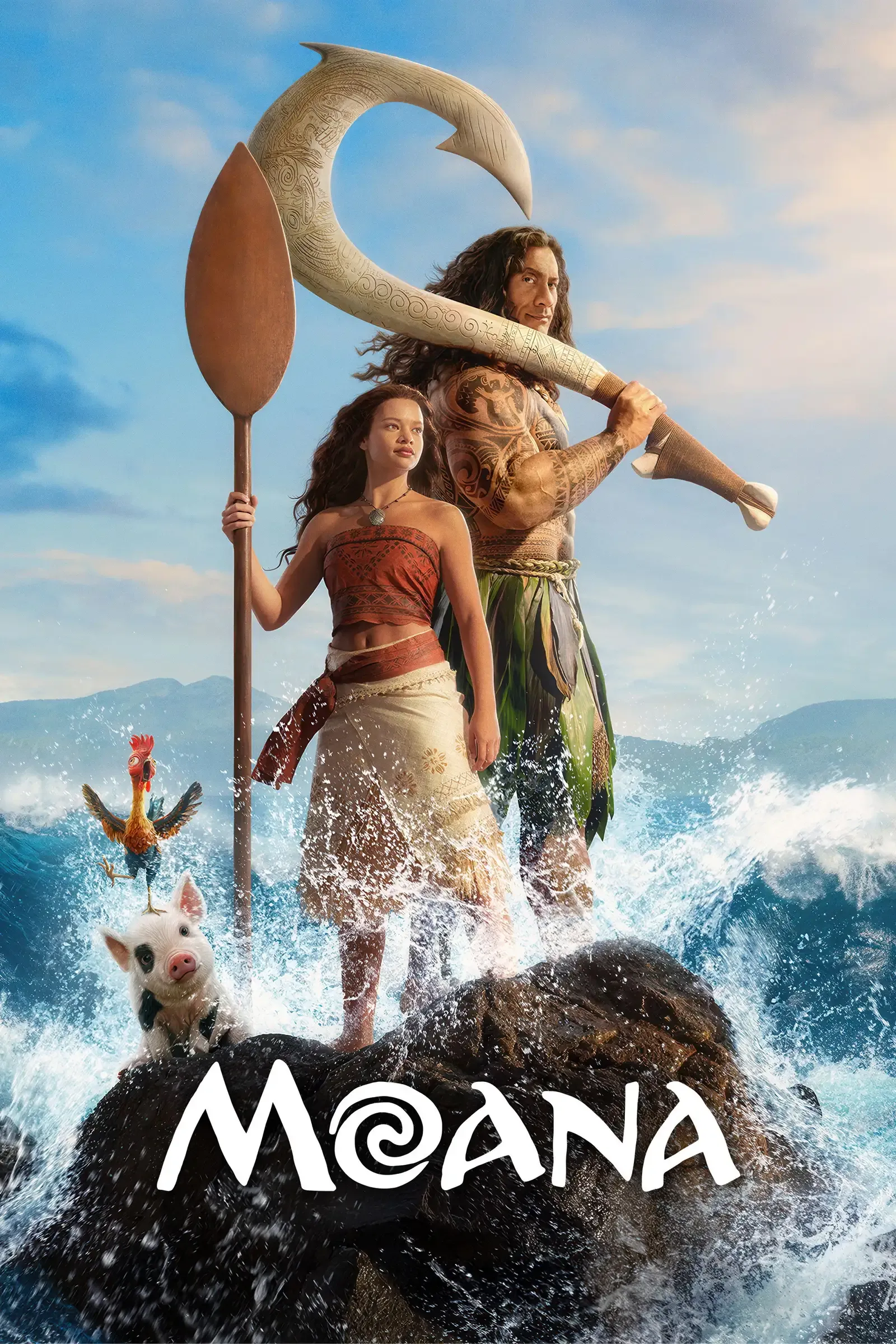
Laga’aia, a newcomer of Samoan heritage, doesn’t just play Moana — she radiates her. Where Auli’i Cravalho’s vocal performance in the 2016 original gave Moana a restless, headstrong energy, Laga’aia brings something quieter and more grounded. Her Moana feels like a real teenager shouldering real weight: the expectations of her village, the grief of watching her island slowly die, the terrifying pull of an ocean that keeps calling her name.
The camera loves her in a way Disney’s live-action cameras haven’t always loved their leads. There’s a sequence early in the film where Moana walks the shoreline at dusk, the water catching the last light, and Kail holds on Laga’aia’s face long enough to let doubt flicker across it — before resolve hardens in her eyes. It’s a small moment, the kind animation would externalize through song or slapstick, but here it lands because Laga’aia earns it.
Her “How Far I’ll Go” is different, too. Less belted, more internal. The production lets the arrangement breathe around her voice rather than swamping it in orchestral bombast, and the result is the rare Disney remake musical number that doesn’t feel like a cover band playing the hits.
The Rock, the Crab, and the Weight of Repetition
Dwayne Johnson returns as Maui, and if you’ve seen the animated film, you know exactly what you’re getting: the flexed pecs, the arched eyebrow, the self-deprecating charm offensive. Johnson’s Maui was always more Johnson than anything else, so the translation from animation to live action costs him less than it might another actor. He’s having fun, and it’s infectious enough.
But the film’s slavish fidelity to its source material means Maui never gets a new beat to play. His arc — self-absorbed demigod learns humility through partnership with a determined teenager — follows the same curve at the same pace. Jemaine Clement’s Tamatoa, the giant treasure-hoarding crab, remains the film’s most inspired sequence. Clement clearly relishes the chance to bring his creature to shimmering, self-aggrandizing life, and the production design team goes gloriously overboard on the bioluminescent cave set. It’s the one scene where the remake feels like it’s adding something rather than tracing.
The problem is everything around it.
The Faithfulness Trap
Disney’s live-action division has been chasing a formula for years. Cinderella (2015) succeeded by expanding its source material meaningfully — giving its prince a personality, its stepmother a backstory, its heroine an interior life beyond “be kind and wait.” Pete’s Dragon (2016) barely resembled its predecessor and was better for it. Even Cruella (2021) understood that the assignment was reinvention, not replication.
Moana (2026) doesn’t seem to have received that memo. Kail, a gifted stage director whose Hamilton capture for Disney+ demonstrated genuine understanding of how to translate performance across mediums, here defaults to deference. The beats arrive exactly where you expect them. The shots mirror their animated counterparts. The emotional architecture of the 2016 film is preserved so carefully that nothing new can grow inside it.
Take the Kakamora sequence. In the original, coconut-armored pirates attacking Moana and Maui’s boat made for a kinetic, Mad Max: Fury Road-lite chase that balanced threat with absurdity. The live-action version stages the same set piece with competent but uninspired CGI. The coconuts look like coconuts. The action lacks the elastic physics that made the animated version sing. You watch it thinking not “what happens next?” but “oh, this part.”
That’s the curse of the too-faithful remake. It turns discovery into recognition.
Where the Magic Holds
The film isn’t without genuine pleasures. The ocean itself — rendered as a sentient, playful body of water that interacts with Moana like an eager puppy — remains a technical marvel. The water effects team earned their paychecks; there’s a moment where the sea parts to reveal a path to Te Fiti that genuinely takes your breath away, all shimmering walls of water and refracted light.
The new Miranda song, “Beyond the Reef,” fits comfortably alongside the original soundtrack. It’s not “How Far I’ll Go” — nothing here is — but it serves its narrative purpose without embarrassment. Miranda understands rhythm and character voice too well to phone it in, even on a project that sometimes feels like one.
The finale, too, finds an emotional register the preceding ninety minutes have been searching for. When Moana restores Te Fiti’s heart, and the burned, volcanic goddess transforms back into a lush, green embodiment of creation, the visual payoff lands. Laga’aia’s face in that moment — wonder, relief, the exhaustion of a journey completed — sells it entirely.
An Island That Looks Real but Never Breathes
The production design team clearly understood the assignment: make Polynesia look like a place you could step into. They succeeded, mostly. The village of Motunui feels lived-in — thatched huts weathered by salt and sun, fishing nets draped over wooden racks, children running barefoot through sand that looks warm enough to feel through the screen. Costume designer Paco Delgado avoids the tourist-brochure trap, dressing the villagers in textures that suggest generations of wear rather than wardrobe-department freshness.
But the curse of the hyper-real approach is that it flattens myth. The 2016 film’s Te Kā — the lava monster that guards Te Fiti — was a triumph of stylized animation, all glowing cracks and furious smoke that felt primordial rather than literal. The 2026 version renders her with photoreal volcanic textures that are technically flawless and emotionally inert. She looks like a very expensive video game boss. The magic leaks out through the pixels.
This tension between the real and the mythic runs through the whole production. Moana’s ocean companion, so charmingly expressive in animation, becomes harder to read when rendered as photoreal water. A wave that parts like a curtain impresses the eye but doesn’t tickle the heart the way the original’s more cartoonish ocean did. It’s the uncanny valley problem applied to wonder: the closer something gets to looking real, the harder it becomes to believe in it.
The Bigger Picture
Whether Moana sinks or swims at the box office may matter less than what it represents. Disney’s live-action pipeline is showing cracks. Snow White (2025) was a genuine disaster, plagued by production controversies and audience indifference. The Little Mermaid (2023) made money but fell short of projections. Mufasa (2024) chugged along on brand recognition rather than creative necessity. The strategy of strip-mining the animated catalog is running into a hard truth: some films don’t need remaking, and some audiences don’t want them remade.
What’s particularly damning about Moana is the timing. This isn’t a dusty property pulled from the vault for a nostalgia play. The original remains one of Disney+‘s most-streamed titles. Moana 2, released in 2024, pulled in over a billion dollars at the global box office. Audiences are still actively engaged with this world and these characters. Dropping a live-action version into theaters now doesn’t fill a gap — it competes with a cultural presence that hasn’t faded.
Moana sits at an awkward intersection. It’s a film that was never broken, never dated, never in need of a technological upgrade. Remaking it in 2026 feels less like homage and more like muscle memory — a studio doing what it knows how to do because it’s easier than figuring out what to do next.
That said, Moana (2026) is far from the worst of these exercises. It’s well-cast, handsomely produced, and anchored by a lead performance that suggests Laga’aia has a real career ahead of her. Kids who haven’t memorized the original will probably love it. Parents who have will spend two hours in air-conditioned comfort while their children watch a perfectly competent adventure story.
Verdict
Disney’s live-action Moana is the cinematic equivalent of a high-budget cover band: technically impressive, professionally executed, and utterly unnecessary. Catherine Laga’aia’s star-making turn and a handful of visual triumphs keep it from capsizing entirely, but the film never answers the only question that matters — why does this exist?
Watch it for Laga’aia. Watch it for the water effects. Watch it in a theater if you have a ten-year-old who’s just discovered the original. But don’t expect to feel anything you didn’t feel in 2016.
Rating: 2.5/5
Share This Article
Comments