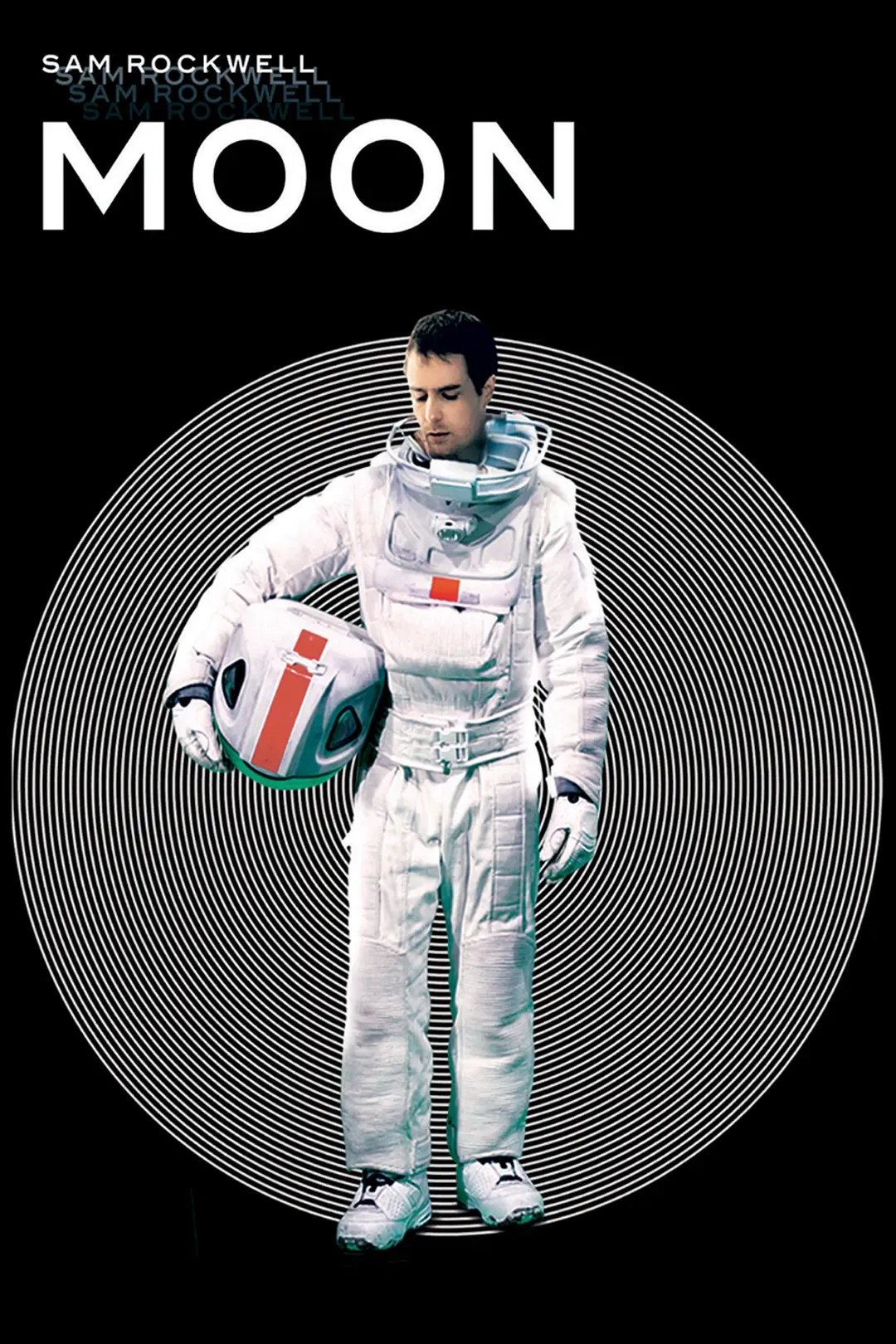
Moon (2009): Duncan Jones' Haunting Meditation on Identity and Isolation
Sam Rockwell delivers a tour-de-force performance in Duncan Jones' cerebral sci-fi debut. How this low-budget film about lunar solitude became one of the decade's most profound explorations of what makes us human.
Editorial Notes
Anna edits BucketMovies criticism and essay packages, with a steady interest in classic Hollywood, literary adaptations, and repertory programming.
Leah Carter
Research Editor
Leah handles source checks, release-date verification, awards coverage, and the reporting framework behind BucketMovies news and industry pieces.
There’s a moment about halfway through Moon when Sam Bell looks at himself—really looks—and everything you thought you understood about the film collapses. What seemed like a straightforward story about loneliness and corporate exploitation suddenly becomes something far stranger and more unsettling.
Duncan Jones’ 2009 debut arrived with almost no fanfare: a $5 million budget, a single location, and one actor carrying virtually the entire runtime. It should have disappeared into the streaming void. Instead, it became one of the most celebrated science fiction films of its decade—a reminder that the genre doesn’t need spectacle to achieve profundity.
Sam Rockwell’s One-Man Show
Let’s start with the obvious: this film doesn’t work without Sam Rockwell.
He plays Sam Bell, an astronaut nearing the end of a three-year contract mining helium-3 on the far side of the moon. His only companion is GERTY, an AI assistant voiced with unsettling calm by Kevin Spacey. His only connection to Earth is delayed video messages from his wife and daughter.
Rockwell must carry scenes alone for extended stretches. He talks to himself, argues with himself, breaks down alone, recovers alone. The performance requires him to make solitude compelling—not just bearable, but watchable, even riveting.
He succeeds by finding infinite variation in isolation. His Sam isn’t a stoic hero enduring hardship; he’s a mess. He talks to his plants. He carves figures from wood. He has full conversations with GERTY about nothing in particular. These details feel lived-in rather than performed, and they make Sam’s eventual crisis feel genuinely devastating.
But Rockwell’s real achievement comes later, when the film’s central twist reframes everything we’ve seen. Without spoiling specifics, he’s eventually required to play multiple versions of the same person—and he makes each version distinct while keeping them recognizably the same man. It’s a technical challenge that most actors would fumble. Rockwell makes it look effortless.
The Twist That Isn’t a Twist
Moon’s central revelation has been discussed so widely that it barely counts as a spoiler anymore: Sam discovers he’s a clone. The “real” Sam Bell is back on Earth; the figure we’ve been watching is one of many copies, each given implanted memories and a manufactured sense of self.
What’s remarkable is that Jones doesn’t treat this as a gotcha. The revelation comes relatively early, and the film spends its remaining runtime exploring the implications rather than milking shock value.
This is the opposite of most twist-dependent films. Instead of building toward a climactic reveal, Moon presents its central concept and then asks: what does it mean? If your memories are manufactured, are they less real? If your identity is a copy, are you less of a person? If a corporation owns your genetic material, do they own you?
These questions don’t have easy answers, and Jones doesn’t pretend they do. Moon is a film about living with ambiguity, about constructing meaning from circumstances you didn’t choose.
GERTY: The Anti-HAL
Every science fiction film featuring an AI invites comparison to 2001’s HAL 9000. Jones knows this, and he plays with the expectation brilliantly.
GERTY looks ominous—a robotic arm with a screen displaying simple emoticons. When things start going wrong for Sam, every instinct tells us GERTY will turn sinister. We’re waiting for the betrayal, the cold machine logic that prioritizes mission over human life.
It never comes.
GERTY turns out to be genuinely helpful, even protective. When Sam discovers the truth about himself, GERTY assists rather than obstructs. The AI’s programming—to support the astronaut—operates exactly as designed, even when that support conflicts with corporate interests.
This subversion is quietly devastating. We’ve been trained by decades of science fiction to distrust artificial intelligence. Moon asks: what if the real monster isn’t the machine but the humans who programmed it? GERTY follows orders, but the orders themselves are monstrous.
Kevin Spacey’s vocal performance deserves credit here. He makes GERTY sound genuinely caring while never letting us forget its artificial nature. The emoticon faces—smiley, frowny, concerned—become unexpectedly touching, a machine’s limited attempt to express emotions it can only simulate.
Corporate Horror
Moon’s villain isn’t an AI or an alien. It’s Lunar Industries, the corporation that employs Sam Bell—or rather, employs his clones.
The corporate scheme is grimly logical. Instead of paying astronauts hazardous-duty rates for three-year lunar assignments, they grow clones with implanted memories. Each clone believes it’s nearing the end of its contract; each clone “returns to Earth” by dying in a chamber designed to look like a transport. Then the next clone awakens, memories intact, ready to work.
Jones never shows us a corporate boardroom or a villainous executive. He doesn’t need to. The horror is systemic rather than personal. No individual decided to do evil; the system simply optimized for efficiency, and human dignity became a rounding error.
This feels uncomfortably relevant. In an era of gig economies and disposable workforces, Moon’s critique of corporate dehumanization lands harder than any explicit polemic. Lunar Industries doesn’t hate its workers; it simply doesn’t consider them workers. They’re equipment. Assets. Resources to be extracted and replaced.
The Visual Language of Isolation
Shot on a budget that wouldn’t cover catering on a Marvel film, Moon achieves visual sophistication through restraint and intelligence.
The lunar base feels genuinely lived-in—cramped, worn, accumulated with three years of one man’s existence. Jones and cinematographer Gary Shaw create intimacy through tight framing, keeping us close to Sam even when the empty moonscape beckons outside.
The moon itself is rendered with practical models rather than CGI, giving the exterior shots a tactile quality that digital effects often lack. There’s weight to the lunar rovers, texture to the regolith, a sense that this environment exists physically rather than virtually.
But the real visual achievement is the doubling sequences. When multiple Sams appear on screen together, the compositing is seamless—no small feat on a limited budget. Jones uses the technique sparingly, understanding that the emotional impact matters more than technical showboating.
The color palette shifts subtly as the film progresses. Early scenes have a cool, sterile quality; as Sam’s situation deteriorates, warmer tones creep in, as if the base itself is becoming feverish. It’s the kind of detail you might not consciously notice, but it shapes emotional response nonetheless.
Clint Mansell’s Score
Clint Mansell’s music provides Moon’s emotional backbone—spare, melancholic, occasionally overwhelming.
The main theme is built on simple piano figures that repeat and layer, creating a sense of obsessive circularity that mirrors Sam’s situation. As the film progresses, strings enter, building toward climaxes that feel earned rather than manipulative.
Mansell understands that less is more. Long stretches of the film play without music, letting ambient sound and silence do the work. When the score returns, it carries weight it wouldn’t have if it had been constant.
The composer previously worked with Jones’ father, David Bowie, on some of his most experimental albums. That connection feels significant. There’s something Bowie-esque about Moon’s themes—isolation, identity, the alien nature of selfhood—and Mansell’s score evokes that lineage without copying it.
The Father Question
It’s impossible to discuss Moon without acknowledging that Duncan Jones is David Bowie’s son.
Jones (born Zowie Bowie, later Duncan Jones) spent his career deliberately avoiding the shadow of his famous father. He went into filmmaking rather than music, took his mother’s surname professionally, and rarely discussed his parentage in interviews.
Yet Moon feels deeply connected to Bowie’s artistic preoccupations. “Space Oddity,” “Life on Mars,” “Ashes to Ashes”—Bowie repeatedly returned to space as a metaphor for alienation, for the distance between who we are and who we present to the world.
Moon asks similar questions through a different medium. Is Sam Bell the “real” Sam Bell? Does it matter? When we construct identities from memories and experiences, what happens when those foundations prove artificial?
Jones never explicitly references his father’s work, but the thematic resonance is unmistakable. Moon feels like a conversation across generations, a son responding to questions his father spent decades asking.
The Science Fiction Tradition
Moon wears its influences openly.
2001: A Space Odyssey provides the obvious template—solitary astronauts, AI companions, the vastness of space as existential backdrop. But where Kubrick maintained cosmic distance, Jones stays intimate, interested in psychology rather than transcendence.
Silent Running (1972) offers another touchpoint—another isolated worker maintaining a corporate outpost, another exploration of what isolation does to the human mind. Like Bruce Dern’s character in that film, Sam Bell finds purpose in small rituals and growing things.
Blade Runner’s influence surfaces in the clone narrative—the question of whether artificial beings have souls, whether manufactured memories create real identities. Moon reaches similar conclusions through radically different methods, preferring quiet tragedy to noir poetry.
What distinguishes Moon from its predecessors is emotional accessibility. This isn’t cold science fiction that holds viewers at arm’s length. It’s a film that wants you to feel Sam’s loneliness, his confusion, his desperate need for connection. The ideas matter, but the feelings matter more.
The Ending: Ambiguous by Design
Moon’s conclusion offers resolution without answers.
One version of Sam escapes; another stays behind to die. The corporation will face exposure; its crimes will presumably end. But the fundamental questions remain unaddressed. What happens to the surviving Sam? Is he the “real” Sam now? What does his existence mean for the original?
Jones cuts to black before resolving these questions, and that’s exactly right. Moon isn’t interested in neat conclusions. Life doesn’t offer neat conclusions. We construct meaning from ambiguity, identity from uncertainty, purpose from chaos.
The final moments achieve something rare in science fiction: genuine hope without false comfort. Sam escapes, but he escapes into a world that may not want him, that may not recognize him as human. His future is uncertain. But he has a future, and after everything we’ve witnessed, that feels like victory enough.
Why Moon Endures
Fifteen years later, Moon remains essential viewing for science fiction fans.
Not because of its effects, which were impressive for the budget but have inevitably dated. Not because of its twist, which has been widely discussed and dissected. Not even because of its performances, though Rockwell’s work remains extraordinary.
Moon endures because it asks questions that don’t expire. What makes a person? What do we owe to each other? How do we find meaning in systems designed to deny our humanity?
These questions mattered in 2009. They matter more now, as technology advances, as corporations consolidate power, as the boundary between authentic and artificial grows increasingly blurred.
Duncan Jones made a film about the moon that’s really about Earth—about us, about the structures we build and the costs they extract. That’s science fiction at its best: using the impossible to illuminate the uncomfortably real.
My Rating: 9/10
Strengths: Rockwell’s career-defining performance, intelligent script, emotional depth rare in concept-driven sci-fi Weaknesses: Some pacing issues in the middle act, budget limitations occasionally visible
If you loved this film:
- Ex Machina (2014) - Another intimate AI-focused sci-fi
- Solaris (1972) - Tarkovsky’s space-as-psychology masterpiece
- Arrival (2016) - Cerebral sci-fi with emotional core
- Her (2013) - Different tone but similar questions about identity and connection
Share This Article
Comments