One Battle After Another Review: Paul Thomas Anderson's Counterculture Masterpiece
Leonardo DiCaprio delivers a career-defining performance in Paul Thomas Anderson's ambitious epic about radical politics and lost idealism.
Editorial Notes
BucketMovies Editorial covers classic cinema, repertory discoveries, and context-rich film criticism with an emphasis on source-backed reporting and careful editorial review.
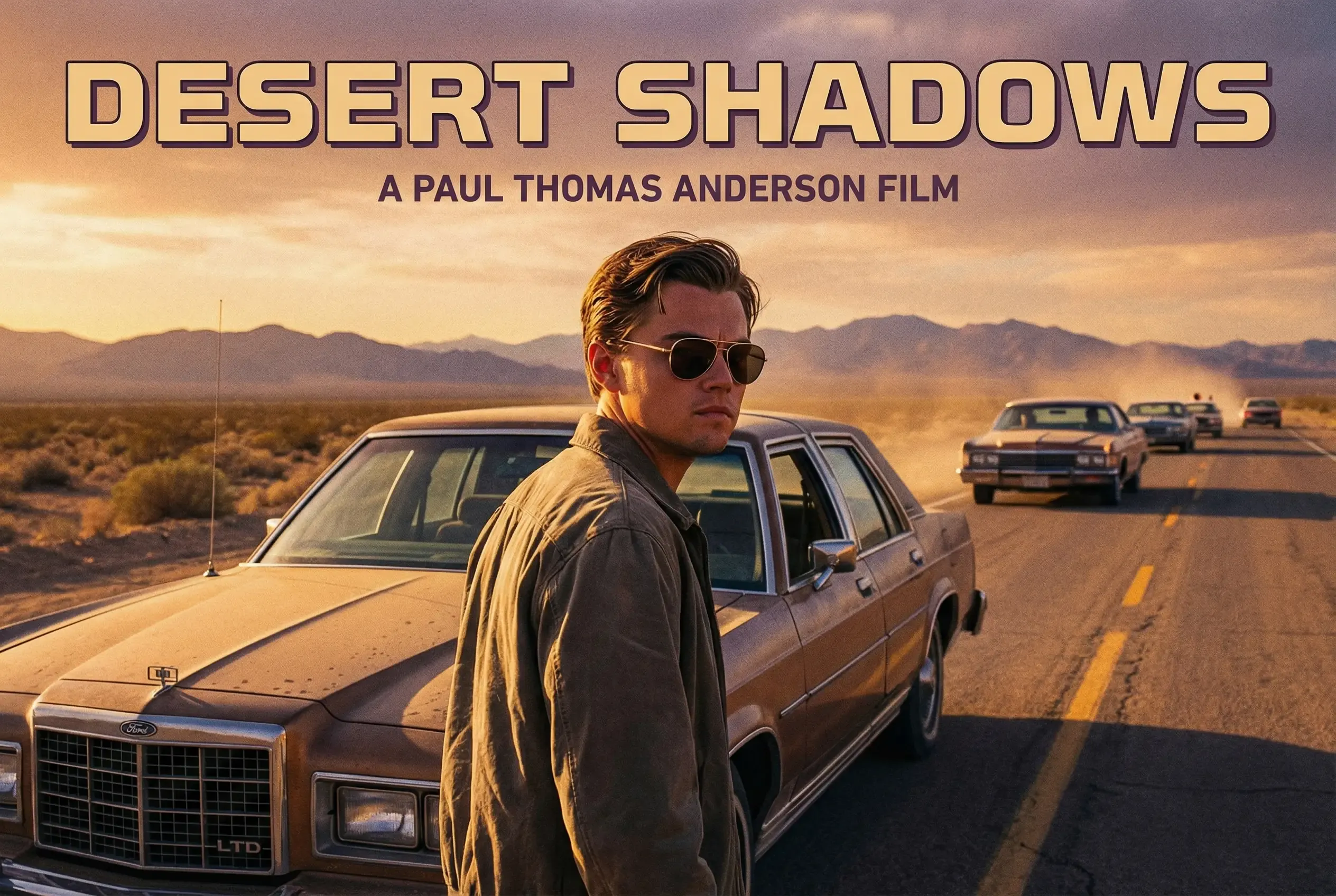
In the opening sequence of One Battle After Another, a convoy of vintage cars winds through the California desert, their passengers singing folk songs at the top of their lungs while FBI surveillance drones hover overhead. It is 1984, and somewhere in the golden state’s rugged landscape, a loose coalition of activists, degenerates, and idealists is about to make its last stand against an apparatus of state power that has grown only more sophisticated since the counterculture’s supposed demise. Paul Thomas Anderson has crafted something rare: a film that feels simultaneously like a period piece and an urgent dispatch from a world that never stopped fighting.
The Story: Counterculture’s Last Gasp
Adapted from Thomas Pynchon’s novel Vineland, this 162-minute epic represents the director’s second collaboration with the notoriously reclusive author, following 2014’s Inherent Vice. Where that film languished in dreamy confusion, One Battle After Another surges forward with propulsive energy, marrying the political urgency of The Master to the operatic ambition of There Will Be Blood. The result is Anderson’s most accessible masterpiece since Boogie Nights, and perhaps his most politically resonant work to date.
The film follows a sprawling ensemble across the landscapes of Northern California, tracing the fates of activists from a bygone revolutionary movement who have been forced underground, into exile, or into uncomfortable accommodations with the system they once sought to overthrow. At the center stands Dale “Dino” Barksdale, a former radical played with remarkable restraint by Leonardo DiCaprio in what can only be described as a career-defining performance.
Dino has spent years in hiding, teaching at a community college under a false identity, cultivating tomatoes in his backyard, trying to disappear into the beige anonymity of suburban life. But when his former comrade-in-arms is dragged before a federal tribunal on fabricated charges, Dino must choose between his hard-won peace and the fight he thought he’d left behind.
The Performances: DiCaprio’s Masterwork
Leonardo DiCaprio has spent three decades building one of cinema’s most remarkable careers, but One Battle After Another contains work that stands apart from everything that came before. His Dino Barksdale is a man haunted by the ghosts of the past, physically present but emotionally elsewhere, perpetually caught between the revolutionary he was and the ordinary citizen he is desperately trying to become. There is a scene late in the film where Dino, having just witnessed a betrayal that cuts to the bone, sits alone in his car watching rain streak across the windshield. DiCaprio says nothing for nearly two minutes. You understand everything.
Teyana Taylor announces herself as a major talent in her first truly significant film role. Prairie is a character who could easily have become a political archetype, but Taylor infuses her with contradictions that feel genuinely human. She is intelligent, fierce, loyal to a fault, and occasionally ruthless in ways that surprise even herself.
Benicio del Toro appears in a supporting role as a shadowy figure whose true allegiances remain uncertain until the film’s final act. His performance is a masterclass in controlled ambiguity. Sean Penn shows up in a cameo that lasts perhaps five minutes and leaves an indelible impression.
The Themes: Resistance and Its Discontents
Anderson has always been interested in the ways power moves through American society, the invisible architectures of control that structure even our most intimate relationships. One Battle After Another represents his most direct engagement with political themes since The Master, but it approaches that territory from an entirely different angle.
The film is set in the 1980s, a decade often remembered for its political complacency, but Anderson reveals the era’s hidden tensions. The Cold War simmers. The drug trade destabilizes communities. The apparatus of federal law enforcement has grown only more invasive, equipped with new technologies of surveillance and control.
The film’s political vision is not simplistic. It refuses to romanticize the radicals of the past, showing how their movements were plagued by ego, infighting, and the occasional descent into violence. It also refuses to condemn them, recognizing that their failures were perhaps inevitable. What remains is the simple fact of resistance itself, the stubborn insistence that things could be different.
Conclusion: A Masterpiece for This Moment
One Battle After Another arrives at a moment when questions of political resistance have regained their urgency. The film does not offer answers, does not pretend to know how movements succeed or fail. What it does offer is something perhaps more valuable: a portrait of what it feels like to believe in something, to fight for it, to lose, and to keep living anyway.
Roger Ebert gave the film five stars, calling it a profound story of rebellious humanism that arrives at a moment when conflict seems to have become an everyday obligation. This assessment is not hyperbole. One Battle After Another is that rare thing: a film that takes politics seriously without becoming preachy, that embraces complexity without sacrificing accessibility.
Rating: 9.5/10
What works:
- Leonardo DiCaprio’s career-best performance
- Teyana Taylor’s breakthrough supporting turn
- Anderson’s confident direction and sharp screenplay
- Visually stunning cinematography
- Themes that resonate urgently with contemporary politics
What does not work:
- The sprawling narrative may challenge viewers seeking linear storytelling
- Some supporting characters could benefit from more development
- The film’s 162-minute runtime demands commitment
Share This Article
Comments