Why Sinners Marks a New Era for Black Filmmaking in Hollywood
Ryan Coogler's record-breaking Oscar success with Sinners signals a fundamental shift in Hollywood's embrace of Black storytelling.
Editorial Notes
Anna edits BucketMovies criticism and essay packages, with a steady interest in classic Hollywood, literary adaptations, and repertory programming.
Leah Carter
Research Editor
Leah handles source checks, release-date verification, awards coverage, and the reporting framework behind BucketMovies news and industry pieces.
Ryan Coogler’s Sinners has done something no film in Academy Awards history has ever achieved. The blues-steeped vampire epic received sixteen nominations at the 2026 Oscars, surpassing the previous record of fourteen held by Titanic and La La Land. This is not merely a statistical milestone. It represents a fundamental shift in what Hollywood considers worthy of its highest honors. Sinners earned nominations across major categories including Best Picture, Best Director for Coogler, and Best Actor for Michael B. Jordan in his first Oscar recognition. Warner Bros. collected thirty total nominations across their releases, with Sinners accounting for more than half. The film grossed $368 million worldwide, proving that Black stories told with artistic ambition can achieve both critical acclaim and commercial success on the largest scale.
Coogler’s Directing Journey
Ryan Coogler’s path to this moment spans nearly two decades of deliberate, purposeful filmmaking. His debut feature Fruitvale Station told the story of Oscar Grant III, a Black man killed by police in Oakland, California. The film announced a filmmaker who understood how to blend social realism with emotional storytelling. Coogler followed with Creed, reimagining the Rocky franchise as a story about boxing, legacy, and Black masculinity. He transformed what could have been a nostalgic sequel into a meditation on race, fatherhood, and reinvention.
Then came Black Panther in 2018. The film became the first superhero movie nominated for Best Picture at the Oscars. It won three Academy Awards and grossed over $1.3 billion worldwide. Coogler proved that a Black-led blockbuster could operate at the highest levels of the industry without compromising its cultural specificity.
Sinners represents Coogler’s most personal work. Set in 1932 Mississippi, the film follows twin brothers who open a juke joint only to encounter a vampire threat. The story allowed Coogler to explore the Great Migration, the birth of the blues, and the violence done to Black bodies throughout American history. At the 2026 BAFTAs, Coogler became the first Black person to win Best Original Screenplay.
Hollywood’s Transformation
The recognition of Sinners exists within a broader transformation of Hollywood’s relationship with Black filmmakers. Barry Jenkins demonstrated the possibilities with Moonlight in 2016, winning Best Picture in one of the most memorable ceremonies in Oscar history. Jordan Peele revolutionized the horror genre with Get Out in 2017, earning the Oscar for Best Original Screenplay and proving that Black-led genre films could achieve both artistic prestige and massive box office returns.
Ava DuVernay built her career on historical dramas like Selma and documentary work including the Oscar-nominated 13th. Spike Lee continued his decades-long pursuit of Black stories with BlacKkKlansman and Da 5 Bloods. These filmmakers, along with Coogler, have collectively changed the landscape. Studios now actively seek Black directors for major releases. Streaming platforms have created additional avenues for diverse storytelling.
The sixteen nominations for Sinners reflect more than one film’s success. They indicate an industry that has, perhaps imperfectly, begun to recognize the value of Black artistic perspectives. The film competed in categories ranging from acting to cinematography to sound, demonstrating that excellence was recognized across every aspect of production.
Cultural Milestone
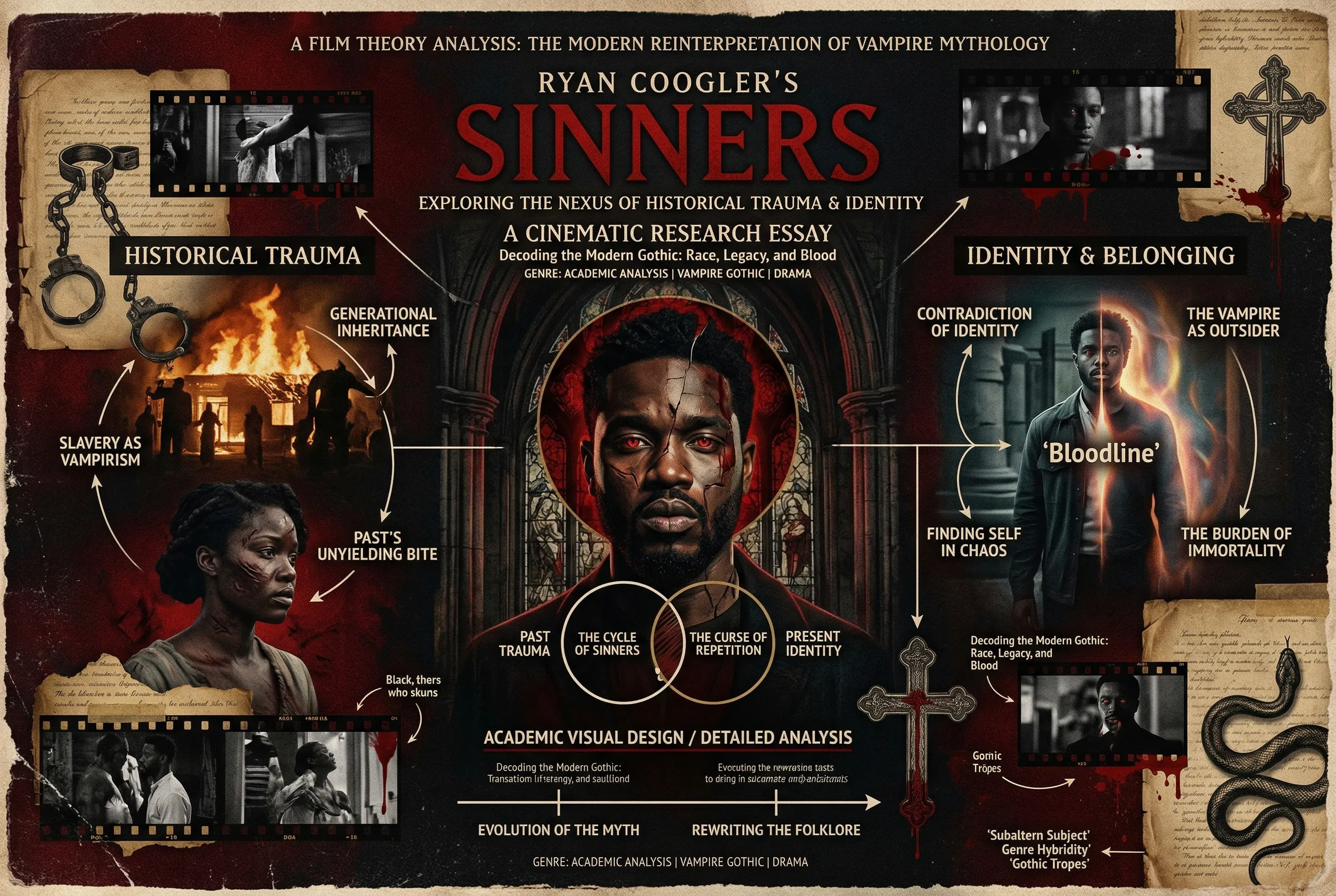
Sinners operates on multiple cultural levels. As a Southern Gothic vampire film, it draws from a rich tradition of American horror while infusing that tradition with specifically Black experiences. The 1930s Mississippi setting places the story during Jim Crow, when Black Americans faced systematic violence and oppression. The vampires in the film can be read as a metaphor for the extraction of Black labor and culture throughout American history.
The blues music at the film’s heart is not merely setting. It is the story. Coogler understood that the blues emerged from the same soil where his characters lived, worked, and died. The music represents both artistic expression and survival mechanism, a way of processing trauma that white America inflicted. By making music central to the film’s horror and healing, Coogler reframes a traditionally white genre through a Black lens.
The response to Sinners extended beyond awards circuits. In Clarksdale, Mississippi, the film became a cultural event, drawing visitors to a region often overlooked by Hollywood. Young Black filmmakers cited Sinners as inspiration, seeing in Coogler’s achievement a validation of their own ambitions.
Looking Ahead
What comes next matters as much as what has been achieved. The success of Sinners creates both opportunity and obligation. Studios will likely seek similar projects, hoping to replicate the formula. The risk exists that genuine artistic vision gets replaced by calculated imitation. Coogler himself has spoken about the importance of maintaining creative control, using his position to greenlight projects from other Black filmmakers through his company Proximity Media.
The Oscar nominations open doors beyond individual careers. Casting directors, cinematographers, sound designers, and other craftspeople who worked on Sinners now have their work showcased at the highest level. This visibility creates pathways for the next generation. The sixteen nominations represent not an endpoint but a foundation.
Sinners proves that Black filmmaking has arrived at a new moment in Hollywood. The question now is whether the industry will build on this achievement or allow it to remain an exception. Coogler’s film did not just break records. It demonstrated what is possible when Black artists are given resources, creative freedom, and the opportunity to tell their own stories on the biggest stage.
Share This Article
Comments