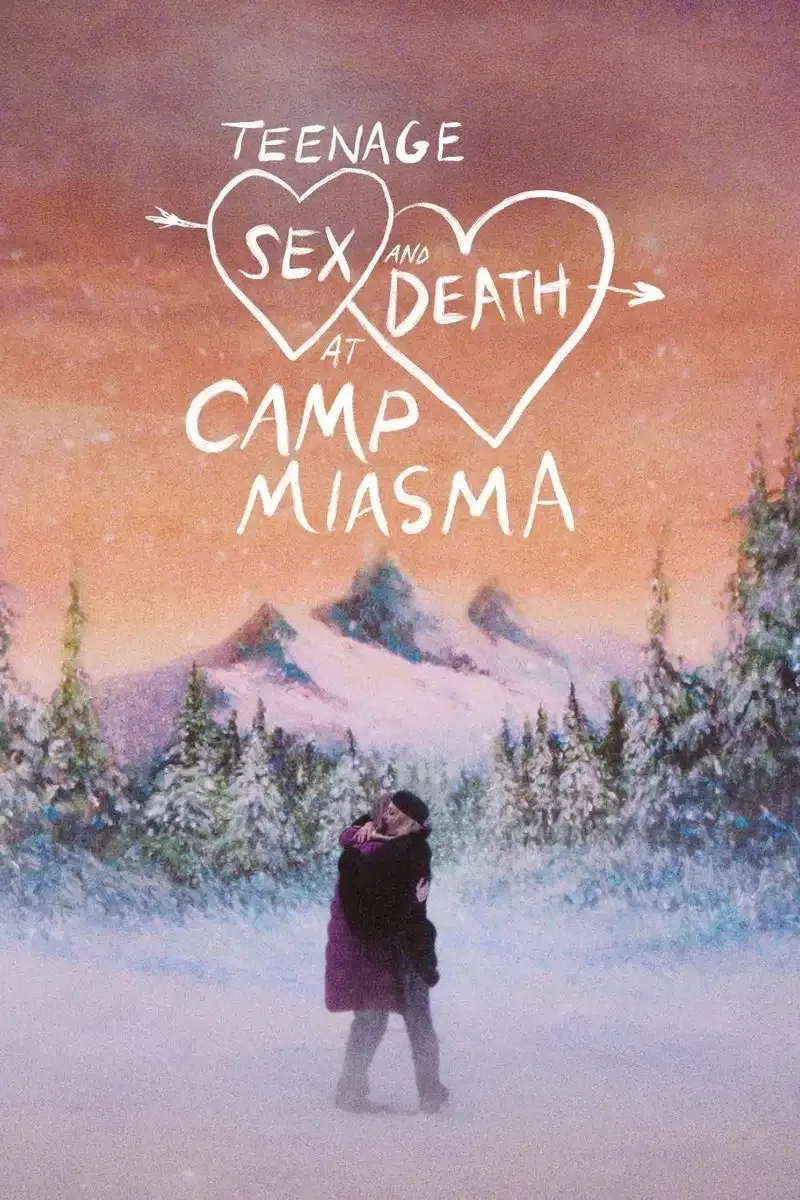
Teenage Sex and Death at Camp Miasma Review: Schoenbrun's Slasher Manifesto
Jane Schoenbrun's third film is a razor-sharp satire of Hollywood's reboot machine and a love letter to the movies that shape us. Hannah Einbinder and Gillian Anderson deliver career-best work.
Editorial Notes
BucketMovies Editorial covers classic cinema, repertory discoveries, and context-rich film criticism with an emphasis on source-backed reporting and careful editorial review.
Jane Schoenbrun has spent three films asking the same question from different angles: what happens when a story gets under your skin and refuses to leave? In “We’re All Going to the World’s Fair,” it was an internet horror role-playing game that blurred the line between performance and identity. In “I Saw the TV Glow,” it was a television show that became a portal to a different kind of existence. Now, with “Teenage Sex and Death at Camp Miasma,” Schoenbrun turns the lens on the machine that manufactures those stories in the first place, and the people who get consumed by them.
The result is Schoenbrun’s most ambitious and emotionally layered film yet. It is also, by some margin, their funniest.
The premise: a reboot that means too much
Hannah Einbinder plays Kris, a young filmmaker fresh off a debut that made her the darling of Sundance. The Hollywood ecosystem does what it does with bright new talents: it hands her a franchise. The Camp Miasma series, a low-budget slasher property that ran through the 1980s and early 1990s, is ripe for the kind of “elevated” reboot that studios now package as prestige horror. The executives want something that feels important without being alienating. They want a product.
Kris wants something else entirely. She grew up watching Camp Miasma films, not as disposable entertainment but as a lifeline. The movies spoke to something in her that nothing else did, and now she has the chance to make one of her own. The problem is that the Camp Miasma she remembers and the Camp Miasma the studio wants to sell are two different things entirely.
To bridge that gap, Kris tracks down Billy Presley, the actress who played the original final girl in the first Camp Miasma film. Billy, played by Gillian Anderson in a performance that should silence anyone who still doubts her range, has not acted since. She lives alone near the site of the original filming location, a recluse who has been forgotten by everyone except the most devoted fans. Kris is one of those fans, and she needs Billy to understand what the franchise meant to the people who loved it.
Anderson and Einbinder: the film’s beating heart
The dynamic between Anderson and Einbinder is what elevates the film beyond its satirical framework. Anderson plays Billy as someone who has spent decades building walls around a wound she has never fully processed. Her experience making the original Camp Miasma was formative in ways that were not entirely positive, and her reluctance to engage with Kris is not mere reclusiveness. It is self-protection. Anderson communicates all of this with remarkable economy. A look, a pause, a change in the way she holds a cigarette. She does not explain Billy’s pain. She lets you see it.
Einbinder, meanwhile, plays Kris with the specific kind of intensity that belongs to someone who has built their entire identity around loving something. Kris is not naive. She understands the industry, she understands the compromise that a reboot requires. But she also believes, stubbornly and perhaps foolishly, that there is a version of this project that honors what the original films meant to her. Einbinder makes that belief feel genuine without making Kris seem delusional. She is ambitious, she is talented, and she is in over her head. That combination is what makes her worth following.
The scenes between the two of them carry the film. Schoenbrun gives them room to talk, to argue, to sit in silence. There is a sequence near the middle of the film where Billy describes what it felt like to be the final girl, to be the one audiences were supposed to root for while the camera filmed her running, screaming, fighting for her life. Anderson delivers the monologue with a flatness that makes it more devastating, not less. She is not performing emotion. She is describing what it was like to have her emotions performed for someone else’s profit.
The slasher as self-portrait
Schoenbrun structures the film as a movie-within-a-movie, and this is where the formal experimentation gets genuinely exciting. As Kris and Billy work together, the boundaries between the Camp Miasma fiction and their real lives begin to dissolve. Scenes from the imaginary slasher bleed into the narrative, not as fantasy sequences or daydreams but as a parallel layer of meaning that runs alongside the main story.
The opening credits lay out the lineage explicitly. Schoenbrun shows us the inspirations: “Friday the 13th,“当然, but also the broader cultural landscape of 1980s horror, the video nasties, the self-aware slashers that came after. The credits function as a thesis statement. This is a film about what slasher cinema is, what it does to the people who make it and watch it, and why it persists.
The film-within-the-film that Kris eventually pitches to the studio executives is a radical reimagining of the Camp Miasma mythology, told from the perspective of the killer rather than the victims. It is a strange, daring idea, and Schoenbrun shoots the pitch scene with a kind of breathless energy that makes you feel Kris’s excitement even as you know the executives are going to hate it. They do. Dylan Baker, playing a producer whose face is a permanent mask of corporate bafflement, responds to Kris’s deeply personal vision with the line: “What the f--- was that?” The scene is funny. It is also, for anyone who has ever tried to make something meaningful inside a system that values marketability over art, painfully recognizable.
Satire with teeth
The Hollywood satire in “Teenage Sex and Death at Camp Miasma” is not subtle, and it does not need to be. Schoenbrun populates the margins with characters who embody different facets of the industry’s absurdity. Sarah Sherman shows up as Kris’s agent, a woman who has internalized the logic of the market so completely that she can no longer hear her client’s creative arguments without translating them into financial terms. She hangs up on Kris mid-pitch, not out of malice but because she genuinely cannot understand why her client would rather make something strange than make something profitable.
These are not cartoon villains. That is what makes the satire work. The executives, the agents, the producers, they are all doing their jobs. They are not evil. They are just incapable of understanding why anyone would choose art over commerce, because the system they work in has never required that choice. Schoenbrun does not excoriate them. She observes them with the kind of clinical precision that makes the humor sharper and the tragedy quieter.
The cost of loving movies too much
Underneath the satire, though, “Teenage Sex and Death at Camp Miasma” is doing something more personal. Richard Brody, writing in The New Yorker, called it “a cinematic manifesto that examines how art can inspire both love and fear.” That is accurate, but it understates the emotional weight. This is a film about what it costs to build your life around stories that were never designed to sustain a life.
Kris’s obsession with Camp Miasma is not casual fandom. It is the kind of deep, formative relationship with art that reshapes your understanding of yourself. The movies taught her what she wanted to be. They gave her a framework for processing fear, desire, and loneliness. And now she has the chance to contribute to that franchise, to add her voice to a conversation that has been going on for decades. The fact that the industry wants to strip-mine that conversation for profit is not just disappointing. It is, for Kris, a kind of violence.
Billy understands this. That is why she hid. Making the original Camp Miasma films gave her something and took something away, and she has spent decades trying to figure out which was greater. Anderson plays this ambivalence with a complexity that anchors the entire film. Billy is not a cautionary tale or a romantic tragedy. She is a person who made art under conditions that were not entirely of her choosing, and who is still reckoning with what that means.
What makes the film resonate beyond its Hollywood setting is how precisely it captures the specific loneliness of loving something deeply and then watching it get repackaged for people who will never love it the same way. Every franchise fan has felt some version of this. The remake that misses the point. The reboot that sandpapers off everything that made the original distinctive. Schoenbrun understands that feeling not as a consumer complaint but as a genuine emotional experience, and the film treats it with the seriousness it deserves.
Verdict
“Teenage Sex and Death at Camp Miasma” is not a perfect film. The pacing sags slightly in the second act, and some of the film-within-a-film sequences are more formally interesting than emotionally engaging. But these are minor complaints about a movie that is doing something genuinely difficult: it is satirizing an industry while also celebrating the art that industry produces, and it manages to do both without cheapening either.
Schoenbrun has made three films about the stories that get inside us and never leave. With this one, they have also made a film about what happens when the people who profit from those stories have no idea why they matter. That is a harder thing to pull off, and Schoenbrun makes it look almost easy.
The film premiered at Fantasia 2026, where it landed on nearly every critic’s top 10 list from the festival. That level of consensus is rare, and it speaks to something the film achieves that goes beyond technical skill or clever writing. It makes you feel the weight of what movies can do to the people who love them too much, and it does so without ever condescending to those people or the films that shaped them.
Hannah Einbinder and Gillian Anderson are extraordinary. The film is sharp, strange, and unexpectedly moving. It is the kind of movie that stays with you for days, not because of its scares or its jokes, but because of how honestly it portrays the relationship between artists and the art that made them. If you care about what movies can be, this is one you should see.
Teenage Sex and Death at Camp Miasma is currently streaming on MUBI.
Share This Article
Comments