The Brutalist: A Monumental Achievement in Contemporary Cinema
Brady Corbet's epic historical drama examines the American dream
Editorial Notes
BucketMovies Editorial covers classic cinema, repertory discoveries, and context-rich film criticism with an emphasis on source-backed reporting and careful editorial review.
In the opening moments of “The Brutalist,” director Brady Corbet thrusts viewers into darkness—the suffocating, chaotic darkness of a ship crossing the Atlantic, where a young Hungarian Jewish refugee named László Tóth navigates through cramped quarters teeming with desperate souls. This is not merely a prologue; it is a thesis statement, a visceral declaration that this film will not shy away from the weight of history. As László emerges from the shadows onto the deck and catches his first glimpse of the Statue of Liberty—upside down, no less, framed against an unforgiving sky—Corbet establishes his visual argument with audacious clarity: what follows will be an inversion, a reckoning with the myth of the American Dream.
“The Brutalist” announces itself with the imposing gravitas of the concrete structures that populate its narrative, demanding attention across its sprawling 215-minute runtime. This is cinema as architecture—monumental, uncompromising, occasionally overwhelming. In his third feature, Corbet has crafted something rare: an American epic that feels simultaneously classical and contemporary, a meditation on art, trauma, and the tension between creative vision and commercial compromise.
An Immigrant’s Odyssey in Concrete and Steel
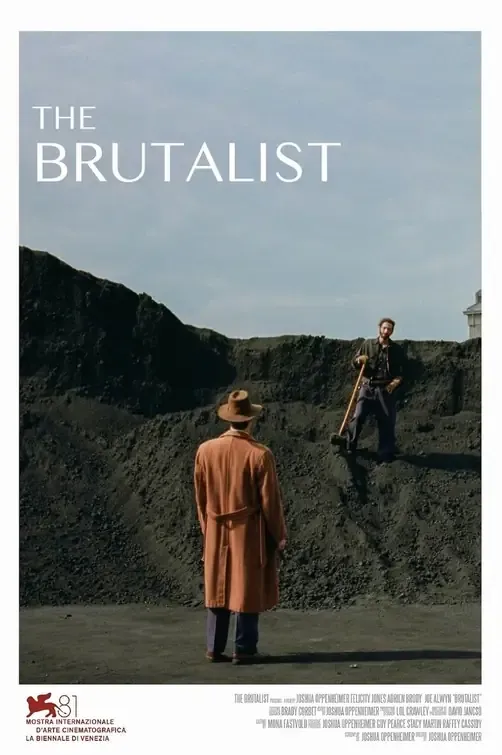
The film follows László Tóth (Adrien Brody), a brilliant Hungarian architect who survived Buchenwald and arrives in the United States in 1947, carrying nothing but the ghost of his former life and a heroin addiction that will prove both a crutch and a curse. Before the war, he was celebrated in Budapest—a practitioner of the Bauhaus philosophy, committed to clean lines, functional beauty, and the revolutionary belief that architecture could transform society. Now, stripped of his credentials, his family separated by the cruelty of shifting borders, he must begin again in a country that neither understands nor particularly wants his vision.
László’s journey brings him to Philadelphia, where he settles with his cousin Attila (Alessandro Nivola), a man who has learned to assimilate, to compromise, to survive by becoming invisible. But László refuses to disappear. When the cousins are commissioned to renovate a study for the wealthy industrialist Harrison Lee Van Buren (Guy Pearce), László transforms the space into something extraordinary—a minimalist sanctuary that speaks to his vision of beauty in an age of excess. This single act sets in motion a chain of events that will define the next thirteen years of his life.
Pearce delivers a performance of remarkable depth as Van Buren—a self-made titan who sees in László both an extension of his own ego and a threat to his carefully curated control. There is something almost Shakespearean in the way Corbet and co-writer Mona Fastvold construct this relationship: patron and artist, benefactor and dependent, predator and prey. Van Buren is not a villain in any conventional sense; he genuinely believes he appreciates art, even as he refuses to truly understand it. His affection for László is real, but it is also conditional, subject to the whims of budget overruns, municipal interference, and his own fragile sense of legacy.
The Architecture of Cinema
To discuss “The Brutalist” without addressing its visual language would be to miss the point entirely. Cinematographer Lol Crawley, working with production designer Judy Becker, has created a film that functions as a meditation on its own medium. Shot primarily on 16mm film, with select sequences employing the rarely used VistaVision format, the movie itself becomes an argument about the nature of artistic integrity in an age of technological convenience.
The choice to shoot on film—particularly in these formats—speaks to Corbet’s reverence for classical Hollywood craftsmanship while simultaneously embracing a contemporary sensibility. The 16mm footage lends certain sequences a raw, almost documentary immediacy, particularly in the opening passages that document László’s arrival in America. The VistaVision sequences, with their stunning clarity and depth, capture the monumental scale of the structures László imagines, transforming architectural blueprints into cinematic poetry.
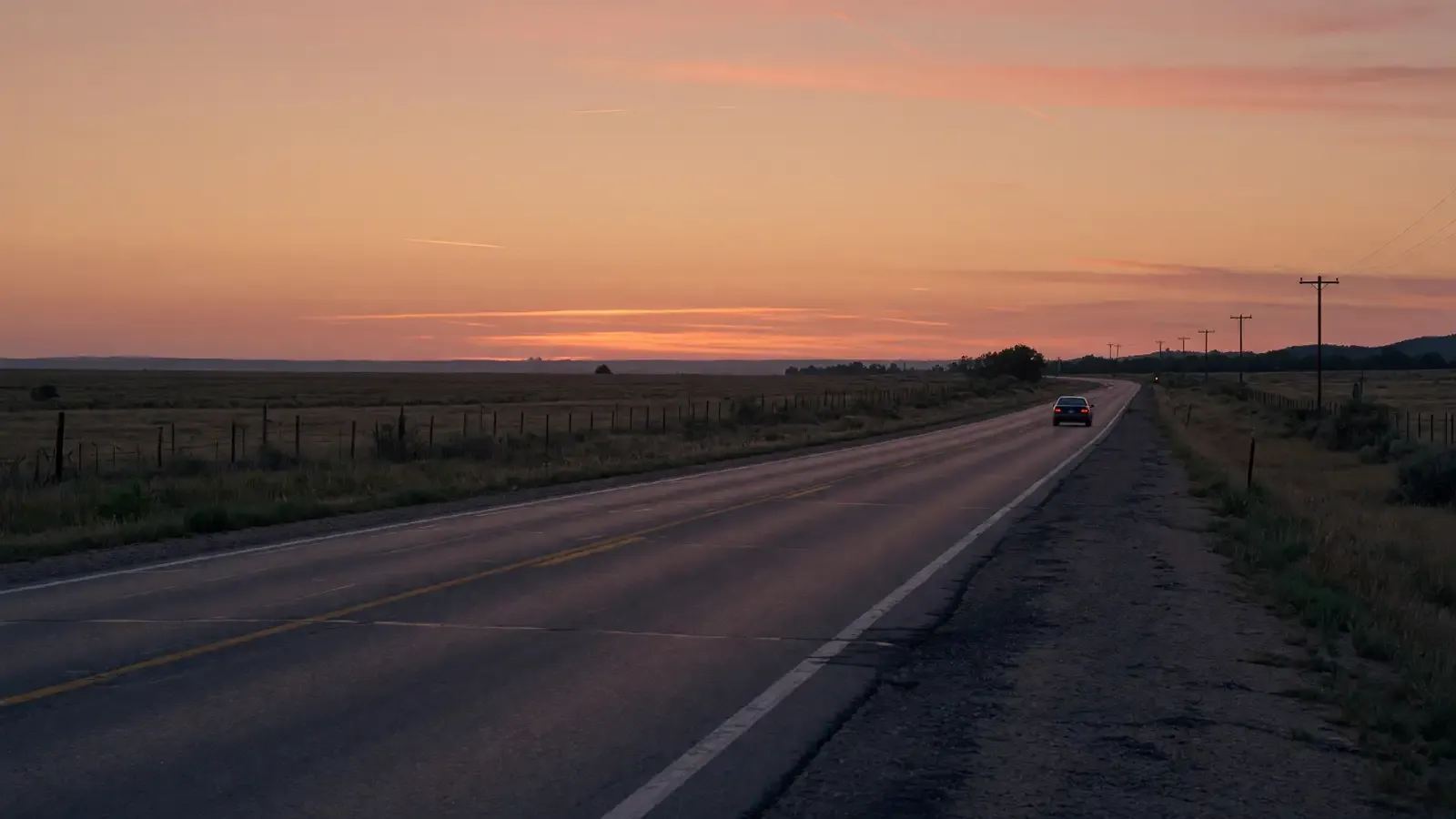
Crawley’s recurring signature shot—a head-on view of roads and train tracks rushing beneath the camera, accompanied by the industrial percussion of Daniel Blumberg’s masterful score—serves as a visual motif for progress, for the relentless forward motion of American ambition. Yet there is always an undercurrent of unease in these images, a sense that this progress comes at a cost. The score itself, composed of discordant piano plinks, percussive bangs, and sounds that evoke both construction and destruction, perfectly complements Corbet’s visual ambition.
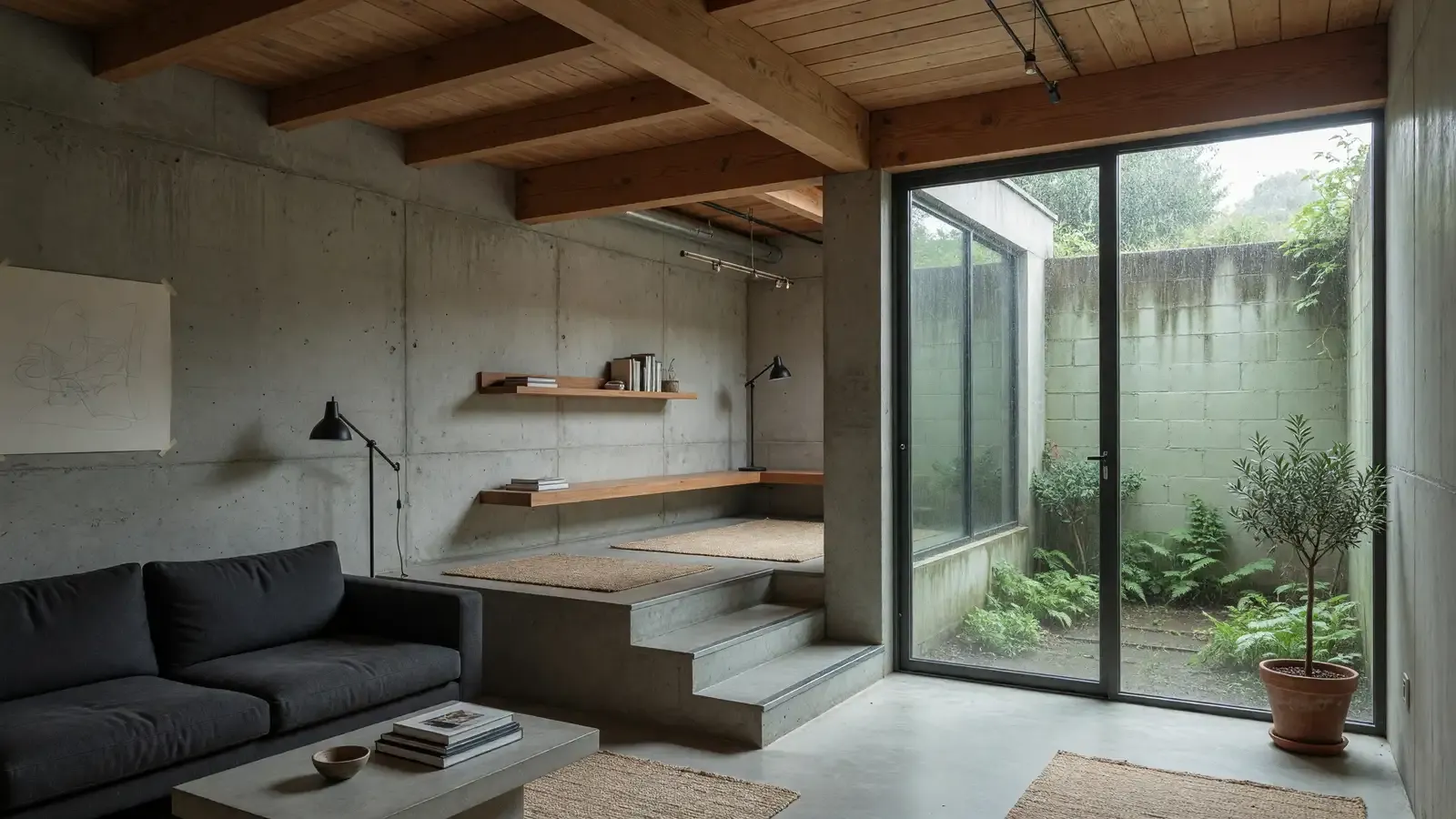
The film’s central architectural marvel—the Van Buren Institute—becomes a character in its own right, a physical manifestation of the tensions that define the narrative. Designed by László as a brutalist community center featuring a library, theater, gymnasium, and (at the municipality’s insistence) a Christian chapel, the Institute represents the collision of European modernism with American conservatism, of artistic vision with practical compromise. Becker and Crawley have created a space that feels simultaneously utopian and oppressive, beautiful and threatening—a perfect reflection of the film’s thematic concerns.
Adrien Brody’s Tour de Force
At the center of this architectural and emotional edifice stands Adrien Brody, delivering what may be the finest performance of his career. There are moments during “The Brutalist” when it becomes easy to forget that László Tóth is a fictional creation; such is the depth and specificity Brody brings to the role. He embodies the character with a physicality that speaks volumes—the hunched shoulders of a man carrying invisible weight, the animated gestures of someone whose hands will never stop designing, the haunted eyes of a survivor who has seen more than any human should.
Brody’s performance is a masterclass in restraint. He never overplays László’s trauma, never transforms the character into a mere symbol of victimhood. Instead, he layers complexity upon complexity: the architect’s stubbornness, his occasional petulance, his capacity for joy when confronted with beauty, his devastating loneliness. When László finally reunites with his wife Erzsébet (Felicity Jones) after thirteen years of separation, Brody’s face registers a cascade of emotions—relief, fear, hope, shame—that passes in waves across his features without ever descending into melodrama.
Felicity Jones, for her part, transforms what could have been a passive role into something far more compelling. Erzsébet is not merely a supporting character waiting to be reunited with her husband; she is a survivor in her own right, a woman who endured horrors in Hungary while maintaining the independence of mind and spirit that defines her. Her scenes with László crackle with a tension that speaks to the impossibility of truly knowing another person, even one you have loved across decades and continents.
A Faustian Bargain for the American Age
The thematic heart of “The Brutalist” lies in its exploration of the artist-patron relationship—a dynamic as old as civilization itself. Corbet, channeling Ayn Rand’s “The Fountainhead” while simultaneously subverting its libertarian ideals, presents László’s arrangement with Van Buren as a Faustian bargain in which the protagonist trades his soul for the opportunity to create. The bargain, of course, proves unequal: Van Buren takes and takes, offering recognition without genuine support, admiration without respect.
The film’s structure reinforces this dynamic through its division into two distinct acts: an astonishing ascent followed by a precipitous decline. The first half chronicles László’s rise—from immigrant desperation to architectural prominence—while the second documents his gradual disintegration at the hands of those who sought to use his genius for their own purposes. A fifteen-minute intermission divides these acts, providing viewers with a moment of reflection that mirrors László’s own suspended state between triumph and tragedy.
Yet “The Brutalist” refuses to offer easy answers or satisfying resolutions. When László finally completes the Institute, what should be a moment of triumph feels hollow, compromised. The building has been altered beyond recognition, stripped of its radical vision to accommodate the fears and prejudices of those who never understood it. This is Corbet’s central irony: the American Dream that promised liberation has instead delivered another form of imprisonment, another system designed to crush individual genius in favor of collective conformity.
The Weight of History
What elevates “The Brutalist” beyond mere allegory is its grounding in historical specificity. Corbet peppers the narrative with period-appropriate newsreels and radio broadcasts—references to the founding of Israel, the rise of suburban conformity, the ongoing struggle for civil rights—that situate László’s personal journey within a larger context of cultural transformation. These touches never feel didactic; instead, they create a rich tapestry of post-war American life against which the protagonist’s struggles gain additional resonance.
The film’s engagement with Jewish identity and immigrant experience proves particularly nuanced. László exists at a complex intersection: a Holocaust survivor whose artistic vision was deemed “not Germanic” by the Nazis, now attempting to rebuild in a country that offers opportunity while simultaneously demanding assimilation. When other Jews flock to Israel in the early 1950s, László faces an impossible question—where does his allegiance lie? Corbet refuses to answer this question definitively, instead allowing the ambiguity to complicate our understanding of his protagonist’s motivations.
The film’s final movement takes an unexpected turn, suggesting interpretations of László’s work that retroactively transform his legacy. Without spoiling the revelation, it suffices to say that Corbet understands the danger of imposing meaning upon art, the way that subsequent generations can reshape creative intent to serve contemporary agendas. The bittersweet coda reminds us that artistic genius often goes unrecognized in its own time, and that the truest measure of a work may only be apparent decades after its creation.
Visual Grandeur and Narrative Excess
Make no mistake: “The Brutalist” is not a perfect film. Its running time, while justified by the scope of its ambitions, occasionally tests the viewer’s patience. Certain sequences feel indulgently long, stretched to the breaking point by Corbet’s insistence on lingering over architectural details and emotional moments that might have been more effectively condensed. The film’s engagement with its themes, while intellectually rigorous, occasionally tips into didacticism, particularly in its dialogue-driven passages.
And yet these very excesses feel appropriate to the material. “The Brutalist” is a film about monumentalism, about the human impulse to create structures that outlast their creators. In its willingness to overwhelm, to challenge, to occasionally frustrate, the movie embodies the spirit of its protagonist’s vision. Just as László refuses to compromise his architectural principles in the face of commercial pressure, Corbet refuses to simplify his film in the face of contemporary attention spans.
The production design deserves particular acclaim. Judy Becker has created spaces that feel simultaneously authentic to their period and symbolic in their resonance. The contrast between the cramped, dark quarters of post-war immigrant life and the gleaming surfaces of Van Buren’s world speaks volumes about the class dynamics that define the narrative. The Institute itself, as it gradually rises from the Pennsylvania landscape, becomes a physical manifestation of aspiration—the beautiful, terrible monument to ambition that will ultimately destroy its creator.
A Cinema of Ideas
In an age of cinematic conservatism, where studios increasingly favor franchise extensions and nostalgic reboots, “The Brutalist” is a bold declaration of artistic ambition. Corbet has made a film that demands to be experienced on its own terms, that refuses to apologize for its length, its difficulty, or its uncompromising vision. This is cinema as architecture: built to endure, made to challenge.
The film received ten Academy Award nominations, including Best Picture and Best Director. What matters is not the accolades but the achievement itself: a movie that will be discussed, debated, and revisited for generations. Like the concrete structures that populate its narrative, “The Brutalist” is built to last.
Adrien Brody’s performance deserves special mention in any assessment of the film’s legacy. This is the role he was born to play—a complex, challenging character that allows him to deploy every tool in his considerable arsenal. One can only hope that “The Brutalist” will open doors for other actors of similar complexity, demonstrating that audiences will embrace challenging performances when given the opportunity.
The supporting cast provides exceptional depth across every frame. Guy Pearce’s transformation from charismatic industrialist to calculating manipulator reveals the character’s psychological complexity with unsettling precision. His scenes with Brody crackle with a tension that speaks to the power dynamics inherent in their relationship. Felicity Jones brings quiet strength to Erzsébet, refusing to allow her character to become a mere appendage to her husband’s narrative. Their reunion scenes constitute some of the most emotionally resonant moments in the entire film.
Alessandro Nivola’s brief but impactful performance as cousin Attila offers a counterpoint to László’s unwavering principles. Where László refuses to compromise, Attila has learned to bend—becoming successful but hollow, accepted but never truly seen. This contrast illuminates the film’s central questions about assimilation, identity, and the price of belonging. Joe Alwyn as Van Buren’s entitled son Harry and Stacy Martin as his more sympathetic daughter Maggie round out a remarkable ensemble, each bringing dimension to roles that could easily have become one-dimensional.
The technical achievements of “The Brutalist” extend far beyond its cinematography. Daniel Blumberg’s score deserves particular attention for its ability to create atmosphere without overwhelming the visuals. The composer’s use of industrial sounds, discordant strings, and occasional moments of haunting melody perfectly captures the film’s dual nature: the beauty of creation and the violence of destruction. Editing by David J. Richards and Corbet himself allows the film to breathe during its quieter moments while maintaining momentum during its more dramatic sequences.
Conclusion: A Masterwork for the Ages
“The Brutalist” is not an easy film to love. It is too cold, too intellectual, too concerned with ideas to offer the emotional catharsis that mainstream audiences typically crave. And yet within its austere beauty lies a profound meditation on art, identity, and the cost of ambition. Corbet has created a work that challenges viewers to meet it on its own terms, to embrace the difficulty and emerge transformed.
The film’s final images return us to the question of legacy—what do we leave behind, and who determines the meaning of our creations? For László Tóth, the answer remains uncertain, his monuments open to interpretation by those who never understood his vision. But for Brady Corbet, there is no uncertainty. “The Brutalist” is his monument, a towering achievement in contemporary cinema that will stand as a testament to the power of ambitious filmmaking for years to come.
In a career that has included the chilling psychological horror of “The Childhood of a Leader” and the dazzling pop tragedy of “Vox Lux,” Corbet has proven himself a filmmaker of restless intelligence and uncompromising vision. “The Brutalist” represents the culmination of these qualities—a film that builds toward something truly monumental, even as it acknowledges the inevitable compromises that accompany any grand undertaking. This is cinema as architecture: enduring, challenging, and absolutely magnificent.
Rotten Tomatoes’ 93% Tomatometer score and 79% audience score reflect a film that has divided critics while captivating those willing to engage with its considerable ambitions. This polarization feels appropriate for a work so concerned with the nature of artistic judgment itself. Just as László’s buildings were misunderstood in their time, “The Brutalist” may ultimately find its audience among those future generations willing to look past its initial strangeness toward the masterpiece beneath.
The film asks us to consider what we owe to art, and what art owes to us. In an era of streaming algorithms and audience-tested formulas, Corbet’s defiant commitment to his vision feels almost revolutionary. “The Brutalist” is not designed to please everyone; it is designed to matter. And in that aim, it succeeds magnificently.
As the credits roll and we emerge from the theater into ordinary life, we carry with us the echoes of László’s struggle—the weight of history, the cost of ambition, the tension between vision and compromise. This is the gift that great cinema offers: not escape from reality, but a deeper engagement with it. “The Brutalist” demands much from its audience. It also gives much in return.
Share This Article
Comments