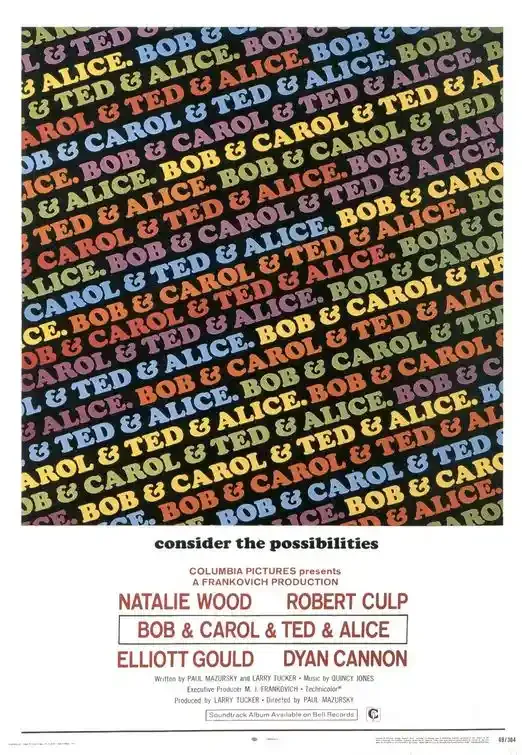
Bob & Carol & Ted & Alice (1969): The Satire That Loved Its Targets Too Much
Paul Mazursky's 1969 debut about two couples and the Esalen-era promise of total honesty: how it was made, what critics said, its four Oscar nominations, and why its ending still divides viewers.
Editor’s note: This article is a retrospective built from published reviews, production histories and other reporting, with analysis by the Bucket Movies Editorial Team. See how we work.
Editor’s note: an earlier version of this article misdescribed the film’s ending and some of its technique, attributed a quotation to the British Film Institute that we could not find, and included first-person impressions, a numerical rating and a reference list that did not point to specific sources. It has been rewritten from the sources linked below.
Our angle: Bob & Carol & Ted & Alice is often remembered as a sex comedy. The reviews from 1969 show that critics argued about something more specific: whether Paul Mazursky was laughing with his four characters or at them. That argument has never been settled, and it is still the best way into the film.
What the film is
Bob & Carol & Ted & Alice is a 1969 American comedy-drama directed by Paul Mazursky in his debut as a director. Mazursky wrote it with Larry Tucker, who also produced it, and Mike Frankovich was executive producer. Natalie Wood and Robert Culp play Carol and Bob Sanders. Elliott Gould and Dyan Cannon play Ted and Alice Henderson. Charles Lang shot the film, and Quincy Jones wrote the score. Columbia released it. It was the first American film to open the New York Film Festival, on September 16, 1969, and it opened commercially in New York on October 8. It runs 105 minutes.
The premise (no ending)
After a weekend of emotional honesty at an Esalen-style retreat, Bob and Carol, a fashionable Los Angeles couple, come home determined to live with complete openness. They try to share their enthusiasm with their more conventional friends Ted and Alice, who are doubtful. Soon Bob, a filmmaker, has an affair while working in San Francisco. When he tells Carol, she accepts it calmly, and the news shakes Ted and Alice far more than it shakes her. The film follows the four friends as each couple tests how far the new honesty can go, leading to a trip together to Las Vegas.
How it was made
- Esalen. Mazursky was inspired by a Time magazine article about the gestalt therapist Fritz Perls at the Esalen Institute in Big Sur. Mazursky and his wife went to Esalen themselves, and he developed the script with Tucker afterward.
- The directing job. Mazursky and Tucker had written I Love You, Alice B. Toklas (1968), but Mazursky was not allowed to direct it. This time he insisted on directing. He cited a short film he had made, his study of acting, his time watching the camerawork on Toklas and night classes in editing at the University of Southern California. Frankovich agreed.
- A real therapist. For the scene in which Alice visits a psychiatrist, Mazursky cast his own therapist, Donald F. Muhich, opposite Cannon. Muhich appeared in three more Mazursky films.
- The ending. The first draft ended with the four characters in tears after an aborted orgy, then pulling themselves together to go to a Tony Bennett show. Mazursky replaced it with what he called his “Fellini ending,” modeled on 8½.
The music
Quincy Jones composed, arranged and conducted the score. It includes Burt Bacharach and Hal David’s “What the World Needs Now Is Love” and adaptations of Handel’s Messiah, including Sarah Vaughan singing “I Know That My Redeemer Liveth.” The soundtrack album came out on Bell Records in 1969. Using Handel’s “Hallelujah” chorus over the opening titles sets up the film’s tone from the start: a lofty piece of sacred music over a story about weekend self-improvement.
What critics said in 1969
The reviews were divided, and the split was sharp.
- Roger Ebert of the Chicago Sun-Times gave it four stars, writing that “the genius of ‘Bob and Carol and Ted and Alice’ is that it understands the peculiar nature of the moral crisis for Americans in this age group, and understands that the way to consider it is in a comedy.”
- Pauline Kael of The New Yorker called it “a slick, whorey movie, and the liveliest American comedy so far this year.” She said Mazursky had built a style from “satiric improvisational revue theatre” and TV situation comedy, and that “though it looks conventional, it isn’t.”
- Gene Siskel of the Chicago Tribune gave it three and a half stars out of four and called it “the best comedy of the year.”
- Charles Champlin of the Los Angeles Times called it “a scintillating social comedy.”
- Gary Arnold of The Washington Post called it “the sharpest American comedy in several years.”
- Vincent Canby of The New York Times disagreed. He found it “unpleasant because it acts superior to the people in it,” and described the characters as “cheerful but humorless boobs.”
- John Simon called it “deplorable.”
Canby’s objection is the opposite of Ebert’s praise. Canby thought the film looked down on its characters, while Ebert and Kael thought it understood them.
Box office and awards
The film was a commercial hit. It was budgeted at about $2 million, earned a reported $31.9 million, and was the sixth-highest-grossing film of 1969. It received four Academy Award nominations: Best Supporting Actor for Gould, Best Supporting Actress for Cannon, Best Story and Screenplay for Mazursky and Tucker, and Best Cinematography for Lang. Cannon was also nominated for two Golden Globes, and Gould received a BAFTA nomination for Best Actor for this film and M*A*S*H. Mazursky later called it the film he was proudest of.
The ending and the argument over it
⚠️ Spoiler warning: this section discusses the ending.
In Las Vegas the two couples talk themselves into a partner swap. They undress and get into bed together, and then all four stop. The film cuts to them walking out through the casino with their own partners as “What the World Needs Now Is Love” plays. Outside, they join a crowd of strangers and exchange long looks, echoing the wordless exercises at the retreat at the start of the film.
Some viewers called the ending a cop-out. Mazursky answered that complaint in 1970: “The easiest thing in the world would have been to show those four making it together in that bed. But it became obvious to us that these four people in these circumstances couldn’t possibly have done it.” Read that way, the ending is consistent with the film’s view of its characters. They believe in total honesty, but they are not prepared for what it would actually require.
The four performances
Wood, then moving from young star to adult roles, plays Carol as the most committed of the four to the new openness. Culp, best known at the time for television’s I Spy, plays Bob as an enthusiast whose new vocabulary also serves his own wishes. Gould and Cannon received the Oscar nominations, and their roles are the most openly comic. Ted wants to join in and cannot quite manage it. Alice reacts to the others’ revelations with dismay, most memorably in her session with the psychiatrist. Together with M*A*S*H the following year, the role helped make Gould one of the defining actors of the early 1970s.
How it is seen now
The film has an 82% approval rating on Rotten Tomatoes from 61 reviews. The consensus is that it “isn’t as subversive as it thinks it is—but it is smart & sophisticated & funny & well-acted.” That verdict is close to where the 1969 debate ended up: admiration for its craft and wit, with doubts about how daring it really is. It became the signature film of Mazursky’s career, and it helped open the way for a run of films about infidelity and marriage in the early 1970s. Mazursky returned to California settings in later films such as Alex in Wonderland and Down and Out in Beverly Hills. A short-lived television series based on the film followed in 1973.
Where it fits
The film is a key work of late-1960s Hollywood’s attempt to deal with the counterculture from the inside, made by a writer-director who had attended the kind of retreat he satirizes. For other retrospectives of films from this period, see our pieces on The Swimmer, a 1968 film about the hollowness of suburban comfort, and on The Conversation. You can also browse the reviews section.
Our read
The record shows a debut that was a hit with audiences and with most leading critics, and a film whose central question, whether it respects or mocks its characters, divided critics from the start. Mazursky’s own account of the ending suggests his answer. He saw his four characters as people who meant what they said about honesty but could not live up to it, and the film treats that failure with more sympathy than scorn.
How this was compiled: credits, production and release details come from Columbia release records and published production histories, including Mazursky’s own accounts; contemporary critics’ quotes come from reviews by Roger Ebert, Pauline Kael, Gene Siskel, Charles Champlin, Gary Arnold, Vincent Canby and John Simon; later assessments come from Rotten Tomatoes. Bucket Movies did not watch the film for this article. See how we work.
Sources & further reading
- 1. Bob & Carol & Ted & Alice — Rotten Tomatoes
- 2. Bob & Carol & Ted & Alice — Golden Globes
- 3. Bob & Carol & Ted & Alice — RogerEbert.com
worth a spot on the list?
Reader notes
Join the discussion
No account needed — leave your take on this film below.
Add these to your list
I Want Your Sex Review Roundup: What Critics Said About Gregg Araki's Erotic Comedy
Gregg Araki's I Want Your Sex, with Olivia Wilde and Cooper Hoffman, drew strong reviews out of Sundance and a small theatrical gross. What critics praised, their reservations, how it was made and who it is for.

'The Dink' Review: Ben Stiller and Jake Johnson Serve Up the Year's Most Surprisingly Charming Sports Comedy
Apple TV+'s pickleball comedy shouldn't work — a 103-minute film about the world's most ridiculed sport, starring a guy who looks perpetually confused. Yet 'The Dink' lands its shots more often than it misses, thanks to a game cast and a script that knows exactly how silly its premise is.

Anora Review: Sean Baker's Unflinching Masterpiece of Class, Desire, and the American Dream
Sean Baker's Anora, the Palme d'Or and Best Picture winner, is a screwball fairy tale about a Brooklyn stripper who marries an oligarch's son. What critics praised, where they pushed back, and how it was made.
Keep Cool (1997): Zhang Yimou's Forgotten Black Comedy About Modern China
Zhang Yimou's 1997 Beijing comedy Keep Cool, starring Jiang Wen and Li Baotian: the story, the handheld style, the censorship fight over Cannes and its ending, and how critics received it.
Loading comments...