Sunrise: A Song of Two Humans (1927): Temptation, Motion, and the Last Silent Dream
An in-depth analysis of F. W. Murnau's Sunrise, from its moving camera and city-country split to Janet Gaynor's tenderness and the film's strange modernity.
Editorial Notes
Anna edits BucketMovies criticism and essay packages, with a steady interest in classic Hollywood, literary adaptations, and repertory programming.
Leah Carter
Research Editor
Leah handles source checks, release-date verification, awards coverage, and the reporting framework behind BucketMovies news and industry pieces.
Some classics ask for reverence before they ask for attention. Sunrise: A Song of Two Humans does the opposite. It pulls you in first, then lets you sort out why you are shaken. The plot sounds almost too bare to sustain a reputation this large: a farmer, seduced by a woman from the city, nearly murders his wife, loses his nerve, and tries to rebuild what he almost destroyed. In weaker hands, that material could have turned into a moral pamphlet or a piece of overripe melodrama.
F. W. Murnau turns it into something stranger and more alive. The film does not rest on the twists of the story. It rests on movement, pressure, and shifts of feeling that happen inside the frame before the characters can even name them. That is why Sunrise still feels fresh in 2026. It is not just a “great silent film.” It is a film about unstable desire, about the pull of modern life, and about a marriage that survives only after passing through fantasy, humiliation, and fear.
MoMA’s essay on the film makes a useful point: Murnau brought German studio technique and visual imagination to Hollywood, then used Fox’s money to build one of the most elaborate worlds of the late silent era. The result does not feel imported or domestic. It feels suspended between places. The Library of Congress essay by Lucy Fischer goes even further and calls Sunrise a border-crossing film, nationally, technologically, and aesthetically. That is exactly the right way into it. The movie keeps crossing lines that other films treat as fixed: country and city, innocence and temptation, silent and sound, realism and dream.
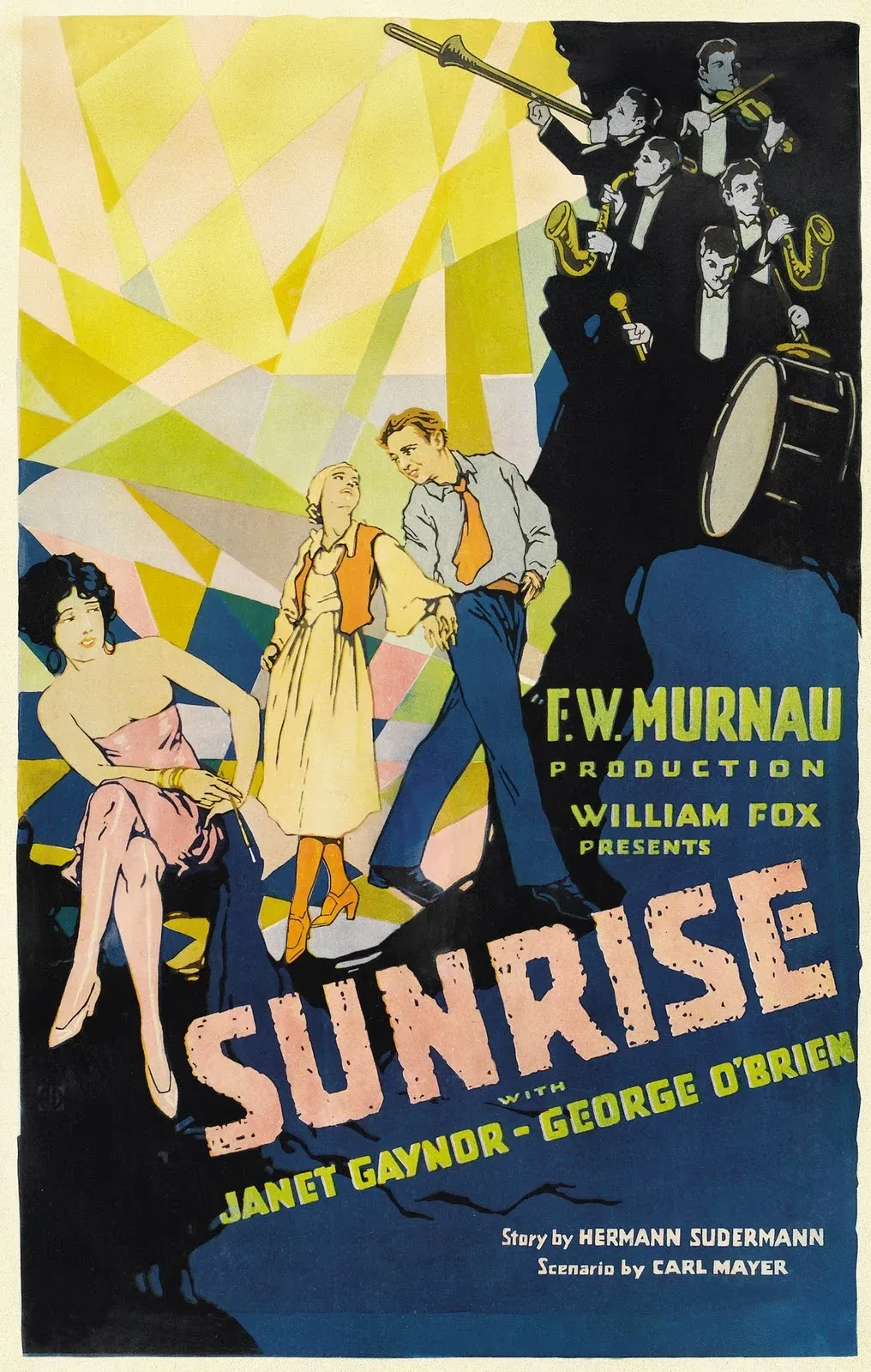
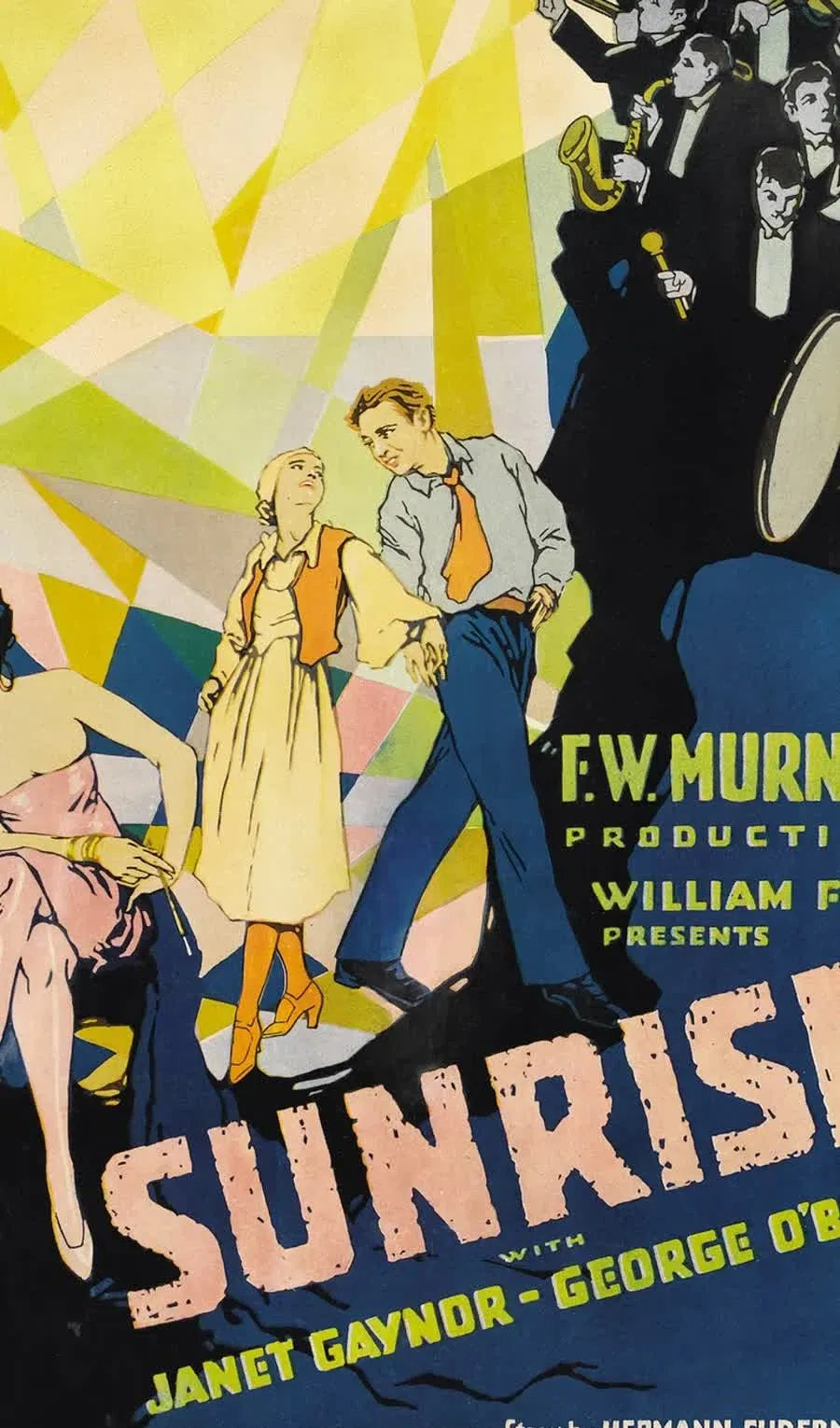 Detail from the original 1927 release poster for Sunrise: A Song of Two Humans, preserved via Wikimedia Commons.
The Story Works Because Murnau Strips It Down
One of the boldest choices in Sunrise is how little psychological explanation it gives us. AFI notes that the characters are identified only as the Man, the Wife, and the Woman from the City. The opening prologue says this is a story of “no place and every place.” Those choices sound simple, but they do a lot of heavy lifting. Murnau is not trying to build a sociological case study of one marriage in one village. He is making a fable, though a very uneasy one.
That matters because the film never asks us to wonder whether the Man has a good reason to drift. The reason is temptation itself. Margaret Livingston’s city woman is not a fully rounded rival in the modern dramatic sense. She arrives like a charge in the air. Cigarette smoke, dark dress, high heels, moonlit marsh. Murnau sketches her as an event before he sketches her as a person. If that sounds schematic, it is, but the schematic quality is part of the film’s force. We are watching emotional weather move across a marriage.
The danger is that such archetypes can flatten a movie. They do not here, mostly because Murnau keeps pushing against simplicity in the staging. The Man is capable of violence, but he is also weak, ashamed, and easily overwhelmed by his own imagination. The Wife is gentle, yet Janet Gaynor never plays her as blank purity. She is frightened, wary, funny, and eventually more emotionally generous than the film’s early scenes lead us to expect. Even the city woman, who might have stayed a stock vamp, lingers in the film as a reminder that desire is rarely neat enough to quarantine.
I keep coming back to how fast Sunrise moves from criminal impulse to embarrassment. The boat sequence is terrifying because the Man’s plan is so close to action, then suddenly collapses under the weight of his own panic. You can feel the movie refusing melodramatic certainty. This is not a story about evil triumphant or virtue automatically rewarded. It is a story about a terrible impulse that has to be lived through after it fails.
The Camera Does Not Record Emotion. It Creates It
If you had to reduce Sunrise to one technical fact, it would be this: the camera keeps moving when most films of the period would have stayed put. Charles Silver’s MoMA piece quotes Rodney Farnsworth’s line that the real protagonist of the film may be the camera itself. That sounds a little grand until you watch the marsh sequence again. Then it feels plain enough.
The camera glides with the Man through reeds and fog as if the landscape were conspiring with him. It does not merely observe temptation. It carries temptation forward. Senses of Cinema is especially good on this point, describing how Murnau moves between external action and the character’s inner world without breaking the spell. You do not feel that the film pauses to explain a state of mind. You feel dragged into it.
That is why the famous tracking shots in Sunrise still look so modern. They are not there to announce technical progress. They change the moral temperature of scenes. When the Man and Wife later walk through the city and the world seems to open around them, the camera loosens with them. When dread closes in, the film tightens. AFI’s production history explains how perspective tricks, sloped floors, oversized practical elements, and carefully staged depth were used to make the built environments feel richer and stranger. None of that reads as a museum fact while you are watching. It reads as feeling.
There is also a difference between movement and release. Plenty of directors use fluid camera work to create freedom. Murnau often uses it to create vulnerability. The camera in Sunrise is soft, lyrical, and curious, but it is also invasive. It moves close when the characters would probably rather be left alone. It finds shame on their faces. It follows hesitation. It lingers just long enough for a glance to turn into a confession.
This is what makes the film more than a technical landmark. The style is not detachable from the drama. Murnau does not take a simple story and decorate it with virtuosity. He makes the style carry the burden of contradiction. The movie has to persuade us that terror, comedy, erotic pull, and forgiveness can live in the same piece of work. The camera is what makes that possible.
The City Is Not the Villain. It Is the Film’s Test Ground
It is easy to reduce Sunrise to a country-good, city-bad morality tale. The film invites that reading just enough to make it tempting. The Woman from the City literally brings the murder plot into the farm household, and the city itself is introduced as a zone of speed, crowds, lights, and danger.
But the film is more complicated than that. Lucy Fischer argues that the movie’s power comes partly from how it crosses borders instead of sitting still inside them. You can feel that during the long central passage in town. The city is where the murder plan dies. It is where the Wife’s fear peaks, but it is also where the marriage begins, awkwardly, to revive. The church, the photographer’s studio, the dance floor, the barbershop, the carnival. These are urban spaces, and the film treats them as places of risk and renewal at the same time.
That middle stretch is one reason the movie still surprises people. After the nightmare mood of the opening act, Murnau allows comedy to flood in. Senses of Cinema notes how important those comic passages are, even if modern viewers sometimes find them odd or prolonged. I think the tonal risk is part of the point. If the city remained pure menace, the film would stay morally tidy. Instead, the urban world becomes the place where the couple relearns each other.
The contradiction is what gives the movie a pulse. The city woman offers fantasy without responsibility. The actual city gives the Man and Wife something harder: the chance to move through public space together again, to look ridiculous, to share embarrassment, to rediscover tenderness in the middle of noise. The marriage cannot be repaired back in the farmhouse as if nothing happened. It has to pass through modern life, not retreat from it.
That is where Sunrise feels less conservative than its outline suggests. The film does not restore order by proving that the old world was enough all along. It sends the couple through a modern maze and lets them come out altered.
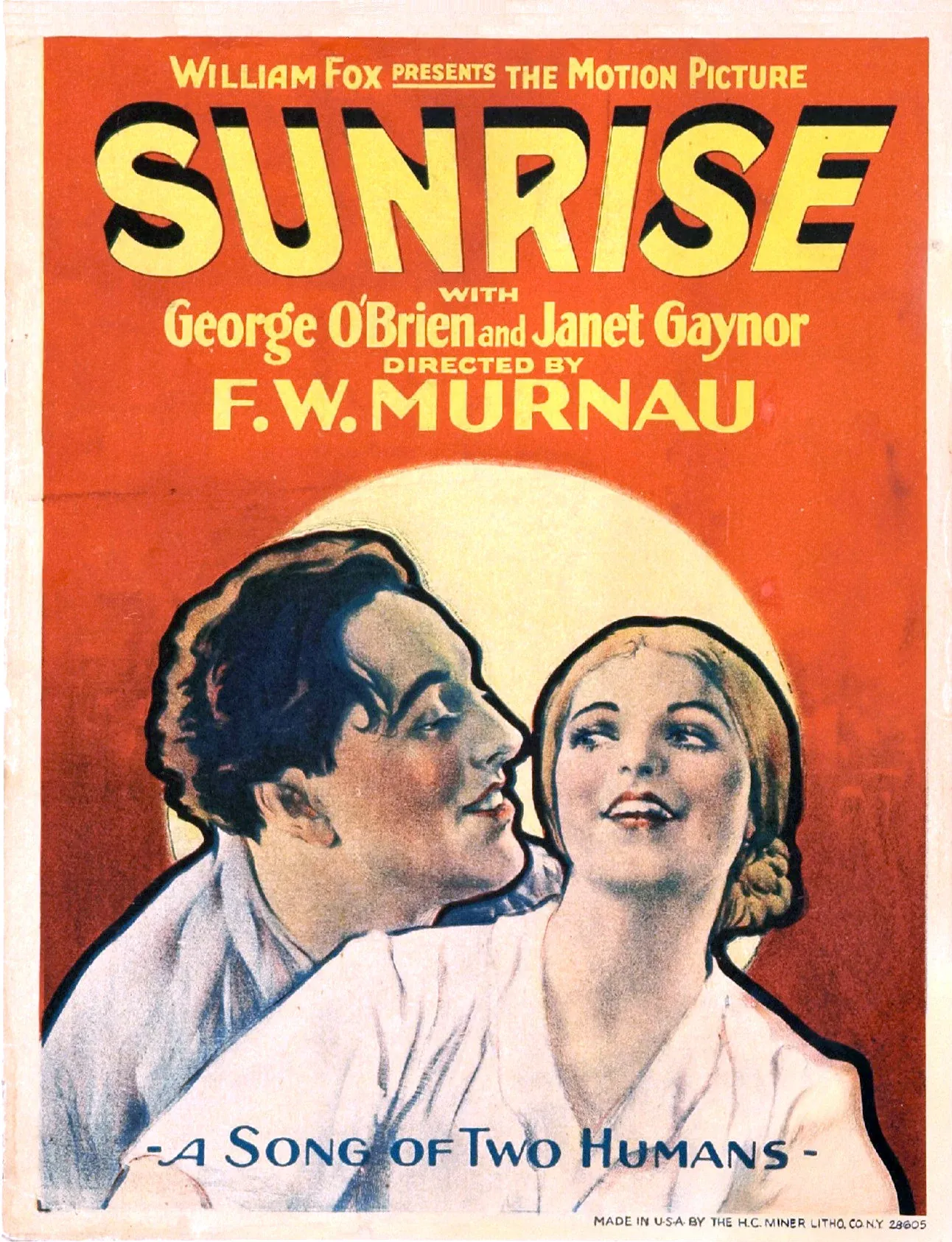 Vintage promotional poster for Sunrise, preserved via Wikimedia Commons.
Sunrise Is a Silent Masterpiece That Was Never Fully Silent
Calling Sunrise one of the greatest silent films ever made is true, but it can also be a little misleading. The Oscars page for the Academy’s 35mm preservation print points out something people still forget: the film was released with a synchronized musical score and sound effects. AFI records it as silent, with Movietone music and effects. Senses of Cinema describes it as part of a transitional moment, bridging silent aesthetics and early synchronized sound. That hybrid status matters.
It matters because Sunrise does not play like a relic from a sealed-off era. It plays like a film made at a threshold. Murnau still works with the expressive clarity of silent acting and visual storytelling, but he is already interested in an audio world that can deepen immersion without turning dialogue into the center of the experience. The score by Hugo Riesenfeld is not a decorative afterthought. MoMA treats it as part of the film’s identity, and it is hard to disagree. Once you hear how the music and effects shape tension, the old divide between silent and sound cinema starts to feel too clean.
The same goes for intertitles. Murnau uses them sparingly, then lets them fade into the background. That restraint does not just look elegant. It changes the way we watch faces and bodies. We are not waiting for the text to explain what has already happened. We are watching movement do the work language usually claims for itself.
This threshold quality helps explain why Sunrise still converts people who do not think they like silent cinema. The film does not ask viewers to admire a lost form from a respectful distance. It offers a full sensory design, one built on rhythm, image, gesture, and music. In that sense it feels less like the end of something than a path cinema might have followed more often if sound had not quickly hardened into a dialogue-first system.
Janet Gaynor Keeps the Film From Turning Into Abstract Beauty
For all the talk about Murnau’s camera, Sunrise would not survive as more than a technical marvel without Janet Gaynor. The Academy page reminds us that Gaynor won the first Best Actress Oscar for work that included Sunrise. Watching the film now, the award makes sense. She gives the movie its emotional gravity.
What I love about Gaynor here is how little she forces. The Wife begins as a near-mythic figure of threatened innocence, but Gaynor keeps tugging her back toward ordinary human feeling. When the Man suddenly looms over her in the boat, fear flashes across her face in a way that still hurts. Later, in the city, she lets suspicion and hope sit side by side. She wants to believe him, but she is not naive enough to forget what just happened.
That middle register is hard to play, especially in silent cinema where gestures can tip into underlining. Gaynor stays alive inside the scene. She is tender without going soft. She is funny without breaking the movie’s fragility. By the time the film reaches its late storm and near-tragedy, we are no longer watching a symbolic wife. We are watching someone whose forgiveness, if it comes, has cost her something.
George O’Brien is more limited, and that helps the movie in a strange way. His stiffness never becomes deadness. It becomes a kind of blunt physicality. He looks like a man struggling to catch up with his own actions. Gaynor, by contrast, reads quickly, delicately, almost musically. Their difference gives the marriage scenes their tension. He acts too late. She feels too much, too soon. Somehow Murnau builds a love story out of that mismatch.
Why Sunrise Still Feels Like a Living Film
A lot of canonical classics now survive on reputation and homework energy. People know they matter before they know how they feel. Sunrise still escapes that trap. It lives in the body first. The marsh scenes feel damp and perilous. The city feels crowded and slightly miraculous. The reconciliation is awkward enough to be convincing. Even the final rescue and dawn light risk sentiment so openly that the film either wins you over or loses you completely. There is no middle ground.
That willingness to risk feeling is part of what Lucy Fischer gets at in the Library of Congress essay. She argues that the film strips viewers of their usual cynicism and makes them “unlearn” some of the habits that later cinema taught us. I think that is right. Sunrise does not flatter sophistication. It asks whether you can still be moved by direct emotion if the form is strong enough to hold it.
It also helps that the film’s ideas remain active. Temptation in Sunrise is not just sexual. It is bound up with fantasy, self-invention, and the promise that another life can wipe out your obligations. The city woman offers escape in that sense. The city itself offers a better answer: not escape, but change. Murnau seems to understand that desire can wreck a life, but also that staying emotionally fixed may wreck it just as thoroughly.
For readers who like their film history tied to style rather than trivia, this makes a good companion to The Passion of Joan of Arc (1928): The Face, the Trial, and the Violence of Looking and The Third Man (1949): Why Vienna Haunts Every Frame. All three films ask what the camera can do once it stops behaving like a neutral witness.
Final Thought
What stays with me about Sunrise is how unstable it remains even after the ending gives us dawn, reunion, and apparent peace. The marriage survives, but it survives with knowledge inside it. The Man cannot unknow what he planned. The Wife cannot unknow the fear on the boat. The city woman leaves, yet desire does not disappear just because a narrative has closed.
That lingering unease is why the film endures. Sunrise is romantic, but it is not innocent. It is lyrical, but it is never sleepy. Murnau takes one of the oldest stories in the world, temptation, near-loss, return, and shoots it with such physical grace that it feels less like a lesson than a dream you wake from a little unsteady. There are silent films that deserve admiration. Sunrise asks for something harder. It asks to be felt.
Sources and Further Reading
- F. W. Murnau’s Sunrise: A Song of Two Humans - MoMA
- Sunrise: A Song of Two Humans (1927) - AFI Catalog
- Sunrise: A Song of Two Humans (F.W. Murnau, 1927) - Senses of Cinema
- 90th Anniversary Screening of Sunrise: A Song of Two Humans (1927) - Academy of Motion Picture Arts and Sciences
- “Sunrise”: Still Shining Bright - Library of Congress
- File:Sunrise - A Song of Two Humans.jpg - Wikimedia Commons
- File:Sunrise vintage.jpg - Wikimedia Commons
Share This Article
Comments