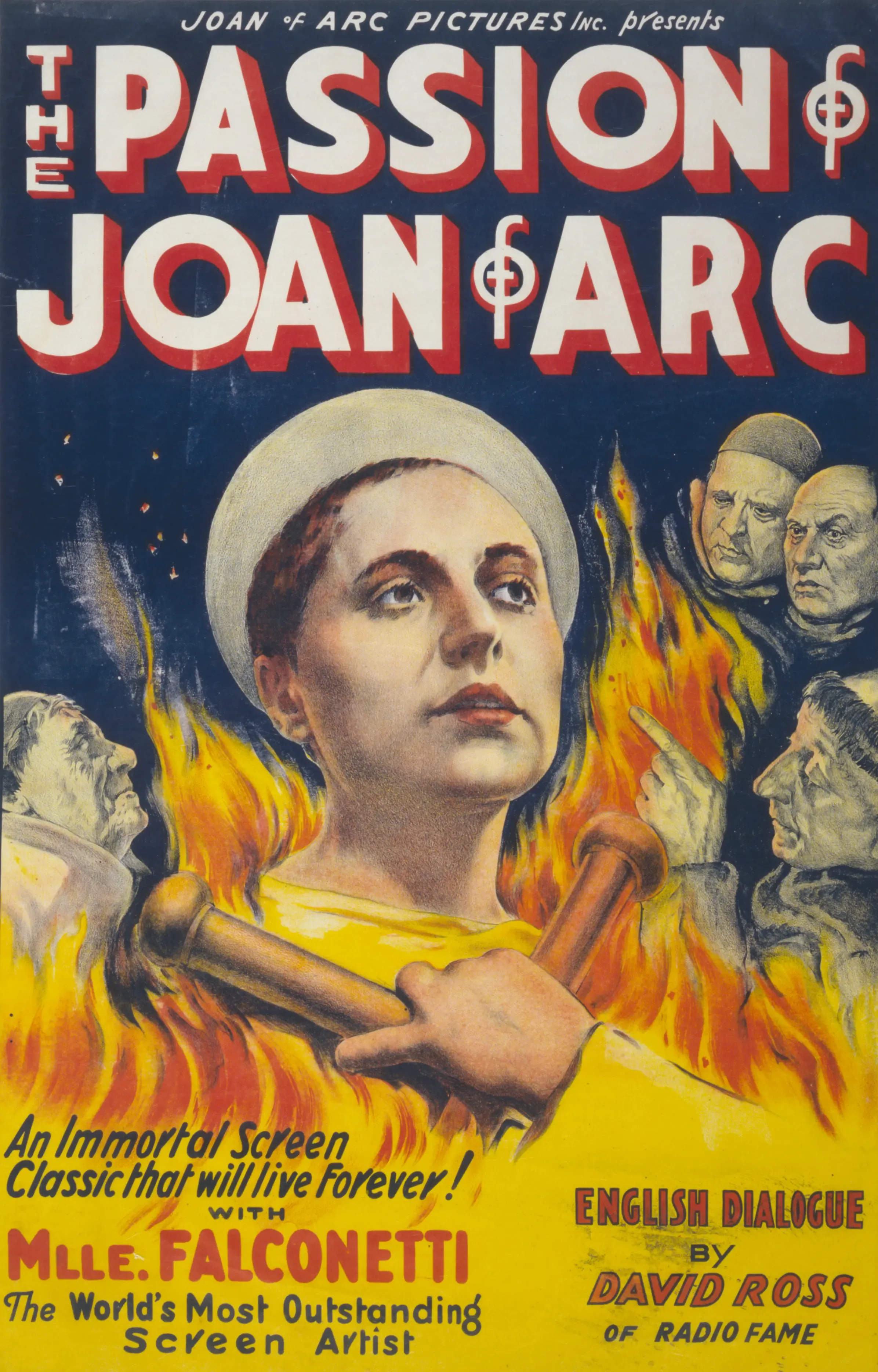
The Passion of Joan of Arc (1928): The Face, the Trial, and the Violence of Looking
An in-depth analysis of Carl Theodor Dreyer's The Passion of Joan of Arc, from Falconetti's close-ups and broken film space to the clash between faith and institutional power.
Editorial Notes
Anna edits BucketMovies criticism and essay packages, with a steady interest in classic Hollywood, literary adaptations, and repertory programming.
Leah Carter
Research Editor
Leah handles source checks, release-date verification, awards coverage, and the reporting framework behind BucketMovies news and industry pieces.
Some silent films feel distant the second you press play. The Passion of Joan of Arc does the opposite. It gets uncomfortably close, and it stays there. Carl Theodor Dreyer does not give us a grand historical pageant or a tidy saint’s biography. He gives us a face under pressure, a room full of men who mistake procedure for truth, and a camera that refuses to look away.
That decision is the whole movie. The film takes the final hours of Joan’s trial and turns them into a study of looking itself: who gets watched, who gets judged, who gets to speak, and who has to survive being read by hostile eyes. Watching it now, nearly a century later, I still find it startlingly modern. Not because it predicts anything, but because it understands how power works when it hides inside process.
Criterion’s notes stress the film’s “painfully intimate close-ups,” and that is exactly where to begin. Dreyer is not using the close-up as decoration. He is using it as pressure. The shot scale traps Joan inside other people’s scrutiny, then traps us there with her. Once the film settles into that rhythm, escape is off the table.
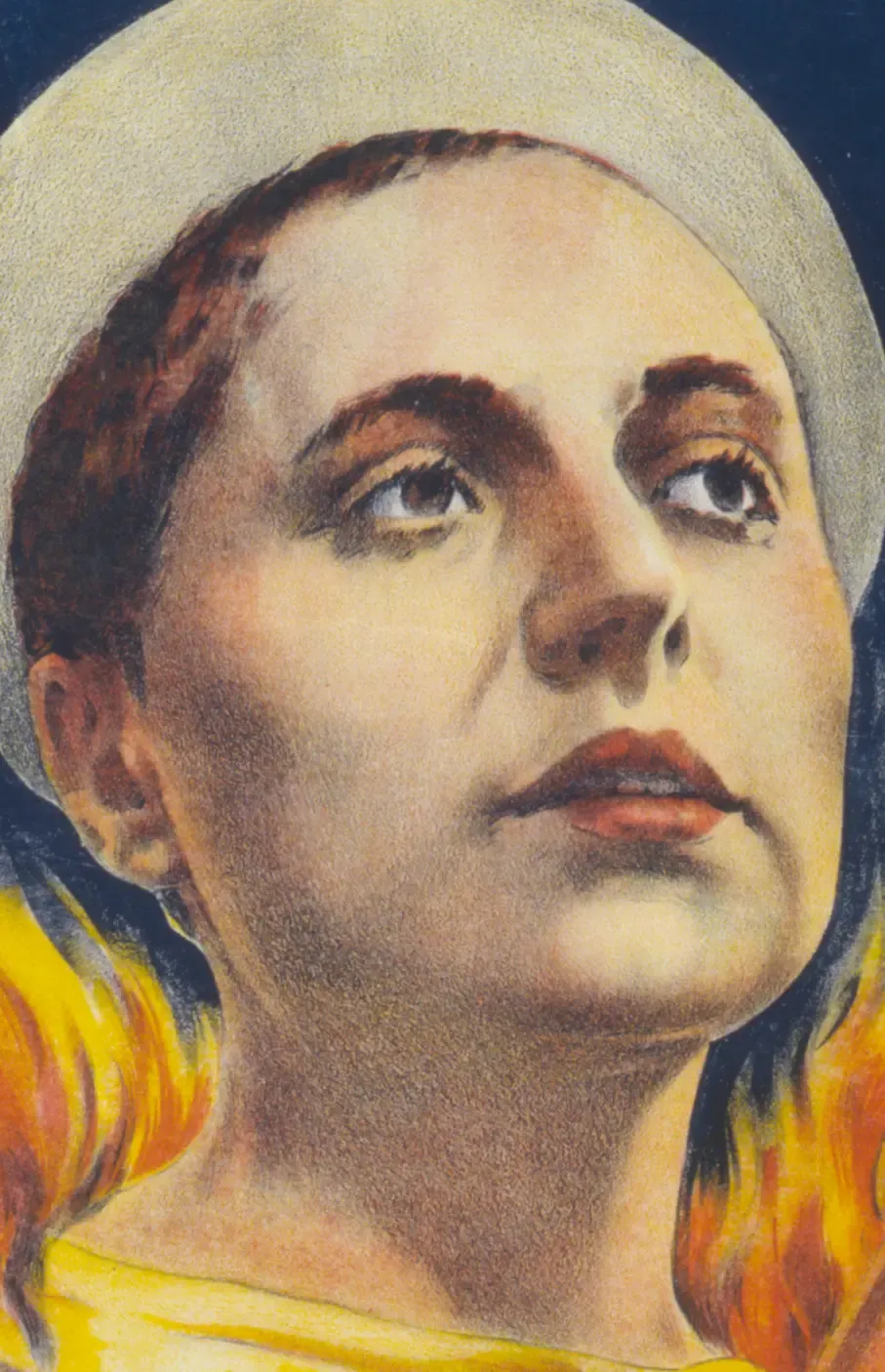 Original English poster detail for The Passion of Joan of Arc, preserved via Wikimedia Commons from a Library of Congress scan.
The Passion of Joan of Arc Turns the Human Face Into a Battlefield
Roger Ebert once wrote that you cannot know silent film history unless you know Falconetti’s face. That sounds like canon-building at first, but it gets at something real. Renée Falconetti is not just expressive here. Her face becomes the film’s main terrain. Dreyer strips away the ordinary comforts of historical drama, so we are left with skin, tears, shaved hair, darting eyes, and exhausted stillness.
The effect is not sentimental. Joan is not framed as a soft icon floating above the world. She looks frightened, stubborn, confused, hurt, and then suddenly composed again. That instability matters. It keeps the performance alive. Falconetti does not play holiness as serenity. She plays it as a state that has to survive humiliation one question at a time.
Britannica points out that Dreyer based the film on the records of the actual trial, and that historical grounding helps explain the movie’s severity. The drama is not built from speculative backstory or battlefield spectacle. It is built from interrogation. Language becomes the judges’ weapon, but Dreyer never lets words do all the work. The real violence comes from the faces that surround Joan, crowd her, doubt her, and wait for a slip.
What stays with me is how little vanity there is in Dreyer’s treatment of close-up. These shots are not glamorous. The skin texture matters. The creases matter. The fatigue matters. The judges are often photographed in ways that make them look grotesque without turning them into cartoons. Joan, by contrast, is not idealized into a marble saint. She looks terribly human, which is why the film hurts.
Dreyer Breaks Space So We Feel Joan’s Fear Instead of Mapping the Room
BFI’s piece on the film’s grammar is one of the clearest guides to what Dreyer is doing. The article walks through his lack of clear master shots, his inconsistent eyelines, and his refusal to build smooth continuity between one close-up and the next. In a weaker film, that might feel messy. Here it feels exact.
The trial room never settles into a stable geometry. We know who is attacking Joan, but we do not always know where everyone stands in relation to everyone else. That matters because the film is not trying to turn the trial into a balanced debate. It is trying to make the trial feel like a trap whose rules keep shifting.
This is where The Passion of Joan of Arc separates itself from most courtroom dramas. Courtroom films often build their force through clarity. They show the room, mark the sides, and let tension grow inside a visible structure. Dreyer does the reverse. He shatters the structure. He makes the room feel unstable, even when the institution running it believes itself to be orderly and righteous.
Ebert notes that the film has no true establishing shot for the full set, and that absence changes everything. Instead of learning the architecture and then following the action through it, we experience the space the way Joan does: in fragments, threats, interruptions, and faces leaning into the frame. The film’s fractured style does not signal confusion on Dreyer’s part. It is the mechanism by which he produces Joan’s experience for us.
Joan’s Faith Is Not Treated as Abstraction
One of the reasons the film still feels alive is that Dreyer does not reduce Joan to a symbol. She becomes one by the end, but he starts from the body. She grows tired. She winces. She hesitates. She seems to gather herself before answering. Even when she speaks with certainty, the certainty looks costly.
MoMA’s Charles Silver wrote that Dreyer’s reliance on close-ups makes Joan feel “unique and ineffable.” I think that is right, though I would put it in plainer terms: the film convinces you that Joan’s inner life is not available to the men judging her. They can question her. They can corner her. They can threaten her. They still cannot fully own what she believes.
That gap between institution and conviction gives the film its moral shape. The judges are not presented as cackling villains. They are worse than that. They are bureaucrats of certainty. They believe process can flatten mystery into confession. They believe power has the right to define reality. Joan’s resistance unsettles them because she will not let their language fully contain her.
This is why the film’s religious charge still lands even for viewers who do not share Joan’s faith. The movie is not asking us to sign a creed. It is asking us to watch what happens when a person insists that the deepest part of her experience cannot be administered by hostile men with official titles.
 Alternate 1929 poster variant for The Passion of Joan of Arc, preserved on Wikimedia Commons.
The Judges Matter Because Dreyer Films Them as Flesh, Not Authority
The movie would be far less upsetting if the judges were just faceless machinery. They are not. They are all too physical. Their pores, wrinkles, teeth, and glances are part of the film’s argument. Criterion describes the film as a study of “institutional hypocrisy,” and the word fits because Dreyer never lets authority float above the body. He drags it back into flesh.
That choice has two effects. First, it demystifies the tribunal. We do not see timeless guardians of order. We see men with petty vanities, cruel curiosity, and a strong investment in winning. Second, it deepens Joan’s isolation. She is not facing a clean abstract system. She is facing people. They sweat, leer, smirk, and crowd her. Their humanity does not soften the system. It makes the system more damning.
There is also a strange equality in the way Dreyer uses the camera. Joan gets the most tender attention, but nobody is protected from scrutiny. The judges are also subjected to the close-up, and many of them fail that test. Their faces look coarse, unstable, and spiritually exhausted. The camera becomes a moral instrument, not because it tells us who is right in a didactic way, but because it records the cost of their certainty.
This is one reason the film has such a sharp aftertaste. It is not only about martyrdom. It is about the ugliness of men who have convinced themselves that procedure absolves them. That is a different kind of horror, and it ages all too well.
Falconetti’s Performance Feels Dangerous Because It Refuses Neat Emotion
Plenty of great performances can be summarized in a phrase. Falconetti’s cannot. Calling it “spiritual” is true but incomplete. Calling it “suffering” is true but also too easy. What makes the work so powerful is that she keeps changing the temperature of the scene without breaking the character’s center.
At times she looks almost childlike, especially when confusion crosses her face before she regains composure. At other moments she is stern enough to make the judges seem small. Then fear comes back. Then exhaustion. Then a flash of something like serenity. The performance keeps moving between terror and resolve, which makes it much harder to consume as piety.
I also think Falconetti benefits from the film’s refusal to romanticize pain. Dreyer does not ask us to admire suffering in the abstract. He makes us sit with indignity. Joan is mocked, cornered, tempted, manipulated, and physically weakened. The result is not inspirational in the usual sense. It is abrasive. That abrasion is part of why the film has remained central to conversations about silent acting.
If you put this performance next to other faces from silent cinema, you start to understand why it still feels singular. It is not bigger. It is more exposed. Dreyer and Falconetti strip away the habits that would make the role legible in a routine prestige picture. What remains is frighteningly direct.
The Film’s Last Movement Refuses Comfort
For a movie so closely tied to sainthood, The Passion of Joan of Arc does not end on reassurance. It ends on violence, spectacle, and public frenzy. Joan’s death is not turned into a calm tableau. Dreyer stages it as a political and emotional rupture.
That matters because the film has spent so much time in close confinement. Once the final movement widens into the crowd and the execution, the energy does not become easier to bear. It becomes harder. The public world that had remained mostly outside the trial now erupts into view, and suddenly Joan’s suffering is no longer private. It has become an event.
The strange thing is that the film still does not offer release in the usual sense. There is grief, yes, but not closure. Joan dies, the crowd reacts, the violence spills outward, and the film leaves us with agitation rather than peace. That choice saves the movie from devotional stiffness. Dreyer does not let martyrdom settle into a clean spiritual finish. He keeps the wound open.
Why the Film Still Feels Current
I try to be careful with the phrase “still relevant,” because it often gets used as a shortcut. In this case, though, the film earns it. The Passion of Joan of Arc still feels current because it understands what happens when institutions confuse authority with moral legitimacy. It understands public humiliation. It understands hostile interpretation. It understands how a system can demand confession while pretending it only wants truth.
That does not make it a simple allegory for the present. The movie is far too severe and strange for that. What it does offer is a durable account of scrutiny as punishment. Joan is watched, tested, and defined by people who already think they know what her words mean. The trial is supposed to be about inquiry, but it becomes enforcement.
There is also the matter of style. A lot of silent classics now live in reputation more than experience. This one still plays. The cuts are sharp. The faces remain unsettling. The broken space still works on the nerves. When a film from 1928 can make modern viewers feel physically cornered, it is not just important. It is active.
For readers interested in how older films turn style into moral argument, this pairs well with The Cabinet of Dr. Caligari (1920): Expressionism, Madness, and the Birth of Modern Horror and The Third Man (1949): Why Vienna Haunts Every Frame.
Final Thought
What keeps pulling me back to The Passion of Joan of Arc is how little padding there is between form and feeling. Dreyer does not use style to decorate belief. He uses style to test it. Every cut, every close-up, every broken spatial relation pushes us toward Joan’s ordeal without turning that ordeal into something easy to admire from a safe distance.
That is why the film remains so hard to shake. It is about faith, but it is also about institutions that weaponize interpretation. It is about sainthood, but it is also about the cruelty of making a vulnerable person perform coherence for hostile spectators. Most of all, it is about the human face under pressure. Few films have looked at a face more closely. Fewer still have found so much fear, dignity, and defiance there.
Sources and Further Reading
- The Passion of Joan of Arc (1928) - The Criterion Collection
- 4 hard-and-fast rules of filmmaking… and how The Passion of Joan of Arc breaks them - BFI
- La Passion de Jeanne d’Arc - Encyclopaedia Britannica
- Carl Theodor Dreyer’s The Passion of Joan of Arc - MoMA
- The Passion of Joan of Arc movie review - RogerEbert.com
- The Passion of Joan of Arc (1928) English Poster - Wikimedia Commons
- Passion of Joan of Arc movie poster - Wikimedia Commons
Share This Article
Comments
_English_Poster.png)
