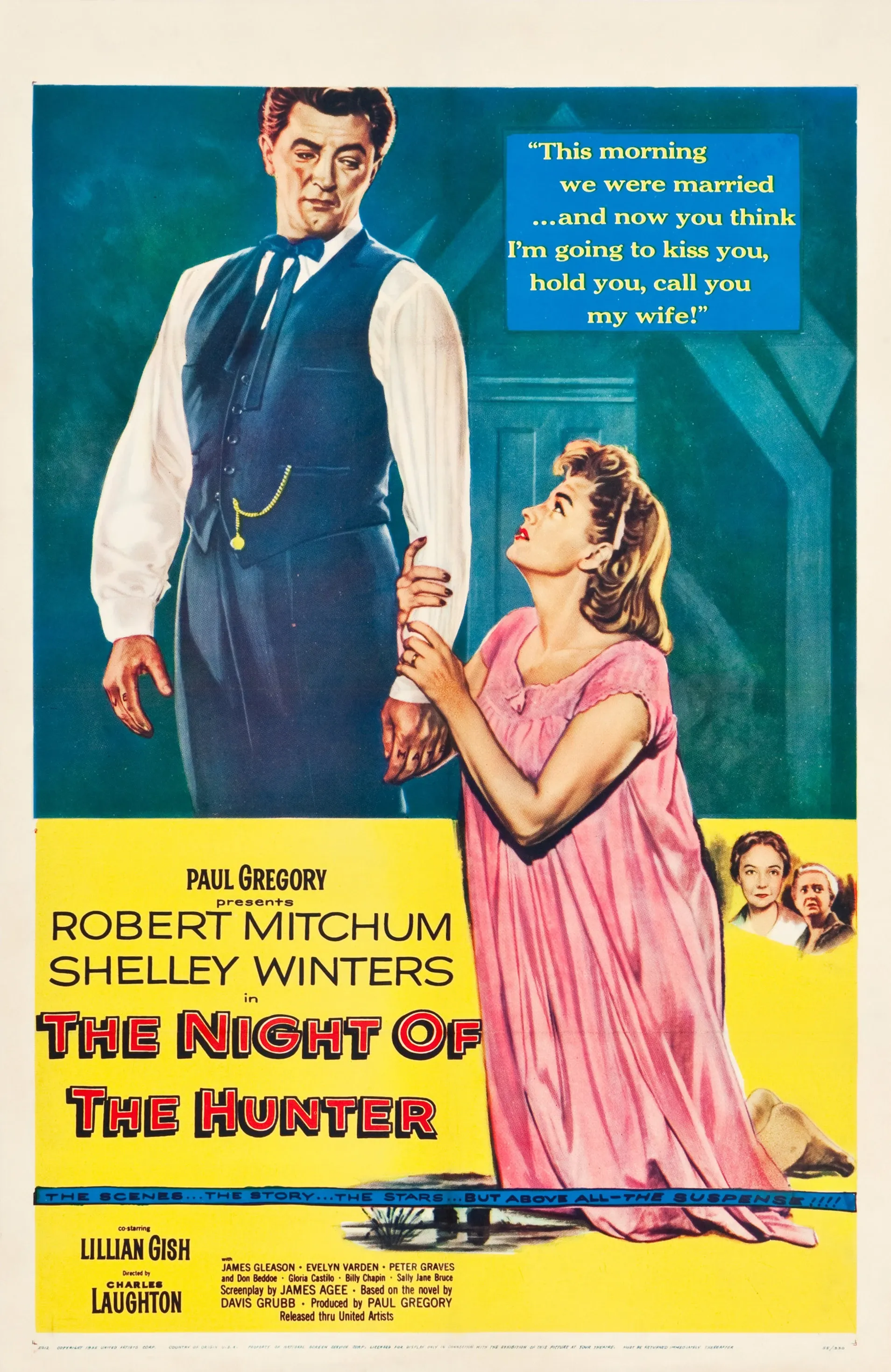
The Night of the Hunter (1955): False Faith, Childhood Terror, and America's Dark Fairy Tale
A deep analysis of Charles Laughton's The Night of the Hunter, from Robert Mitchum's false preacher and Stanley Cortez's expressionist images to childhood fear, sex panic, and the eerie calm of the river.
Editorial Notes
Anna edits BucketMovies criticism and essay packages, with a steady interest in classic Hollywood, literary adaptations, and repertory programming.
Leah Carter
Research Editor
Leah handles source checks, release-date verification, awards coverage, and the reporting framework behind BucketMovies news and industry pieces.
Some classics ask you to admire them before they ask you to feel anything. The Night of the Hunter does not have that kind of patience. Charles Laughton’s only film as a director opens like a folk sermon, slides into a child’s nightmare, and never fully returns to ordinary life. It is a thriller, a fairy tale, a religious horror film, and a piece of American pulp that turns all of those things into one bad mood.
That mood is what makes the film hard to shake. On paper, the story is blunt. A false preacher named Harry Powell comes out of prison, tracks down the widow of his executed cellmate, marries her for the hidden robbery money, and terrorizes her children when they refuse to tell him where it is. You can tell that plot in a few lines. What you cannot summarize so easily is the film’s strange emotional pressure, the way terror, humor, lust, religion, and childhood loneliness keep grinding against each other until the movie feels less like a crime story than a bad dream the United States had about itself.
Watching it now, I think the film’s real subject is false authority. Powell is dangerous because he looks, sounds, and moves like a man who expects to be obeyed. Adults keep handing him power because he flatters the stories they already want to believe about faith, sex, and respectability. The children do not believe him. That difference is the whole movie.
Criterion is right to call the film a stand-alone masterwork, and BFI is right to see it as both allegory and nightmare. But what keeps pulling me back is something more specific. The Night of the Hunter is one of the rare American films that understands how evil can arrive dressed as reassurance. It smiles. It quotes Scripture. It says it wants to protect the home. Then it goes after the children.
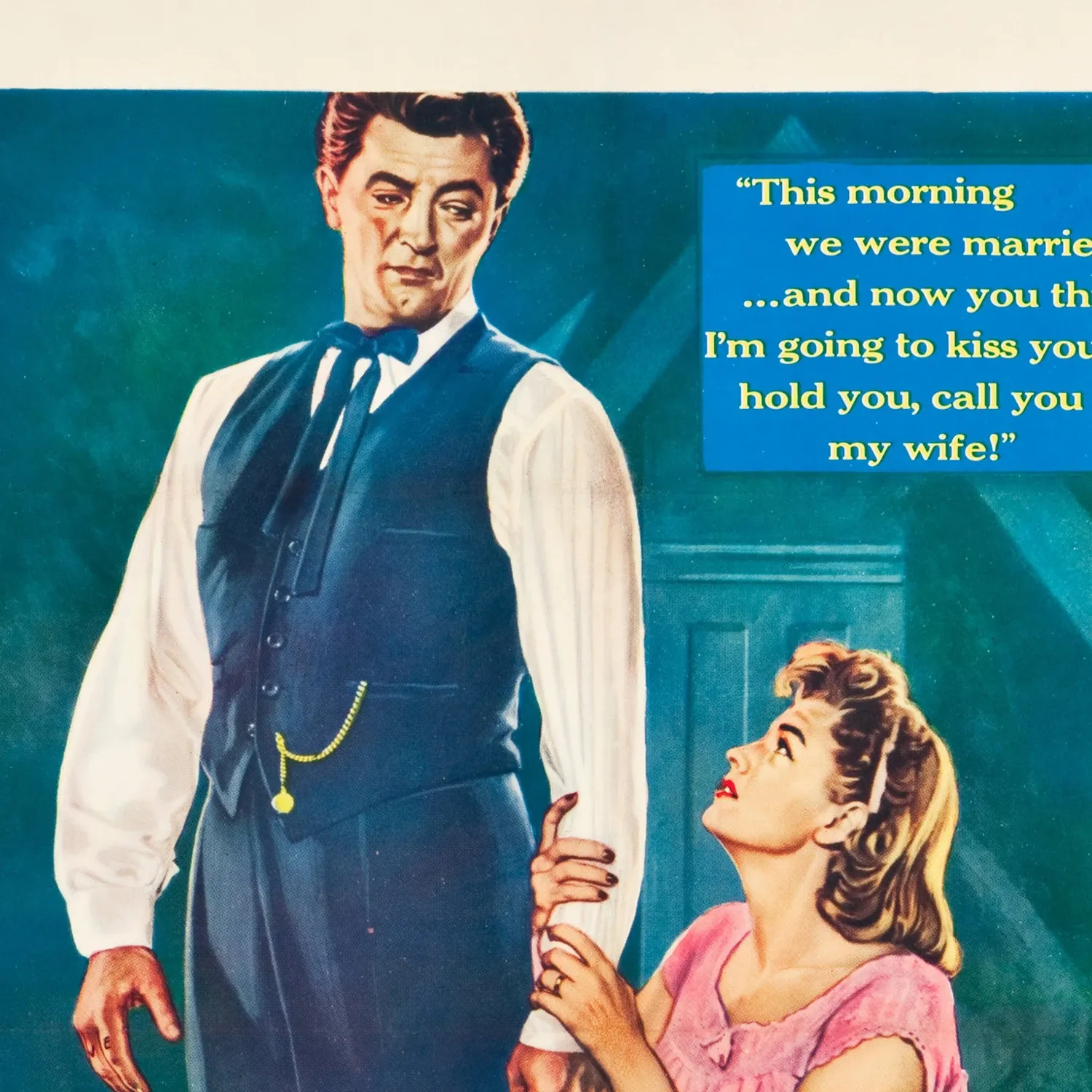 Detail from the original U.S. theatrical poster for The Night of the Hunter, preserved via Wikimedia Commons.
Charles Laughton Turns America Into a Storybook Trap
One of the first things people notice about The Night of the Hunter is that it does not look realistic, even when the plot brushes against Depression-era hardship. Roger Ebert made a sharp point about this years ago: the sets look too artificial to belong to ordinary life, and that artificiality is not a weakness. It is what gives the film its timelessness. Houses lean at strange angles. Staircases feel too steep. Bedrooms look like chapel interiors or coffins with wallpaper. The river sequence seems built from memory rather than geography.
TCM records Laughton describing the movie as a “nightmarish sort of Mother Goose tale,” and that phrase gets close to the film’s method. He is not chasing documentary truth. He is taking pieces of American life, small-town gossip, revival religion, children’s rhymes, and old river songs, then pushing them until they start to look haunted. The result is not camp, and it is not realism with pretty shadows laid on top. It is a moral fairy tale shot through with sex, panic, and hunger.
That fairy-tale quality helps explain why the movie survived its commercial failure. MoMA, which has kept the film in circulation for years, notes that its renown has only grown with time. Once the first baffled reactions wore off, people could see that the stylization was the point. Laughton took a pulp premise and refused to flatten it into routine suspense. He wanted the town, the river, the animals, and even the sky to feel as if they had joined the story.
Britannica singles out the nighttime boat journey as the place where the film’s battle between innocence and evil becomes clearest. I think that is true, but the groundwork comes much earlier. From the start, adults in this film live inside a world of surfaces. They trust respectable clothes, public prayer, and the performance of conviction. Children, by contrast, respond to tone, rhythm, and menace. John knows Powell is wrong before he can prove a single thing. The movie keeps telling us that children are often the only ones who recognize danger before the explanation arrives.
Harry Powell Is Terrifying Because He Sounds Familiar
Robert Mitchum’s Harry Powell is one of those screen villains who seem to have existed before the movie and after it. Even people who have not seen The Night of the Hunter know the knuckles, LOVE on one hand, HATE on the other. But the tattoos are not what make Powell frightening. The frightening thing is how little he has to invent. He walks into a community that is already ready for him.
BFI describes Mitchum here as charismatic, charming, vicious, and violent. All four matter. If Powell were only monstrous, the film would lose half its force. He succeeds because he knows how to flatter a town’s moral vanity. He tells people what purity should look like. He knows how to make desire sound dirty, how to make women feel ashamed of wanting warmth, and how to turn religiosity into social power. Shelley Winters’ Willa Harper is tragic, but never stupid. She is lonely, frightened, and easy to judge from the outside. Powell gives her a script for holiness, and she steps into it because the world around her has prepared her to believe that suffering might be the price of being good.
This is where the film gets uglier and smarter than a plain good-versus-evil fable. Powell is not a hypocrite in the casual sense. He is twisted by sex, obsessed with it, revolted by it, drawn to it, and eager to punish it in others. The wedding-night scene is one of the strangest and cruelest scenes in American cinema. Willa reaches for married intimacy. Powell answers with disgust and domination. What he wants is not companionship, and not even just money. He wants spiritual control over a woman’s body. He wants to make her feel filthy for desiring the life she thought marriage promised.
The Library of Congress essay on the film treats Powell as a false prophet who enters the story to test everyone around him. I would go a little further. Powell is not just a test sent into the community. He is what the community has been quietly preparing for. He works because the town already shares enough of his fear of the body, and enough of his appetite for judgment, to make his performance believable.
Mitchum understands all of this without overplaying it. He moves lazily. He talks in a syrupy drawl. He seems amused by his own evil, which is somehow worse than fury. There is a sleepy confidence to him that never strains for effect. You believe adults would fall for him, and you believe children would hear the threat underneath the charm.
The Film Believes Children Before It Believes Adults
A lot of horror and noir stories use children as sentimental markers. The Night of the Hunter does not. John and Pearl are not there just to make us worry. They are the film’s moral intelligence. The adults keep misreading the world. The children, especially John, keep seeing it correctly.
This is where the movie’s tone becomes unusual. The Library of Congress piece argues that the film feels like a child’s fable imagined by a child, and that gets at something essential. The images are stark, but not cold. Animals loom in the foreground. The moonlight feels storybook bright. Houses become shapes a child would draw if trying to remember a frightening place. Laughton is not asking us to observe childhood from an adult distance. He is pushing us back into a child’s way of sorting danger, where a song, a silhouette, or a voice in the dark may matter more than facts.
That choice makes the movie much sadder than its legend suggests. John is not just the brave boy. He is a child forced to understand adult rot too early. He sees his mother submit to Powell’s piety. He sees respectable townspeople cheer the wrong man. He learns, with awful speed, that being correct does not mean anyone will believe you. Billy Chapin gives the performance a strained watchfulness that feels older than the character should be. He looks like a boy already calculating the cost of truth.
Pearl works differently. She is younger, more open, and more liable to trust sounds and stories. That makes her both vulnerable and strangely resilient. The money hidden in her doll turns her into a walking fairy-tale object, the child carrying the dangerous secret she barely understands. Yet the film never treats her as abstract innocence. She chatters, sings, blurts, and wanders. She is a real child, which is why the danger around her feels so acute.
One reason the film still hits hard in 2026 is that it never pretends adults are naturally safer than children. Quite the opposite. Adults are vain, gullible, lonely, horny, exhausted, frightened of scandal, and eager to outsource moral judgment to anyone who sounds certain enough. The children survive because they stop expecting rescue from the grown-up world that failed them.
Stanley Cortez Makes the River Feel Calm and Terrible at Once
If Mitchum gives the film its voice, Stanley Cortez gives it its dream logic. Criterion talks about the movie’s eerie beauty, and that phrase can sound a little polite until you sit with the images. Cortez does not just make the film pretty. He makes it unstable.
The river sequence is the obvious example, because it is one of the great passages in American cinema. Britannica calls it peaceful, and it is, in a way. The children drift past frogs, rabbits, reeds, spiderwebs, and distant songs. The night feels open and hushed. Yet nothing about the calm is reassuring. It is the kind of calm you get when the world has gone too still, when safety and exposure have started to resemble each other.
Ebert was especially good on the way the film uses giant foreground details to turn the river into a kind of biblical corridor. The point is not nature documentary precision. The point is scale. The children look tiny in a world that does not bend to their fear. That is what makes the sequence so moving. It does not sentimentalize escape. It shows escape as drifting through an indifferent creation, hoping evil will lose the trail before daylight returns.
The movie does something equally haunting with Willa’s death. Her body under the water is one of those images that lives in film history because it feels both obscene and serene. TCM notes how much the movie mixes hymn, children’s song, and orchestral unease in Walter Schumann’s score. That mixture matters here. The beauty of the image never cancels the horror. It makes the horror quieter, and somehow harder to shake.
Cortez’s lighting keeps doing that all through the film. Shadows fall across bedroom walls like prison bars or church rafters. Powell’s figure stretches into black shape before he arrives as a man. Rachel Cooper’s farmhouse glows with warmth, yet even there the frame keeps a hard edge. The film will allow refuge, but not innocence restored in any easy way.
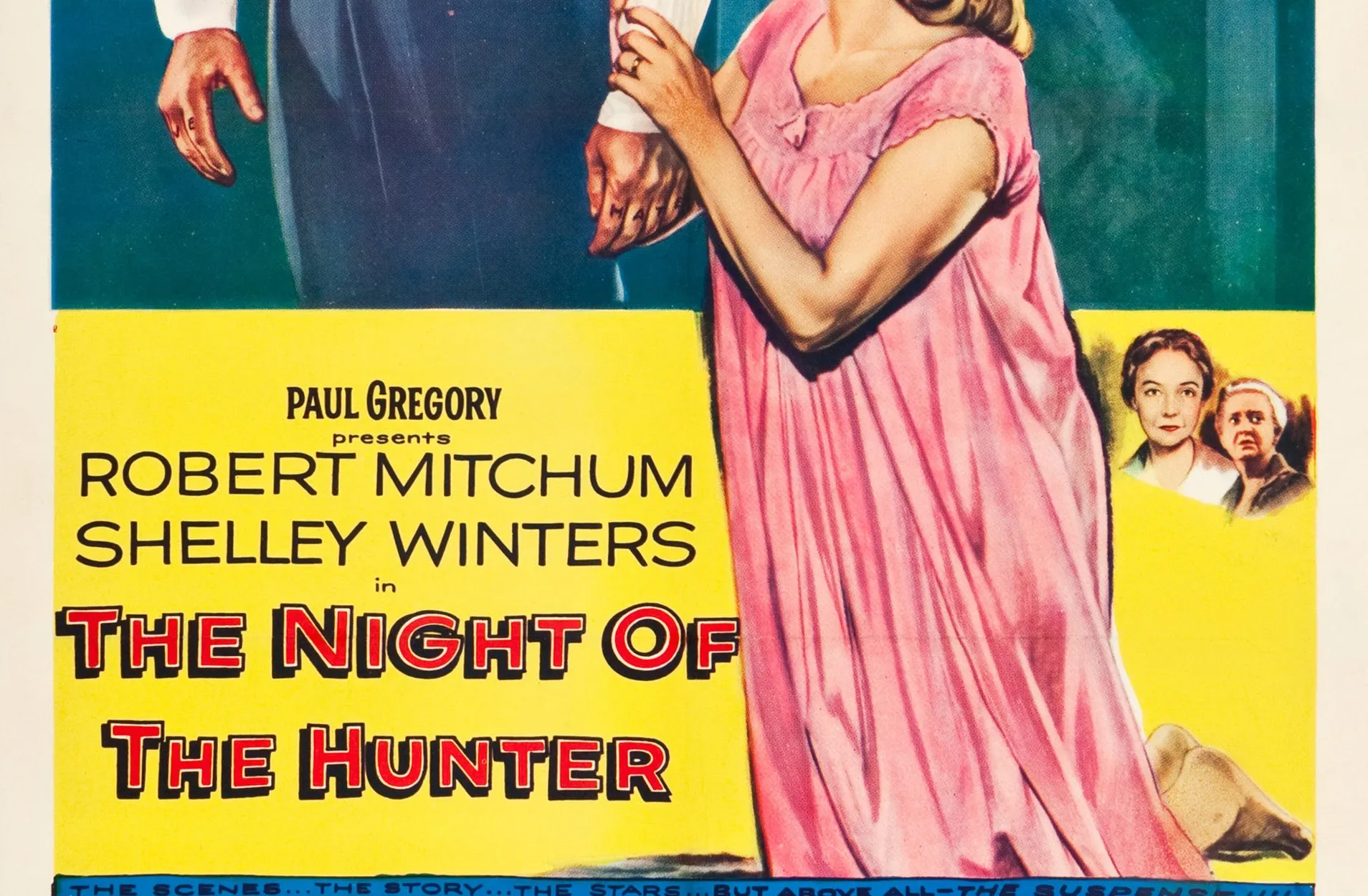 Lower section of the original one-sheet, where the title block and the tiny children already promise panic in lurid pulp colors.
Rachel Cooper Is Not Sentiment. She Is Earned Moral Force
Lillian Gish enters this movie so late that a weaker film would use her as a simple answer. Good woman versus bad preacher. Safe house versus nightmare house. But Rachel Cooper is more interesting than that. She is not soft-focus virtue. She is worn, practical, sharp-eyed, and armed.
What I love about Gish here is how unsentimental she is. Rachel takes children in, feeds them, and fights for them, but the performance never asks for applause. The goodness is stern. She has no illusions about evil, and no appetite for public drama. When Powell circles her house and sings “Leaning on the Everlasting Arms,” she answers him in song while holding a rifle. That is one of the film’s great moments because it refuses the comforting split between faith and force. Rachel knows Scripture, but she also knows evil men do not leave because you spoke gently.
The Library of Congress essay argues that Rachel sees things whole, unlike Powell, whose entire life narrows into appetite and hatred. That feels right. Powell is a man of single notes, even when he disguises them with charm. Rachel carries experience inside her. The film hints at pain, estrangement, and compromise, years already lived. She is not innocence preserved. She is goodness that has survived contact with the world.
That survival matters because The Night of the Hunter never suggests innocence alone can defeat predation. John survives partly because he is suspicious. Rachel survives because she is wise. The movie can sound simple if you reduce it to preacher equals evil, old woman equals good. The emotional truth is harder than that. The children need a protector who knows what the world is.
If you want companion pieces, our analysis of The Passion of Joan of Arc (1928): The Face, the Trial, and the Violence of Looking looks at another film built around judgment and spiritual pressure, while The Third Man (1949): Why Vienna Haunts Every Frame shows how stylized space can make moral corruption feel physical. Laughton’s film sits somewhere between those modes. It turns faces, rooms, songs, and shadows into one moral weather system.
Why The Night of the Hunter Still Feels Alive
One reason canonical films sometimes go dull is that later movies borrow their surface tricks and leave the original feeling overfamiliar. That has not happened here. Plenty of movies borrowed Powell’s tattoos, his sing-song menace, the river flight, or the child-under-siege structure. Few took the whole package. Fewer still understood that the real horror is not a killer in a black hat. It is a culture so eager for moral theater that it cannot see the predator standing in the revival tent.
That is why the film still feels current without needing to be dragged into headline language. Powell sells righteousness as performance. He makes cruelty sound like discipline. He makes shame sound holy. He turns public certainty into a weapon. We still know that figure. We still make room for him.
The film also understands something uncomfortable about American myth. Small towns, porch talk, hymns, and children’s bedtime stories, all the things that usually get treated as wholesome here, can also carry menace. Laughton does not attack those traditions from the outside. He shows how thin the line can be between shelter and suffocation, between belief and coercion, between family language and nightmare language. That is much scarier than a stranger breaking in from some distant world. Powell comes from inside the vocabulary.
Ebert argued that the film has lasted because it built its own world outside conventional realism. I think that is only half the story. It lasted because that invented world tells the truth about emotional realities that plain realism often misses. Children notice danger adults excuse. Predators learn the sounds communities trust. Goodness, when it finally arrives, often looks less like purity than like a tired woman with a gun who has seen enough already.
Final Thought
What stays with me about The Night of the Hunter is not just Powell, or even the river. It is the movie’s refusal to let adult authority keep its automatic dignity. Fathers fail. Townspeople fail. Marriage fails. Religion as public performance fails. The film strips all of that down and asks a hard question: when the grown-up world has made itself useless, who is left to tell the truth?
Laughton’s answer is severe but not hopeless. Children can tell the truth. A woman like Rachel Cooper can tell the truth. Art can tell the truth, too, by refusing the safe look of ordinary life and turning the whole country into a nightmare nursery rhyme. That is why this one still bites. The Night of the Hunter does not just show evil chasing innocence through the dark. It shows how eagerly the daylight world helped evil get to the door.
Sources and Further Reading
- The Night of the Hunter (1955) - The Criterion Collection
- The Night of the Hunter (1955) - BFI
- The Night of the Hunter - RogerEbert.com
- The Night of the Hunter - Encyclopaedia Britannica
- The Night of the Hunter - TCM
- Charles Laughton’s The Night of the Hunter - MoMA
- Happy Halloween: It’s the “Night of the Hunter” (1955) - Library of Congress
- File:The Night of the Hunter (1955 poster).jpg - Wikimedia Commons
Share This Article
Comments
.jpg)